
Forat del Gel
Cova de 180 metres de recorregut i 60 metres de fondària al Montsec de Rúbies (Llimiana).
EspeleoWorld
Forat del Gel
Cova de 180 metres de recorregut i 60 metres de fondària al Montsec de Rúbies (Llimiana).
Llimiana · Pallars Jussà
Length: 180 m · Depth: 60 m
Updated record
https://espeleoworld.com/en/c/forat-del-gel
Information can change. Always verify coordinates, access, weather, and cave conditions before setting out.
A cave 180 metres long and 60 metres deep in the Montsec de Rúbies (Llimiana), on the N slope. Known since time immemorial, with archaeological remains and troglobitic fauna.
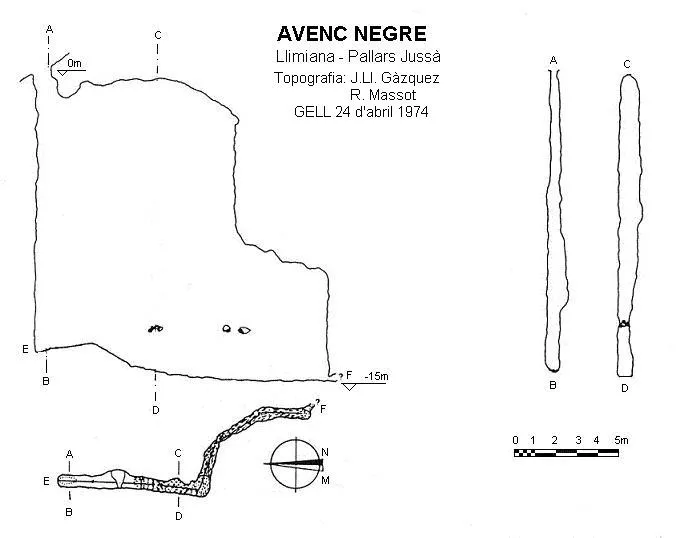
Topographic
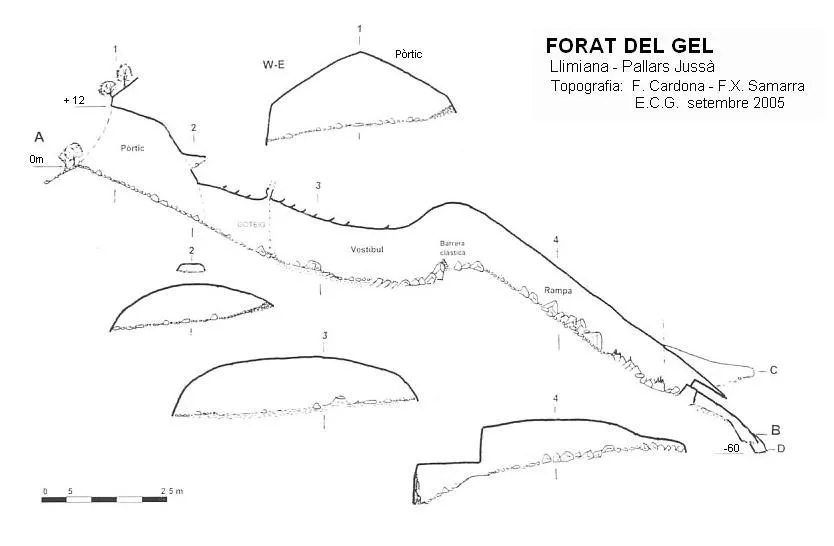
Espeleoindex · CC BY-NC 4.0, https://creativecommons.org/licenses/by-nc/4.0/ · Image © its author.
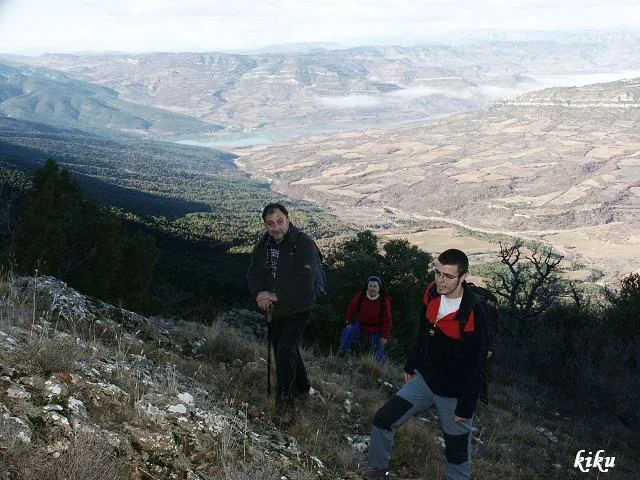
Photos
Espeleoindex · CC BY-NC 4.0, https://creativecommons.org/licenses/by-nc/4.0/ · Image © its author.
Description
Morphology
The mouth is large, more than 10 metres from the top of the scree cone to the upper lip by 40 metres wide; the height is enlarged by the slope of the scree cone towards the interior and by the vault that does not completely cover it, but ends further in. The scree cone, partly open to the sky, descends at a slope of 20º to 25º and the vestibule gradually narrows. Shortly after, at 45 metres from the mouth, we reach a lower portico 19 metres wide; a little further on we reach a change of slope where the gallery takes on a width of up to 48 metres. From the block barrier, the gallery takes on a strong inclination, between 25º and 40º, interrupted only by two clastic processes similar to -40 and -50 metres. The floor is formed by large packages of strata detached from the ceiling and countless blocks of smaller dimensions. The right wall (West) is more irregular and forms several lateral spaces. At the final part we find several conduits between blocks that run through practically the entire width of the cavity.
Speleothems
Some blocks present concretions of flowstone and stalagmites in some points. On the right wall (West), in winter quite a few ice stalactites form.
Progression
The scree cone, partly open to the sky, descends at a slope of 20º to 25º and the vestibule gradually narrows. Shortly after, at 45 metres from the mouth, we reach a lower portico 19 metres wide; a little further on we reach a change of slope where the gallery takes on a width of up to 48 metres. At this point we reach a large block barrier. This point marks the limit of light penetration and, therefore, the disappearance of the vegetation that we find in the vestibule. From the block barrier, the gallery takes on a strong inclination, between 25º and 40º, interrupted only by two clastic processes similar to -40 and -50 metres.
Other details
The large block barrier is nothing other than remains of walling like a trench, carried out during the incivil war of 1936-39 and of which we find remains throughout the mountain range; we can even find a cement plaque from the period, giving evidence of the presence in this place of the Durruti column.
History
Cavity known since time immemorial by the people of the region. It is said that in summer they went to fetch ice from its interior for medical purposes. The first speleological reference is the visit made by the Frenchman A. Hustache on 19 August 1910, locating the troglocharinus that bears his name; a few weeks later, on 7 September 1910, Jeannel and Racovitza went there also for biospeleological purposes, as did C. Bolivar some years later, on 23 August 1918. We no longer have news of the cavity until the year 1958 when members of the Centre Gimnàstic Barcelonès visit it during their campaigns in the Montsec. In December 1952, E. Boixadera (GES - CMB) leaves a record in the activities book of the Club of the exploration of a cavity in this area of the Montsec that he calls Cova-avenc de Can Pey, to which he grants 165 metres of depth and of which news was never heard again, becoming part of the so-called 'phantom' cavities. With the passage of time it was deduced that it was the Forat del Gel itself, with a very disproportionate topographic vision (Boixadera himself came to publish in Speleon a topography of the Cova de Vallmajor, Albinyana, in which he attributed a drop of 139 metres!!; and curiously, as co-author of that article E. Suñer also appears, the one of the Afrau Suñer, in l'Estartit, another 'phantom' cavity). The cave has also been the object of archaeological work, where remains belonging to the Neolithic, Bronze, Roman and Medieval periods have been found.
Bio
Troglocharinus hustachei; Speonomus puncticolis. Collected by A. Hustache on 19 August 1910; by Jeannel and Racovitza between 31 August and 8 September 1910; and by C. Bolivar on 23 August 1918. The T. Hustachei has never been located again in this cavity.
User Comments (0)
No comments yet.
Be the first to share your experience!
Registered Explorations (0)
No explorations registered yet.
Register your visit to this cave!
Bibliography
- Cardona Oliván, F.(2010).-”El Forat del Gel i la seva anomalia tèrmica” Exploracions (19):113-122. Espeleo Club de Gràcia. Barcelona.
- Escolà i Boada, Oleguer. (1970).- “Algunes dades sobre el Forat del Gel o Espluga de Correis”. Espeleòleg (11/12):542-547. ERE-CE Catalunya. Barcelona.
- Jeannel, R et Racovitza,E.G.(1912).-”Enumérations des grottes visitées, 1909-1911(4ª série)” Biospéleologica (24).
- Notes sobre arqueologia aportades per Federico de la Vega.
Nearby caves
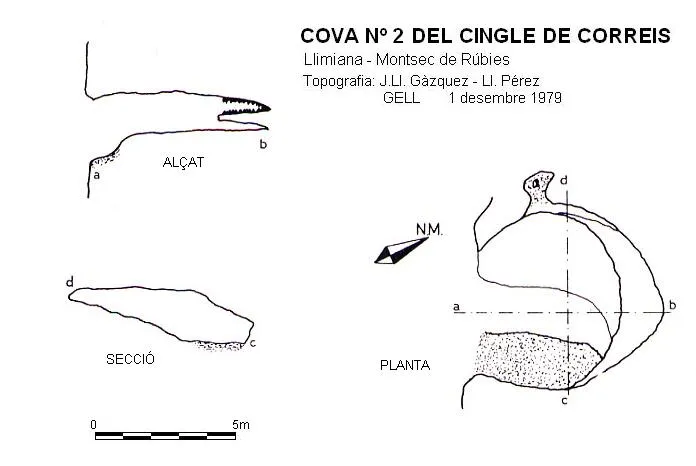
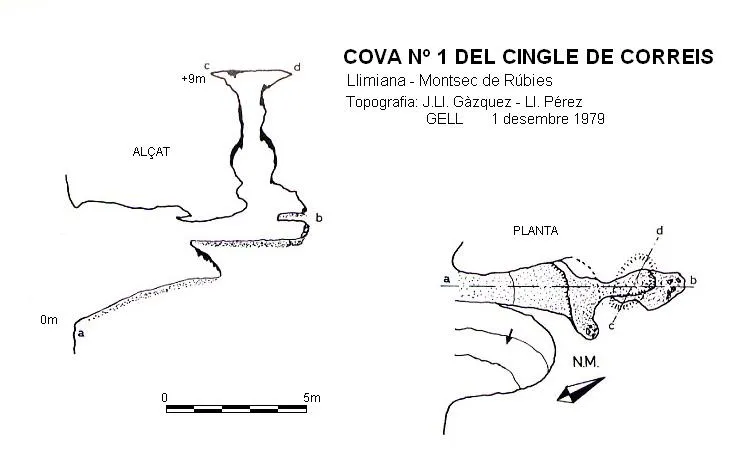


Source: Espeleoindex (espeleoindex.com), modified. CC BY-NC 4.0, https://creativecommons.org/licenses/by-nc/4.0/