
Espluga del Sabater
Curiosa cova penjada a la Serra de Sant Joan i que serví d'amagatall
EspeleoWorld
Espluga del Sabater
Curiosa cova penjada a la Serra de Sant Joan i que serví d'amagatall
Coll de Nargó · Alt Urgell
Length: 14 m · Depth: 7 m
Updated record
https://espeleoworld.com/en/c/espluga-del-sabater
Information can change. Always verify coordinates, access, weather, and cave conditions before setting out.
Curious hanging cave (cova penjada) in the Serra de Sant Joan that served as a hiding place.
Topographic
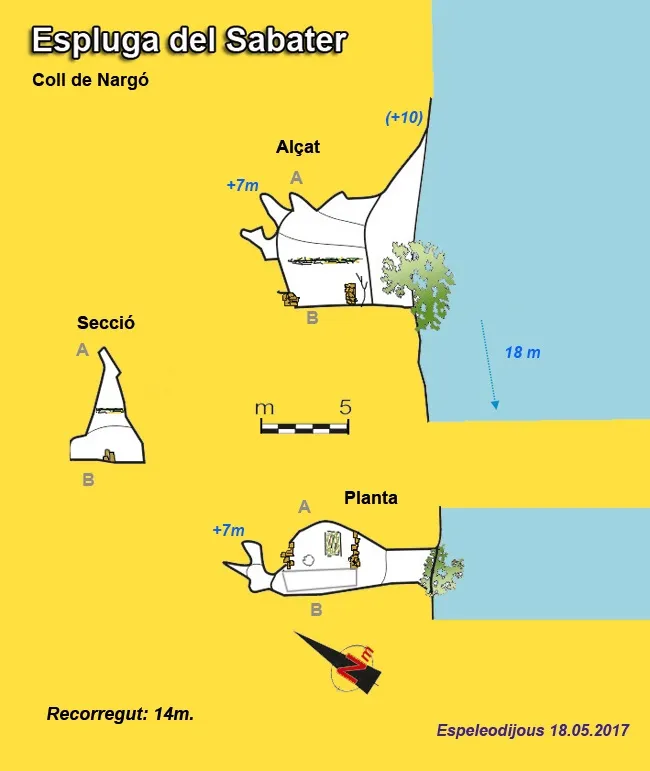

Espeleoindex · CC BY-NC 4.0, https://creativecommons.org/licenses/by-nc/4.0/ · Image © its author.
Photos

Espeleoindex · CC BY-NC 4.0, https://creativecommons.org/licenses/by-nc/4.0/ · Image © its author.
Description
Morphology
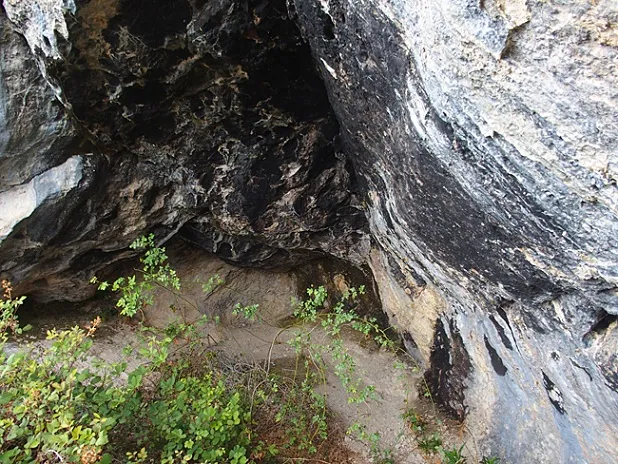
The initial gallery is about seven metres long, and at the end of this stretch there is a hole covered by stones on the right-hand side, and on the left a chimney climbs up. We also find a small protection wall to shelter from the wind, a bed of branches and a kind of fireplace.
We find a first hanging bunk and, on an artificial upper floor formed by a framework of branches, a new place to lie down. From this level there is a communication hole with the lower floor and an access to the infiltration chimneys in the roof that show dissolution forms, so it must be agreed that this is a true hanging cave (cova penjada) due to the evolution of the slope.
Progression
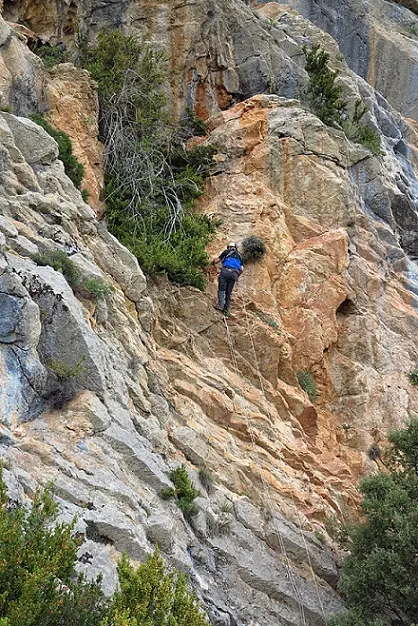
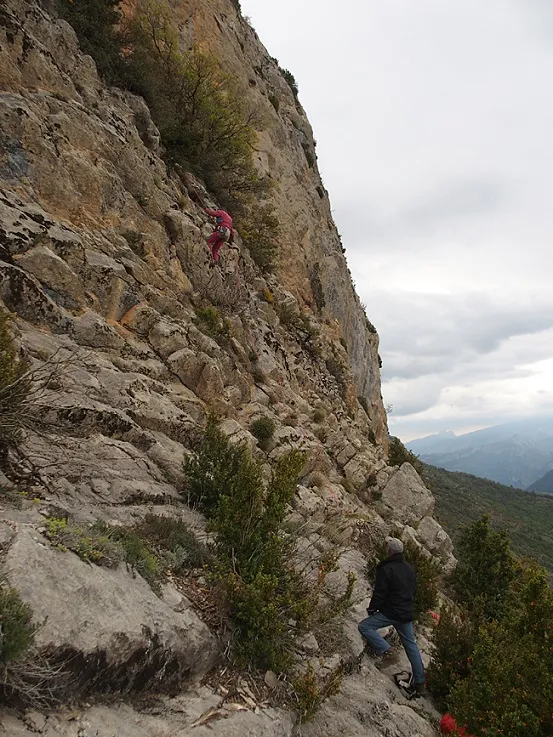
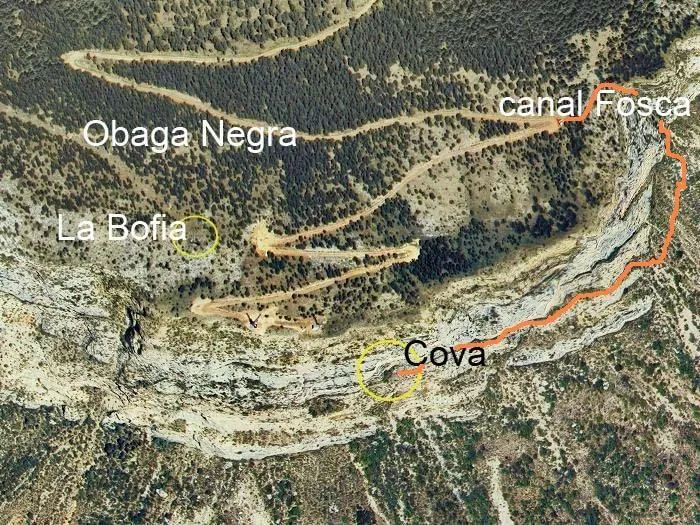
From the foot of the cliff it can be reached after overcoming about 18 metres of wall. In May 2017 there were several ropes rigged.
Other details
The cavity is a truly singular lair for its occupation of undoubted historical and ethnographic value. Everywhere there are signs of its use as a hiding place, shelter, dormitory, kitchen and workshop... without setting aside its privileged viewpoint.
Everywhere there are hanging bundles, cans, bottles for collecting drips, tools and many shoe soles made with an insole over tyre remains, some rudimentary furniture and a couple of rustic ladders made of wood and wire.
History
Together with other nearby cavities, it had been known for many years by the people of the area, who had used it as a hiding place, perhaps both the so-called emboscats and later the anti-Francoist groups (“maquis”).
These cavities were not documented until climbers began to open routes on the wall known as the Planxa vermella. Informed by Jordi Francès, members of the Espeleodijous located them in May 2017, carrying out the appropriate cataloguing and documentation work.
User Comments (0)
No comments yet.
Be the first to share your experience!
Registered Explorations (0)
No explorations registered yet.
Register your visit to this cave!
Bibliography
- Totes les dades, topografia i fotografies han estat extretes del blog: espeleobloc.blogspot. Apunt del dia 25-5-2017.
Nearby caves
Espluga dels Maquis
0.0 km · W
Coll de Nargó (Alt Urgell)
1 topo.7 photos
Espluga Fumada
0.1 km · E
Coll de Nargó (Alt Urgell)
1 topo.1 photos
Forat Negre de la Roca de Set Comelles
1.0 km · SW
Coll de Nargó (Alt Urgell)
1 topo.2 photos
Bòfia dels Prats
1.1 km · W
Coll de Nargó (Alt Urgell)
4 topo.11 photos
Source: Espeleoindex (espeleoindex.com), modified. CC BY-NC 4.0, https://creativecommons.org/licenses/by-nc/4.0/