
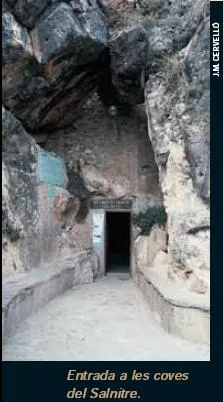
Coves del Salnitre
Cavitat turística de 958 metres de recorregut al municipi de Collbató
EspeleoWorld
Coves del Salnitre
Cavitat turística de 958 metres de recorregut al municipi de Collbató
Collbató · Baix Llobregat
Length: 958 m · Depth: 43 m
Updated record
https://espeleoworld.com/en/c/coves-del-salnitre
Information can change. Always verify coordinates, access, weather, and cave conditions before setting out.
Tourist cave with a 958-metre route in Collbató, with a height difference of 42.7 metres (-19.5/+23.2), rich in history and speleothems.
Topographic
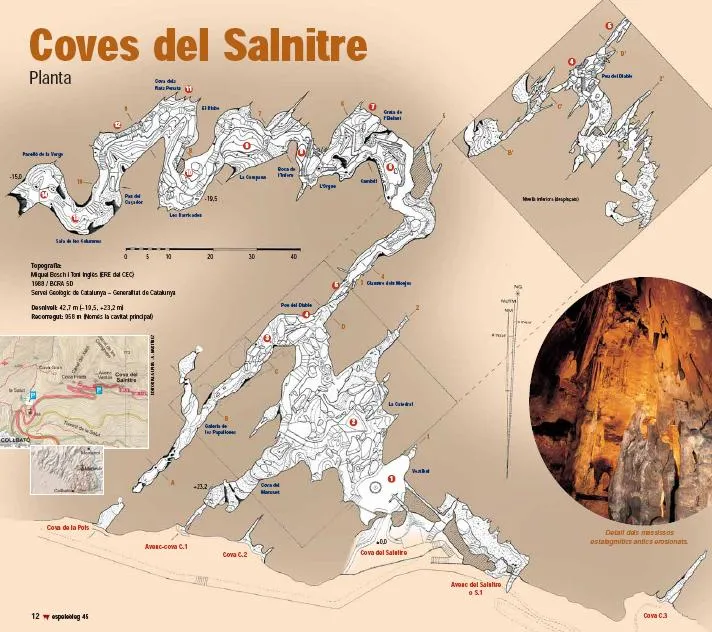
Espeleoindex · CC BY-NC 4.0, https://creativecommons.org/licenses/by-nc/4.0/ · Image © its author.
Photos
Espeleoindex · CC BY-NC 4.0, https://creativecommons.org/licenses/by-nc/4.0/ · Image © its author.
Description
Morphology
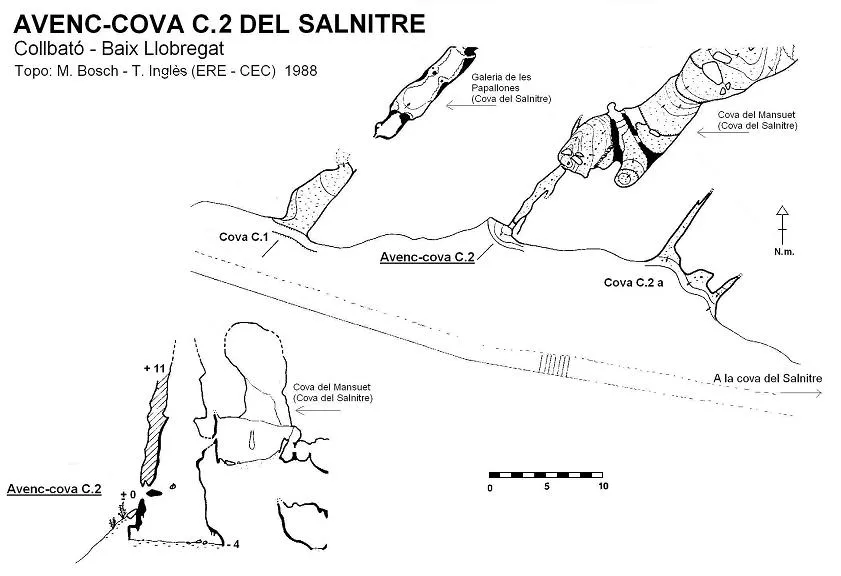
The cave can be divided into three sectors: Pis superior (Upper Level); Pou del Diable and Pis inferior (Lower Level). The Pis superior (Upper Level) is the group of galleries and halls located at the level of the entrance. Once past the grille that closes the mouth of the cave, one enters the Vestibule, broad, triangular in shape and well lit thanks to an upper opening closed with a grille. From here one can already see the hall of la Catedral, the largest in volume in the cavity, with an irregular floor plan and a floor covered with large fallen blocks. In a corner of the south wall, just from the wooden bridge, we can make out a cavity hanging some 7 or 8 metres above us; it is the cave of the Mansuet, where the famous bandit is said to have hidden during the time of the Peninsular War.
On reaching the top of the pou del Diable, we leave to the left the gallery of the Papallones, open to the same fracture that gives rise to the shaft and about 100 metres long in a SW-NE direction.
The Pou del Diable appears among blocks and is 16 metres deep, descended with the help of a ladder. Its bottom is full of fallen blocks and, off the usual route, there is a short gallery with a floor formed of dark clay and with levels of organic sediments. It was probably from this point that the famous saltpetre was extracted.
The Pis inferior (Lower Level) is a group of galleries located between 18 and 25 metres deep with respect to the entrance. Once the pou del Diable has been descended, the route continues along a narrow corridor that follows a joint running NE-SW, reaching a broad gallery called the claustre dels Monjos. Immediately afterwards, climbing a flight of steps, one reaches the Cambril, where numerous speleothems stand out and continue in the following stretch, the gruta de l'Elefant. The boca de l'Infern allows a descent that leaves us at the base of a gallery that forms an incised meander and opens into the Campana, a cavity with a large stalagmite flow that descends along the left-hand sector and is cracked. Next, in the sala de les Barricades, we can observe important collapses with large blocks quartered by fracturing. Passing beneath one of these blocks that has come to rest on some stalagmites, one enters the so-called cova dels Ratpenats, a broad meander well preserved on the concave side and disfigured by a chaos of blocks on the convex side. The presence of an important colony of bats that inhabited the cave at various points is documented by many accounts, especially during the 19th century, and the guano produced then could be the source of the controversial saltpetre. Next, in the sala de les Columnes (the dampest part of the whole cavity) we can observe two different phases in the formations, an older one, with broken and tilted forms, and a later one, which welds onto and grows over the former. The cambra Final is formed by a high vault that rises to 11 metres. The floor is formed by an accumulation of fallen blocks covered and masked by a more modern flow that seals the gallery and closes the continuity of the cave towards the south.
The cavity has a height difference of 42.7 metres (-19.5/+23.2)
History
The coves del Salnitre are undoubtedly the cavity with the most history and legends in Catalonia and the one that has generated the most literature.
Known since time immemorial, inscriptions from different periods have been found inside it, the oldest: (Francesc Roca, 1511). In 1609, J. Pujades already mentions it in his Crónica Universal del Principado de Cataluña, without citing its name. In 1789, Francisco de Zamora, then chief magistrate of the Audience of Catalonia in Barcelona, visited Montserrat and, among other curiosities of the mountain, highlights his exploration of the caves, and with Pere Pau Muntanya, a fashionable painter and decorator, and with Francesc Remart, they made various engravings of the mountain and of the cave (the survey of the Salnitre is the first known work of this kind in Catalonia).
Abbot Miquel Muntades, in his book on the history of Montserrat, attributes to Gerard Joana, a monk of the monastery, the authorship of a manuscript from 1806, in which a series of observations and hypotheses about the subterranean cavities are made. Recent research makes the authorship of the manuscript by Father Joana more than doubtful, and it may possibly be part of the work directed by Zamora or by one of the monks who accompanied him.
The visit organised by Víctor Balaguer in 1852 together with artist friends of the Romantic era raised a great stir and the caves were widely popularised, to the point that a posada de las cuevas was created at cal Pepa de Collbató, from where visitors set out accompanied by hired guides.
On 16 September 1896, Martel and his companion Louis Armand were received in Barcelona and the next day were accompanied to Montserrat and to the coves del Salnitre by the members of the CEC, Artur Osona and Josep Castellanos. His description of the caves is very realistic and dismantles the exaggerations that had been transmitted from the visits of the middle of the century.
M. Faura i Sans with members of the Club Muntanyenc completely explored the cave on 25-7-1908 and made the survey (which until recently was believed to be the oldest) and which was not published until 1911. Faura gives it a route of 700 m. Two weeks later they accompanied the French botanist J. Maheu to different cavities of Montserrat, among them Pouetons and Costa Dreta, but it is not clear how it has always been said that they returned to the Salnitre, since Maheu had been collecting flora the previous summer.
The cavity was property of the State and later of the company Aeri de Montserrat. In 1928 the electric lighting was inaugurated according to a project by Walther Gunther and Carles Buigas, but following the outbreak of the war of 1936 it was dismantled.
Between 1946 and 1952, N. Llopis Lladó and Josep M. Thomas carried out an extensive study of the area and produced a new survey, all of which was published in 1953. At that time they gave it a route of 530 m.
Both the survey by Faura (1908) and that by Thomas and Llopis (1952) have been redrawn and adapted in different versions to illustrate some works and tourist brochures about the cave.
It was not until 1977 that members of the SIRE-UEC Sants again produced a fairly detailed survey of the cave. They give it a route of 549 m.
For years the cave could be visited with an accompanying guide and with acetylene lamps (what we called carburers). Finally, in 1985 the Generalitat de Catalunya took charge of a new fitting-out and lighting, transferring management to the ajuntament de Collbató.
Finally, in 1988, members of the ERE-CEC carried out, commissioned by the Servei Geològic de Catalunya, an Estudi de les possibilitats d'educació ambiental de la Cova del Salnitre which includes a very accurate and fully detailed survey of the whole set of galleries, which is calculated to present a total route of 958 m and a height difference of 42.7 m (-19.2/+23.5). This survey, however, was not published until 20 years later.
User Comments (0)
No comments yet.
Be the first to share your experience!
Registered Explorations (0)
No explorations registered yet.
Register your visit to this cave!
Bibliography
Aragonès, Enric (2010).- Marià Faura i Sans espeleòleg (1883-1941). 106 pp. Federació Catalana d'Espeleologia
Cardona, F. (1990).- Grans cavitats de Catalunya, vol 2. 484 pp. EC Gràcia, Barcelona
Cervelló, Josep M. (2008).- 'Les coves del Salnitre' Espeleòleg (45): 8-18 ERE del CE de Catalunya. Barcelona.
Faura, M. (1911).-'La espeleología de Cataluña'. Mem. Real Soc. Esp. Hist. Nat. (6): 167 pp. Museo de Ciencias Naturales. Madrid.
Llopis, N.; Thomas, JM. (1953).- 'Estudio hidrogeológico de la vertiente meridional de Montserrat'. Speleon IV (3-4): 121-192 Universidad de Oviedo.
Maheu, J. (1912).- 'Exploration et flore souterraine de cavernes de Catalogne et des iles Baleares' Spelunca Bulletin-Mémoires (67-68):108 pp París.
Miret, F. (2004).- 'Exploracions a la cova del Salnitre (1789-1808) Collbató. Baix Llobregat'. Actes del 1er. Congrés Català d'Espeleologia: 171-181. Federació Catalana d'Espeleologia. Barcelona.
SIRE-UEC Sants (1978).- 'Les coves del Salnitre'. Boletín de Información SIRE (1-2): Barcelona
Valles, Jordi de (2017).- Catàleg Espeleològic de Catalunya. Baix Llobregat. Vol. 6 : 468 pp. Espeleo Club de Gràcia / Federació Catalana d'Espeleologia. Barcelona.
Gravats extrets de Montserrate subterranea. (1852) de Manuel Solà,
Fotos sense nom de l'interior de la cova de Roger Rovira (ERE-CEC)
Nearby caves
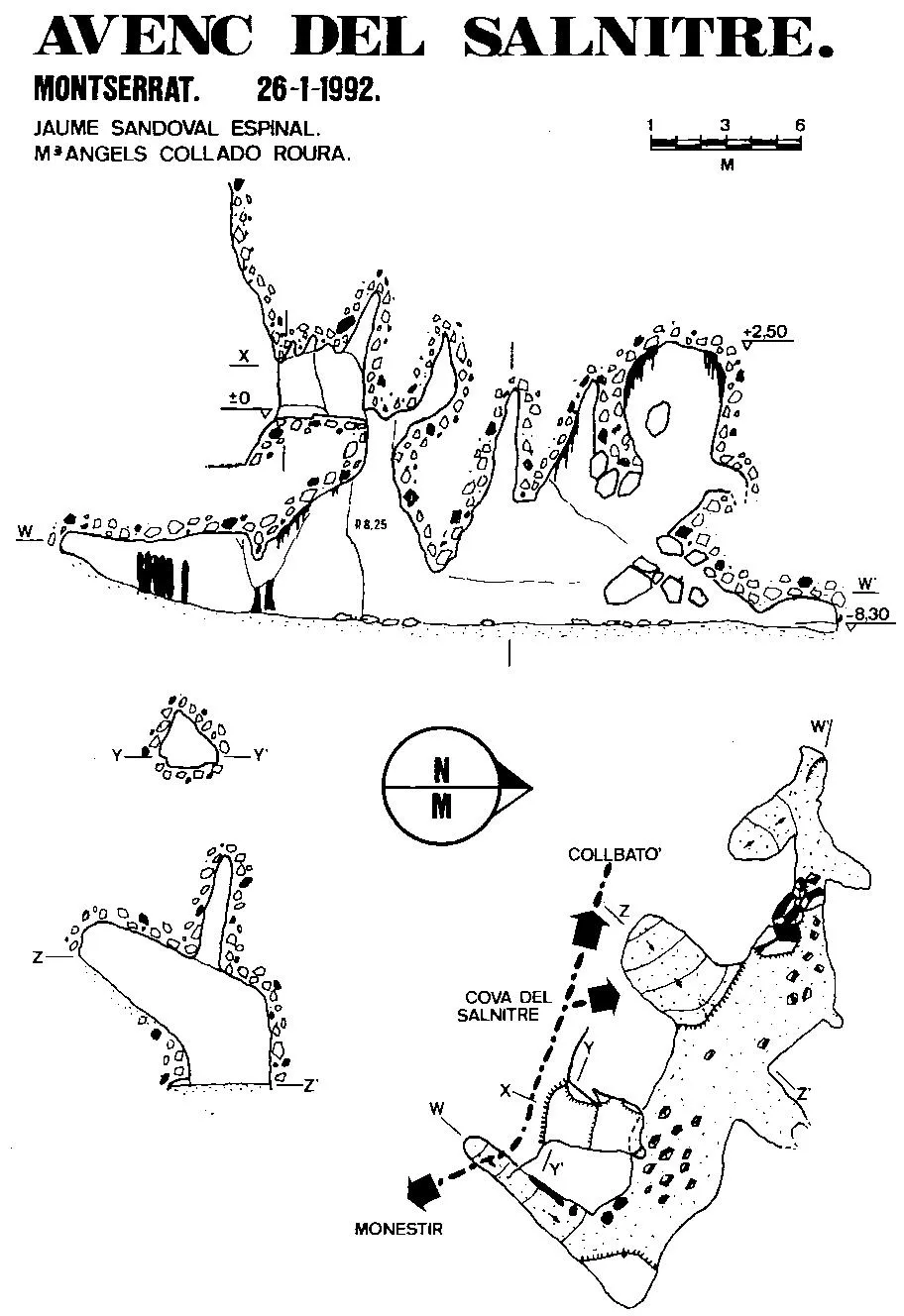
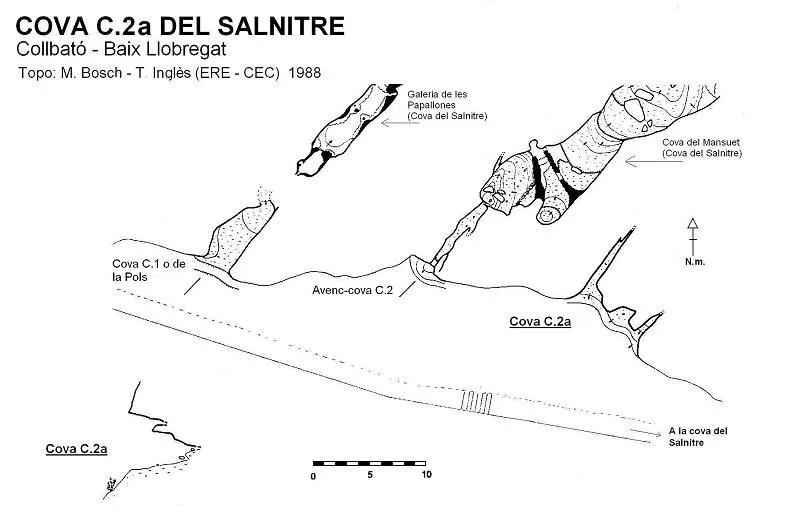


Source: Espeleoindex (espeleoindex.com), modified. CC BY-NC 4.0, https://creativecommons.org/licenses/by-nc/4.0/