
Cova Nº1 del Barranc de Moredo
A cavity with 764 m of passage in Alt Àneu, discovered and explored in August 1979 by the S.S. Plantaurel and completed in September 1991 by the SIS del CE Terrassa.
EspeleoWorld
Cova Nº1 del Barranc de Moredo
A cavity with 764 m of passage in Alt Àneu, discovered and explored in August 1979 by the S.S. Plantaurel and completed in September 1991 by the SIS del CE Terrassa.
Alt Àneu · Pallars Sobirà
Length: 764 m · Depth: 42 m
Updated record
https://espeleoworld.com/en/c/cova-n-1-del-barranc-de-moredo
Information can change. Always verify coordinates, access, weather, and cave conditions before setting out.
A cavity with 764 m of passage in Alt Àneu, discovered and explored in August 1979 by the S.S. Plantaurel and completed in September 1991 by the SIS del CE Terrassa.
Topographic
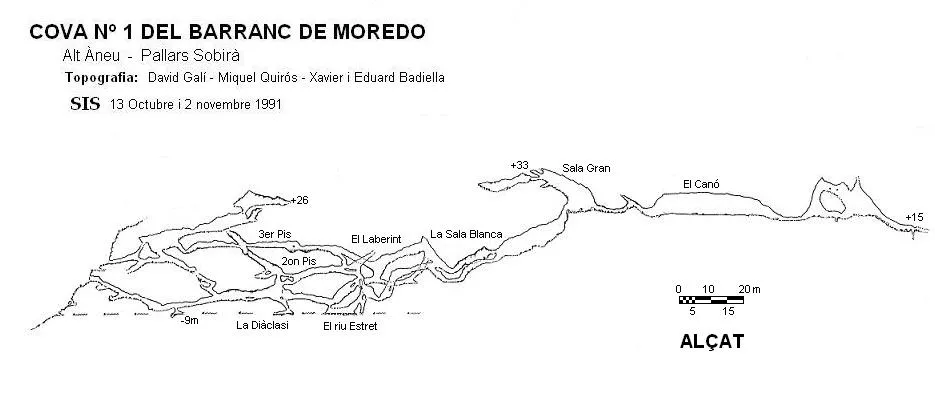
Espeleoindex · CC BY-NC 4.0, https://creativecommons.org/licenses/by-nc/4.0/ · Image © its author.
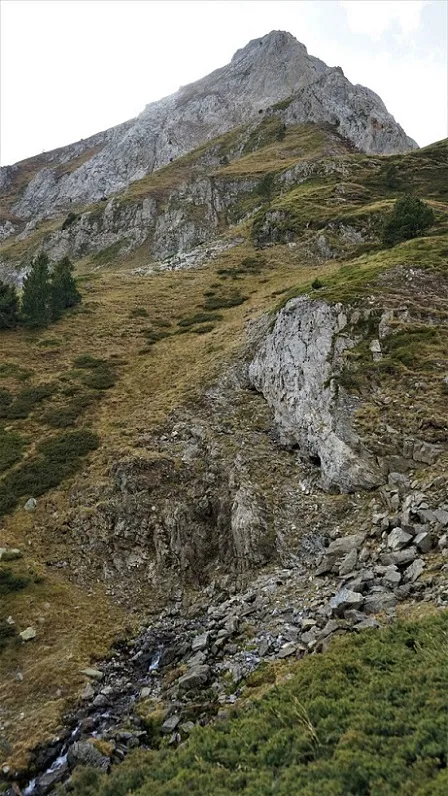
Photos
Espeleoindex · CC BY-NC 4.0, https://creativecommons.org/licenses/by-nc/4.0/ · Image © its author.
Description
Morphology
The Sala Gran measures 8 metres wide by 22 long and the maximum height is 10 metres. In the upper part an access gallery begins, low and 20 metres long, ending in a debris cone. At the SW end of the Sala Gran a narrow and heavily decorated conduit starts which, after a slight breathing space in a more comfortable chamber, a short ramp leads us to the Canó, a gallery 35 metres long by 3 wide and 7 high, the largest in the whole cavity. At its end a sandy access crawlway that very often becomes muddy will leave us at the final conduit of the cavity, divided by two half-chambers formed by respective chimneys that join at the top; at the W end the gallery continues a few metres more to end in a pile of debris that hinders progress to greater depth.
The maximum depth is -9 metres, in the area of the small pool of the river in the entrance gallery, and the highest point relative to the entrance mouth is at +33 metres at the upper end of the Sala Gran. This makes a total elevation difference of 42 metres (+33/-9).
Speleothems
The Saleta Blanca is a heavily decorated chamber. At the SW end of the Sala Gran a narrow and heavily decorated conduit starts.
Hydrology
A few metres after the corridor begins, a small pool of just over 2 metres can be seen that leads to the river that we will find further on. The end of the entrance conduit is where we find the active part of the cavity, we are at La Diàclasi, where we can see the river a few metres further on. The galleries of the Riu Estret are not very advisable; one must always advance crawling and skirting the river close to the skin until climbing up a narrow diaclase that will wind us towards the Laberint. This third floor has a fairly narrow connection with the lower one at the height of the Diàclasi del Riu.
Progression
Entry to the cavity is through the lower mouth, quite narrow, and immediately turns right to descend a ramp of stones where one must progress crawling to a short step up on the left that lets us stand up a little. This conduit, at whose end one must crawl, soon presents an opening on the left that, sometimes upright and sometimes crouched, forms a fairly long passage that leads to the active part of the cavity. A little further on there is a crawlway that climbs a little until it is filled with sediments from an upper floor.
This conduit, which crosses the initial one perpendicularly, forms a chimney that leads to the upper floors; climbing only the first step, the gallery quickly leads towards the Riu Estret and El Laberint. From the start of the Riu Estret one climbs a little until placing oneself in the middle of the tangle. At the front (west) two conduits that join will lead us, first along the right side to the Riu Estret and later, descending a little, we will be surprised by a conduit climbing up which is followed by a fairly long diaclase. On the right a descending gallery starts that we will meet again once past the Saleta Blanca, in the direction of the Sala Gran, and if we go to the end of the long diaclase above, we will cross an inclined gallery. Downwards the Saleta Blanca is reached by two conduits; the chamber, heavily decorated, is preceded by a climbing gallery that joins the aforementioned one but above it, thus forming a large conduit that, except for a local crawlway, gives onto the foot of a climb, a little delicate, that emerges at the Sala Gran.
Back in the Laberint, we can follow a conduit on the left, just next to the one we took previously and which immediately leads us to a lower level that opens into the inclined gallery of the Saleta Blanca. In the opposite direction, but within this sector of the cave, a narrow conduit starts that leads us to the third floor, passing through some potholes very often full. If we continue forward along this third floor we will reach the chamber where the Galeria de la Sand and the upper mouth, very narrow, converge.
Other details
Interesting cavity with 764 m of passage in the municipality of Alt Àneu.
History
Discovered and explored in August 1979 by the S.S. Plantaurel, calculating an approximate passage of 400 metres, while recognising that galleries remain to be checked. In September 1991, the SIS del CE Terrassa devoted some weekends to completing the exploration and producing a new and complete survey.
User Comments (0)
No comments yet.
Be the first to share your experience!
Registered Explorations (0)
No explorations registered yet.
Register your visit to this cave!
Bibliography
- Géraud, Ph. (1979).- “Roca Blanca 1979” L'Echo des Ténèbres (5): 33-45, S.S.Plantaurel
- SIS – CET (1992).-”La Cova del Barranc de Moredo”. Accèssit V Premi Font i Sagué (inèdit)
- Coordenades, situació i fotografies facilitades per A. Satorra (GELL). Fitxa actualitzada el novembre de 2017.
Nearby caves
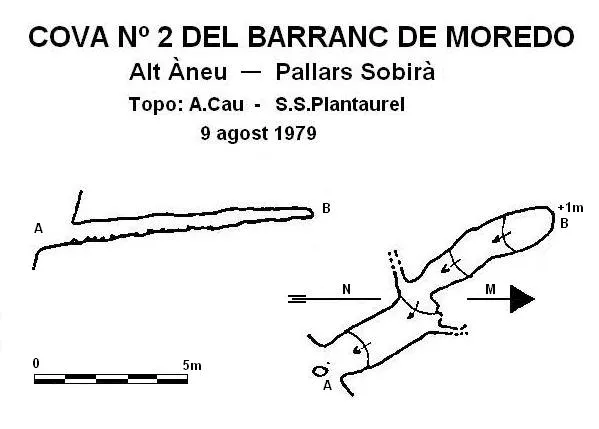
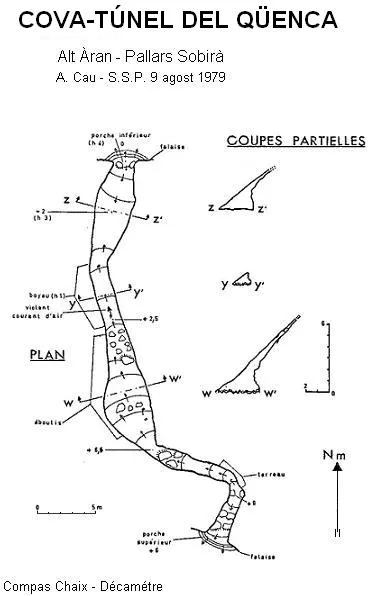


Source: Espeleoindex (espeleoindex.com), modified. CC BY-NC 4.0, https://creativecommons.org/licenses/by-nc/4.0/