
Cova del Tendo
Cave of about 200 m of passage in Montsià, on the S slope of the Mola de Calatrava, known as Cova del Tendo, with a vanished rock painting and a survey made in 2018.
EspeleoWorld
Cova del Tendo
Cave of about 200 m of passage in Montsià, on the S slope of the Mola de Calatrava, known as Cova del Tendo, with a vanished rock painting and a survey made in 2018.
Sant Carles de la Ràpita · Montsià
Length: 202 m · Depth: 15 m
Updated record
https://espeleoworld.com/en/c/cova-del-tendo
Information can change. Always verify coordinates, access, weather, and cave conditions before setting out.
Cave of about 200 m of passage in Montsià, on the S slope of the Mola de Calatrava, known as Cova del Tendo, with a vanished rock painting and a survey made in 2018.
Topographic
Espeleoindex · CC BY-NC 4.0, https://creativecommons.org/licenses/by-nc/4.0/ · Image © its author.
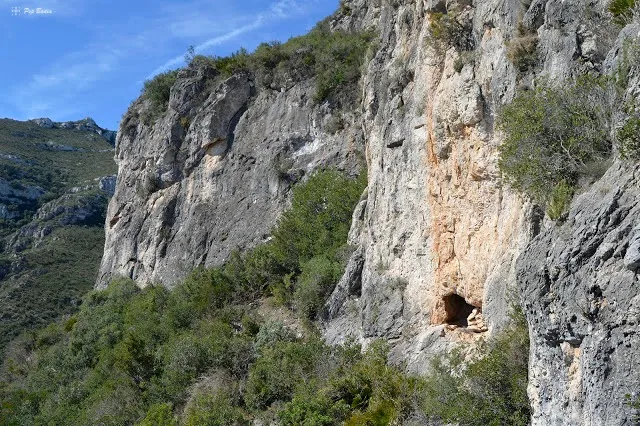
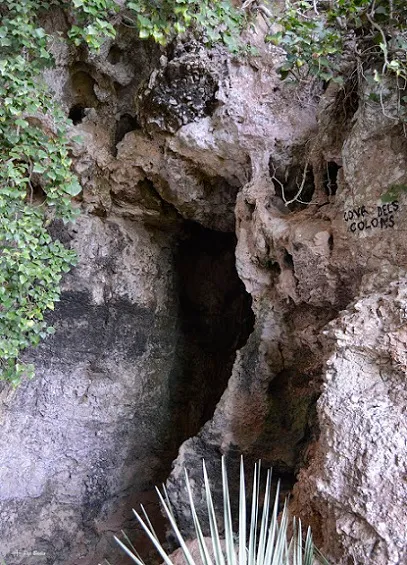
Photos
Espeleoindex · CC BY-NC 4.0, https://creativecommons.org/licenses/by-nc/4.0/ · Image © its author.
Description
Morphology
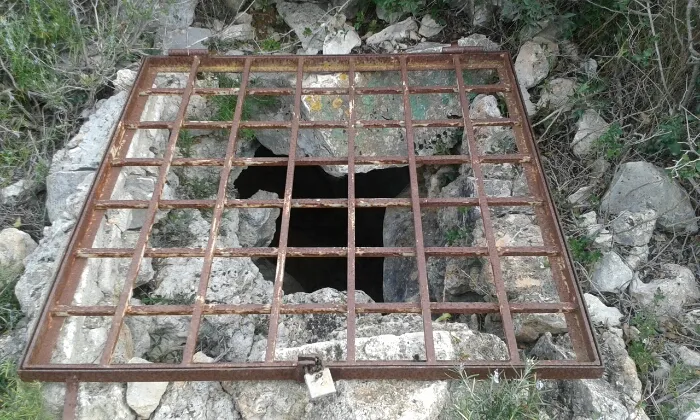
The current entrance, since the original was blocked by rockfalls, is a small opening 0.70 x 0.50 metres, opened in the vault of what had been a chamber and next to a wall, which avoids the use of equipment to descend this shaft of about 8 metres, the first of which are covered by an inclined slab. At the bottom of the shaft a crawlway opens, beneath a large fallen block in the opposite direction to that of the entrance, leading to a chamber which, despite being the largest in the cave, can be seen to have had much more volume in the times when it was inhabited, now occupied by passages, crawlways, cracks and other narrow conduits, which must be passed to reach the small chamber where, on one of the two flags, the rock painting is found in a good state of conservation. (Description made by Isidre González Urgellés in 1964, very shortly afterwards the painting disappeared).
Update January 2019: The entrance, rather small, opens in the floor and has been modified since a grille was put in place which has now been unhinged from its frame.
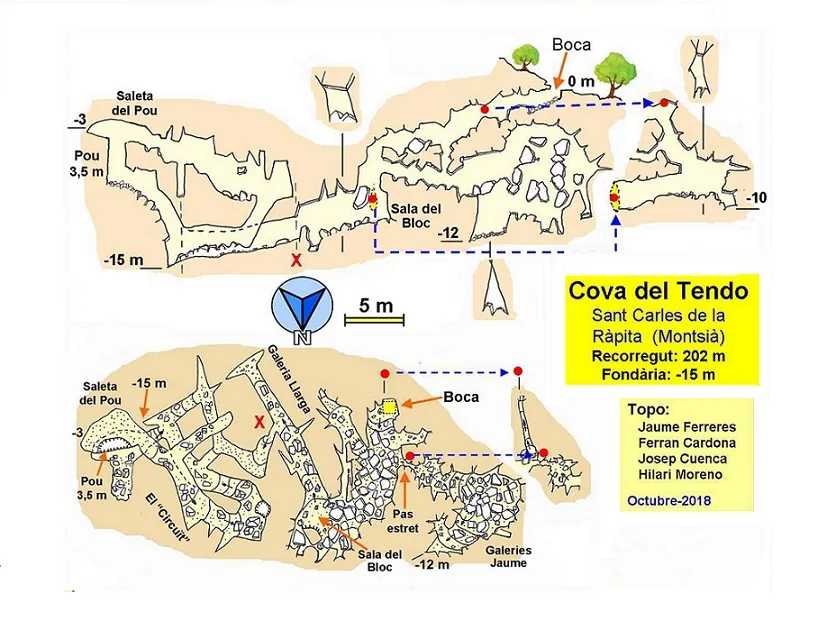
Just on entering, we reach a first small chamber, full of blocks. From it different routes begin which, with a steep gradient, will take us to the lower levels of the cave. All of them give access to a sector of chaotic configuration, full of blocks and passages between them, difficult to represent in a survey since the different levels overlap.
Whichever route we take, we will end up at the sala del Bloc, a relatively wide space that receives this name since there is a wedged block. Before reaching the chamber, along one of the routes, there is a narrow passage that gives access to a new network of small galleries (“galeries Jaume”).
From the lower part of the sala del Bloc begins the longest, straightest and most comfortable gallery in the whole cave (“galeria Llarga”), which is 13 metres long. Towards its middle a new gallery branches off to the left at what is the entrance to a new network of galleries. Along it we will reach the lowest point of the cave (-15 m). Starting from here, we can take a new gallery that becomes ascending until reaching the highest point, located in the saleta del Pou, with a shaft of 3.5 metres opening in its floor (it can be descended carefully without equipment), followed by galleries with a steep gradient that will place us again at a point near the lowest point of the cave, thus closing a “circuit”.
Speleothems
The rock painting was found on a stalactitic formation, of the flag type.
Progression
The current entrance is a small opening 0.70 x 0.50 metres, opened in the vault of what had been a chamber and next to a wall, which avoids the use of equipment to descend this shaft of about 8 metres, the first of which are covered by an inclined slab. At the bottom of the shaft a crawlway opens, beneath a large fallen block in the opposite direction to that of the entrance. Just on entering, we reach a first small chamber, full of blocks. From it different routes begin which, with a steep gradient, will take us to the lower levels of the cave. All of them give access to a sector of chaotic configuration, full of blocks and passages between them, difficult to represent in a survey since the different levels overlap. Whichever route we take, we will end up at the sala del Bloc. Before reaching the chamber, along one of the routes, there is a narrow passage that gives access to a new network of small galleries (“galeries Jaume”). From the lower part of the sala del Bloc begins the longest, straightest and most comfortable gallery in the whole cave (“galeria Llarga”), which is 13 metres long. Towards its middle a new gallery branches off to the left at what is the entrance to a new network of galleries. Along it we will reach the lowest point of the cave (-15 m). Starting from here, we can take a new gallery that becomes ascending until reaching the highest point, located in the saleta del Pou, with a shaft of 3.5 metres opening in its floor (it can be descended carefully without equipment), followed by galleries with a steep gradient that will place us again at a point near the lowest point of the cave, thus closing a “circuit”.
Other details
The cave is very well known and visited by hikers from the area. For some years it has been known as Cova del Tendo; we do not know whether this was the name by which it was known before and has been recovered, or whether it is a modern designation. The name Cova de la Moleta Cartagena seems to have been given to it by Dr. Ripoll, but what surprises us is that we have not been able to find this toponym in the cartography of the period nor in the most current, the relief where the cave is located being called Mola de Calatrava.
History
The first news of the cave is that it was explored at the end of March 1964 by Isidre González Urgellés and Armand Avalo (GIE – CE de Gràcia) who were accompanied by Mr. J.Aguilar, from Sant Carles de la Ràpita, who acted as their guide through the reliefs of Montsià. On that first exploration they found a rock painting on a stalactitic formation, of the flag type. A few weeks later they returned accompanied by Dr. Eduard Ripoll and Mr. Llongueras, both from the Museu Arqueològic de Barcelona and the Institut de Prehistòria. These were able to verify that it was the figure of a wild bull in a rampant position and the possible figure of an archer. A tracing and photographs of the painting were made, dating it as belonging to the Palaeolithic.
Unfortunately, shortly afterwards someone went chipping at the flag and managed to take the painting away, of which its fate has never been known again.
Visited in October 2018 by members of the Espeleo Club del Barcelonès and the Grup d'Espeleologia de Badalona who carry out a complete exploration and make the only known survey of the cave.
Bio
Coleoptera
- Paranillochlamys urgellesi (unpublished record: F. Fadrique)
User Comments (0)
No comments yet.
Be the first to share your experience!
Registered Explorations (0)
No explorations registered yet.
Register your visit to this cave!
Bibliography
- González Urgellés, I. (1964).- “Hallazgo de la primera pintura del paleolítico en Cataluña”. Geo y Bio KARST (1): 9. J.Mª Armengou, editor. Barcelona.
- Grimal, A. ; Alonso, A. (1989).- “Sobre la figura de tipo levantino en la Cueva del Tendo, Moleta de Cartagena (Montsià – Tarragona)”. Boletín (2): 18-21. Asociación Española de Arte Rupestre. Barcelona.
- Coordenades i fotografia boca extretes de wikiloc. Autor: Vicent Carrillo
- Fotografies interiors extretes del blog del Club d'espeleologia Dinàmics (St. Carles de la Ràpita).
- Actualització de la descripció i topografia (2018) extretes del web: geb.cat (del Grup d'Espeleologia de Badalona). Apunt del 18-11-2018. Dades: F. Cardona; J. Ferreres i H. Moremo (EC Barcelonès) i J. Cuenca (GE Badalona)
Nearby caves


Source: Espeleoindex (espeleoindex.com), modified. CC BY-NC 4.0, https://creativecommons.org/licenses/by-nc/4.0/