
Cova del Ramer
Petita però bonica cova de 33 m de recorregut a Tivissa (Ribera d'Ebre)
EspeleoWorld
Cova del Ramer
Petita però bonica cova de 33 m de recorregut a Tivissa (Ribera d'Ebre)
Tivissa · Ribera d'Ebre
Length: 33 m · Depth: 10 m
Updated record
https://espeleoworld.com/en/c/cova-del-ramer
Information can change. Always verify coordinates, access, weather, and cave conditions before setting out.
A small but pretty cave with a 33 m passage in Tivissa (Ribera d'Ebre), known since ancient times and visited by hikers and scholars.
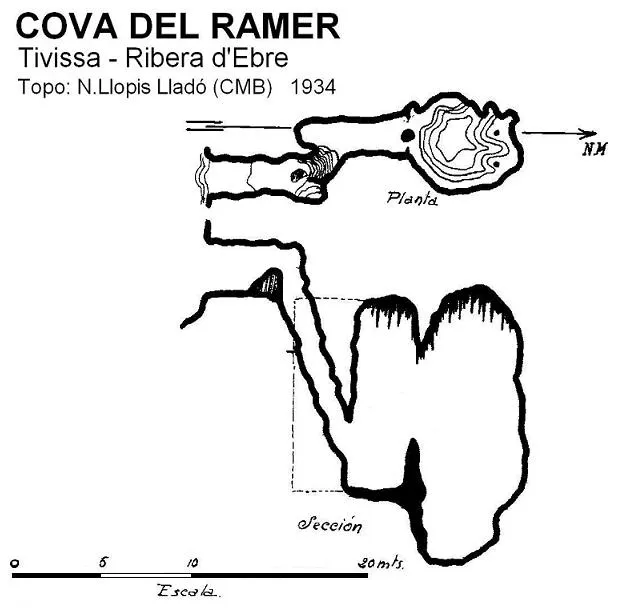
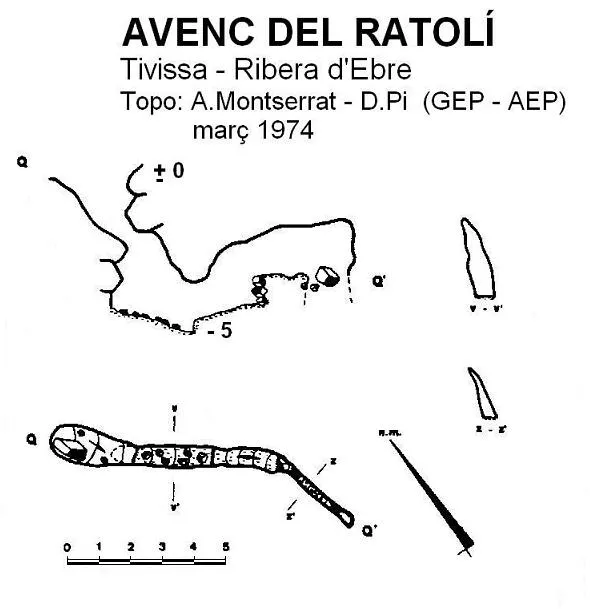
Topographic
Espeleoindex · CC BY-NC 4.0, https://creativecommons.org/licenses/by-nc/4.0/ · Image © its author.
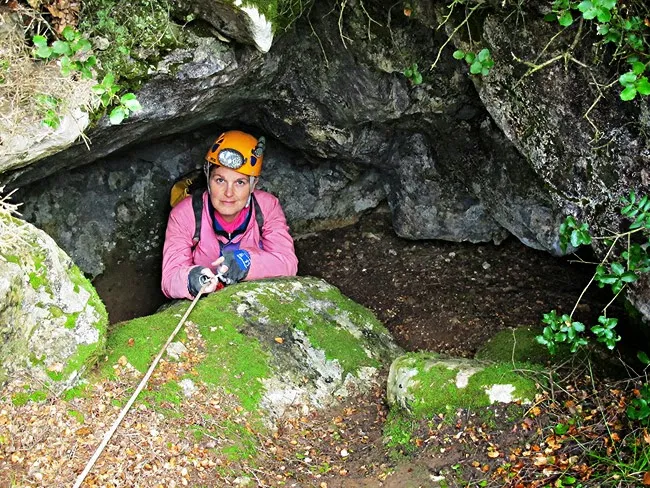
Photos
Espeleoindex · CC BY-NC 4.0, https://creativecommons.org/licenses/by-nc/4.0/ · Image © its author.
Description
Morphology
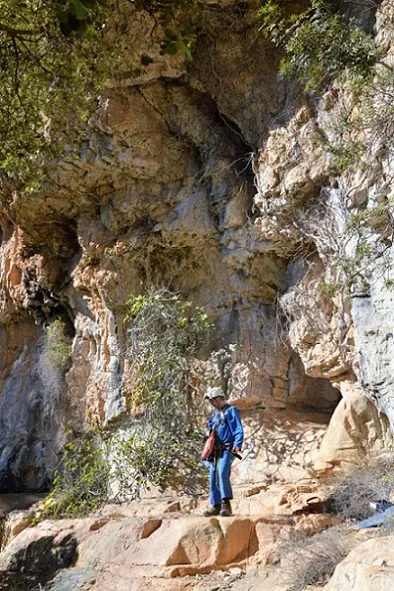
After climbing over a rise of +1.80 m we find ourselves at an entrance 2.50 m high and 1.20 wide; a little further on we come to a descending ramp of about 6 m. We reach a gallery about 8 m long and about 2 m wide. At the beginning we find a chimney of 18.5 m. A large dry gour leads us to a shaft about 4 m in diameter and 4 deep. Once at the base of the shaft, on the left there is a small meandering fissure of about 2 metres. This base of the shaft gives us the maximum depth level: -10.50 m.
Speleothems
The gallery is beautifully ornamented. At the head of the shaft there is a beautiful stalagmite. In front of us there is a spectacular flow with a balcony of stalagmites and columns.
Progression
We will have to install a rope for better safety on the descending ramp. We can do a small route by ascending behind the stalagmites and columns and coming back down.
Other details
N. Llopis Lladó considers that it could have a certain relationship with the origin and evolution of la Fou de Capçanes.
History
Known since ancient times. According to oral tradition, this cave was one of the many hiding places of the Austrianist military man and guerrilla fighter Pere Joan Barceló i Anguera, alias Carrasclet.
The first mention of this cavity is from 1916, when members of the Agrupació Excursionista de Reus visited it. Two years later, J. Ferraté included it in his work, providing a detailed description and accompanying a sketch of the plan.
Around 1934 or 1935 it was visited by N. Llopis Lladó (CMB), who made a detailed survey and study. Llopis already noted at that time that the cave was much visited.
Bio
Isopods
- Porcellio expansus Dollfus, 1892
User Comments (0)
No comments yet.
Be the first to share your experience!
Registered Explorations (0)
No explorations registered yet.
Register your visit to this cave!
Bibliography
- Borràs, J.; Miñarro, JM.; Talavera, F. (1984).- Catàleg espeleològic de Catalunya. Vol. 7 (el Baix Camp, el Priorat i la Ribera d'Ebre. Políglota: 283 pp. Barcelona.
- Ferraté, J. (1918).- Espeleologia de les comarques tarragonines. 133 pp. Agrupació Excursionista de Reus.
- Montserrat, A. (1983).- Sobre algunes cavitats de les comarques del Baix Camp i Priorat (i III)”. Espeleòleg (34-35): 280-293. ERE – Centre Excursionista de Catalunya. Barcelona.
- Actualització de dades, topografia 2016 i fotografies extretes del web: geb.cat (del Grup d'Espeleologia de Badalona). Apunt del 30-12-2016
Nearby caves


Source: Espeleoindex (espeleoindex.com), modified. CC BY-NC 4.0, https://creativecommons.org/licenses/by-nc/4.0/