
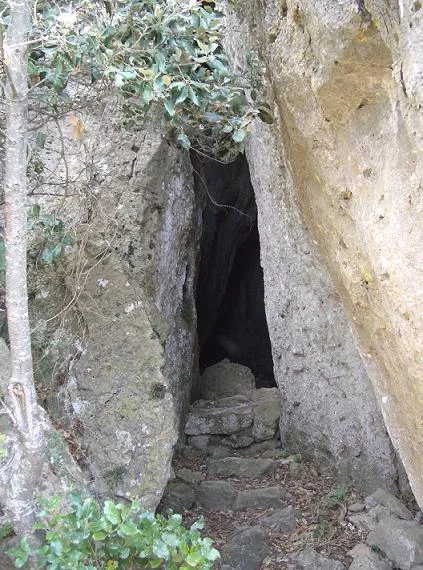
Cova de les Gralles
An 80-metre-long cave at Cogullons (Montblanc), discovered in 1927, with a site from the Final Neolithic to the Final Bronze Age.
EspeleoWorld
Cova de les Gralles
An 80-metre-long cave at Cogullons (Montblanc), discovered in 1927, with a site from the Final Neolithic to the Final Bronze Age.
Montblanc · Conca de Barberà
Length: 80 m
Updated record
https://espeleoworld.com/en/c/cova-de-les-gralles-montblanc
Information can change. Always verify coordinates, access, weather, and cave conditions before setting out.
An 80-metre-long cave at Cogullons (Montblanc), discovered in 1927, with a site from the Final Neolithic to the Final Bronze Age.
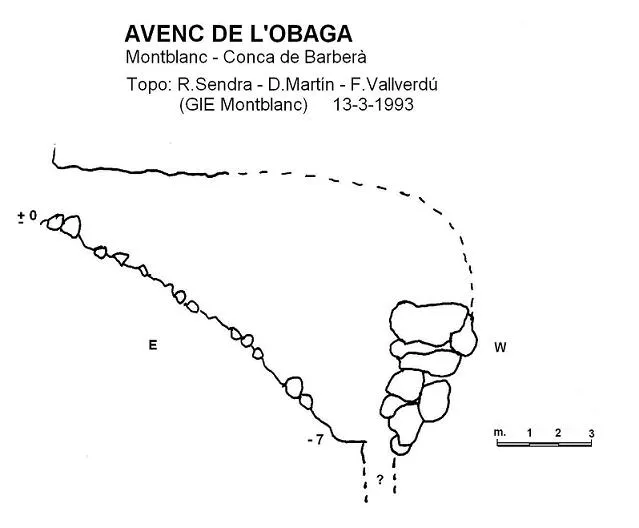
Topographic
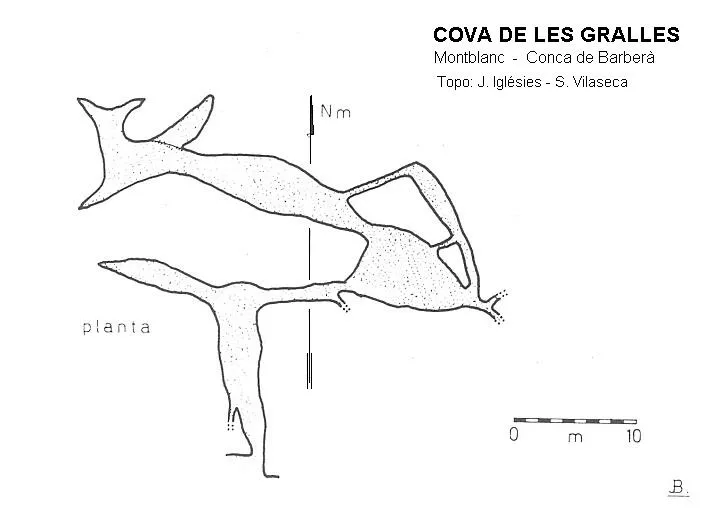
Espeleoindex · CC BY-NC 4.0, https://creativecommons.org/licenses/by-nc/4.0/ · Image © its author.
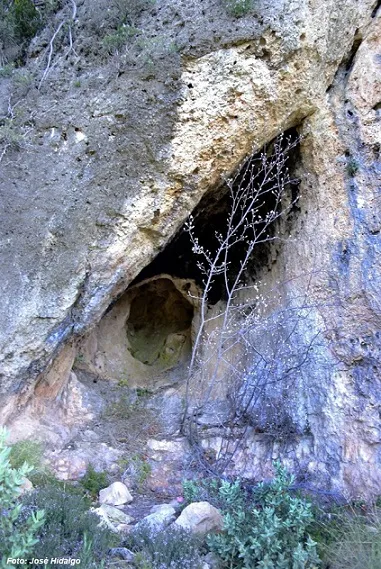
Photos
Espeleoindex · CC BY-NC 4.0, https://creativecommons.org/licenses/by-nc/4.0/ · Image © its author.
Description
Morphology
The mouth faces S and has dimensions of 0.7 m by 11 m in length, and it widens progressively to about 5 m at the back of the vestibule, while its height is considerable, on the order of 12 m, remaining so in the greater part of the cavity. At the back it is crossed by a joint almost perpendicularly and its continuation is along the right-hand side, where there is a narrower passage that rises slightly and is about 15 m long, which at its eastern end forms a chamber part of whose vault has collapsed, communicating with the surface. On the NW side of the chamber a new gallery begins, almost 20 m long, cutting at its NW end an almost perpendicular fissure that lies some 5 m higher. Once up there, we can follow some 25 m along a more rugged joint that turns and becomes narrower, allowing light to enter at the end; continuing along the wider part towards NW among blocks we can climb a few metres where the cavity ends and light also enters from outside.
History
The cavity was discovered in 1927 and later, Salvador Vilaseca, Serra Ràfols and Manel Mata carried out some interventions there around the 30s. According to S. Vilaseca, at the entrance of the cave, on one of the walls of the first chamber, there was a human hand painted in red. It should be said that today it is not visible.
Among the material recovered by S. Vilaseca are flint pieces, arrowheads, a fragment of a basalt axe, fragments of quartzite pebbles, bone awls, two arrowheads also made of animal bone, plain ceramic fragments decorated with reliefs, Bell Beaker-type pottery and channeled pottery.
Also noteworthy is the discovery of human remains that came out mixed with stones and other materials, which presented no order and were highly fragmented. According to Vilaseca, 21 individuals were counted.
It is a site from the Final Neolithic to the Final Bronze Age (-2500 / -650).
In the late 50s and early 60s, just before the creation of the prehistory group of the Museu Arxiu de Montblanc, its members carried out various explorations and investigations there, without many results, referencing only some fragments of flint and pottery. It was also explored by the first speleology group of Montblanc, the SERS del CEM.
In 1964, it was visited by a group of young people before the formation of the GIEM itself, who would later become part of it.
Following the purchase of the land and most of the village by a Buddhist community, they undertook some actions that were disrespectful to the surroundings, filling Cogullons with abandoned roulottes, putting up a lamentable shack that still remains at the foot of the village and turning the cave into a kind of deranged sanctuary, building a red brick wall, iron doors and a cement floor with the aim, they said, of filling it with paintings with images of their gods. Thanks to a timely campaign against it and the corresponding complaint by GEPEC to the archaeological heritage department of the Generalitat, the project did not go any further and the owners had to dismantle all the mess they had caused.
On 30-5-2010 the GIEM carried out a new survey, attempting to look for fauna there and to access some lower galleries that S. Vilaseca described in the publication of the year 32; with the good result that on opening the conduit to access what we supposed was the lower part, some fragments of pottery appeared, a beautiful bone awl and in the surroundings a spectacular Roman bronze sculpture about 20 cm of the god Mercury.
User Comments (0)
No comments yet.
Be the first to share your experience!
Registered Explorations (0)
No explorations registered yet.
Register your visit to this cave!
Bibliography
- Borrás, J.; Miñarro, J.M.; Talavera, F.(1978).-”alt camp, la conca de barberà, el baix penedès i el tarragonès”. Catàleg Espeleològic de Catalunya (vol.2): 201-202. Ed. Políglota. Barcelona.
- Vilaseca, S.; Iglesies, J.(1932).-”Exploració Prehistòrica de l'alta conca del Brugent. III. La cova de les Gralles”. Revista Centre Lectura de Reus 13(225-227):26-36. Reus.
- Dades extretes de Patrimoni.Gencat.Arqueologia, Generalitat de Catalunya (invarque.cultura.gencat.cat) Fotografia de M.Corominas/E. Vilalta, agost 2005.
- Fitxa actualitzada el 31 desembre 2017. Coordenades topografia i dades facilitades per Joan Pallisé (Montblanc).
Nearby caves


Source: Espeleoindex (espeleoindex.com), modified. CC BY-NC 4.0, https://creativecommons.org/licenses/by-nc/4.0/