
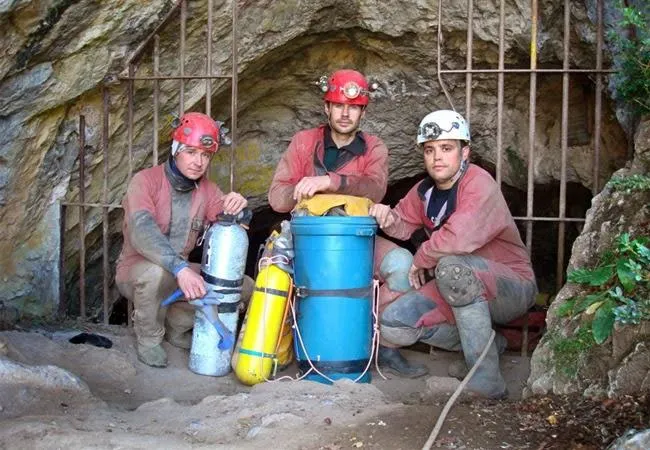
Cova de la Fou de Bor
Històric i important sistema subterrani de més 4000 m. de recorregut a Bor (la Cerdanya)
EspeleoWorld
Cova de la Fou de Bor
Històric i important sistema subterrani de més 4000 m. de recorregut a Bor (la Cerdanya)
Bellver de Cerdanya · Cerdanya
Length: 4246 m · Depth: 206 m
Updated record
https://espeleoworld.com/en/c/cova-de-la-fou-de-bor
Information can change. Always verify coordinates, access, weather, and cave conditions before setting out.
Historic and important underground system of more than 4000 m of passage in Bor (Cerdanya), with a vertical range of 206 m and a length of 4246 m.
Topographic
Espeleoindex · CC BY-NC 4.0, https://creativecommons.org/licenses/by-nc/4.0/ · Image © its author.
Photos
Espeleoindex · CC BY-NC 4.0, https://creativecommons.org/licenses/by-nc/4.0/ · Image © its author.
Description
Morphology
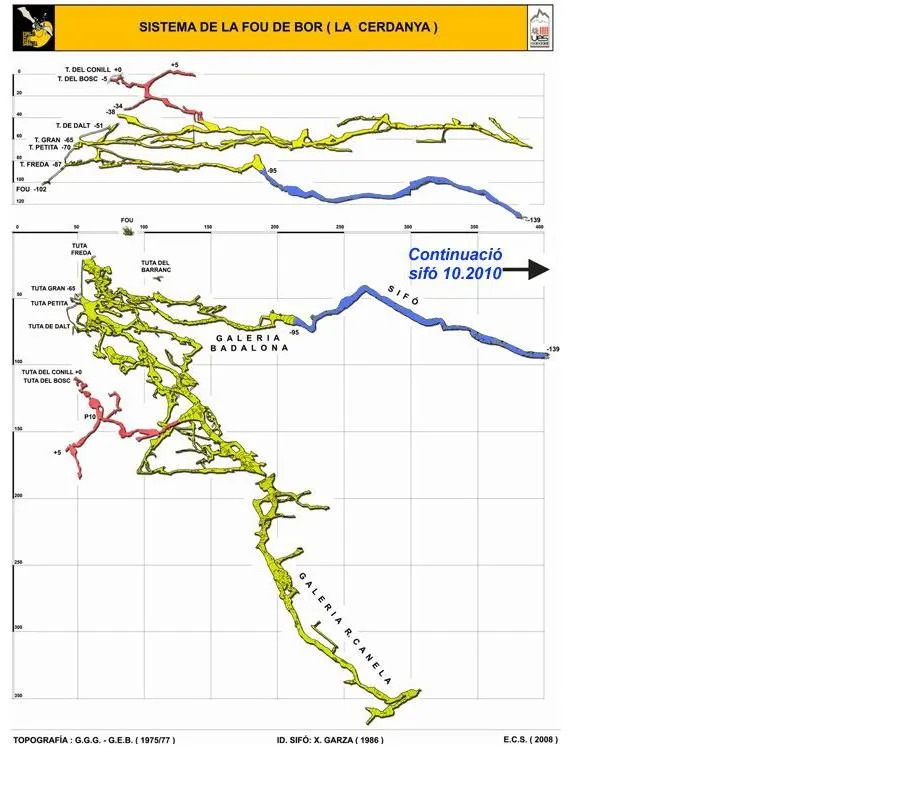
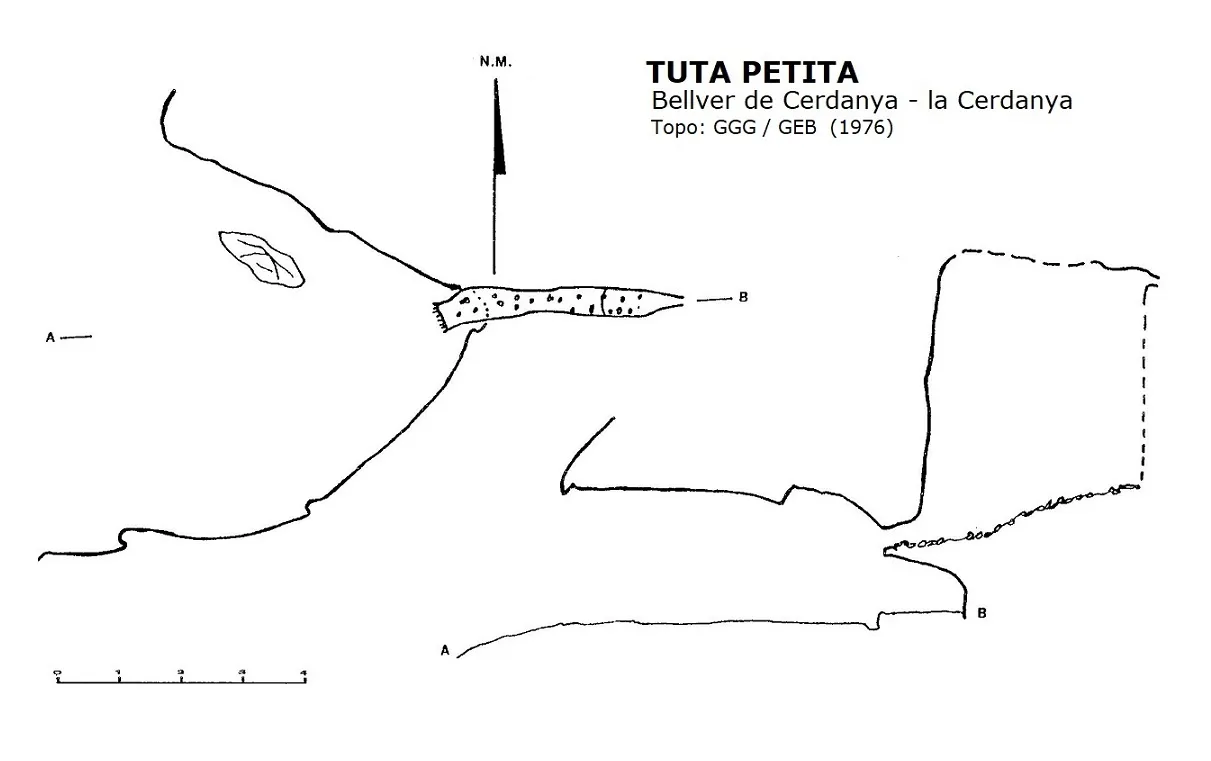
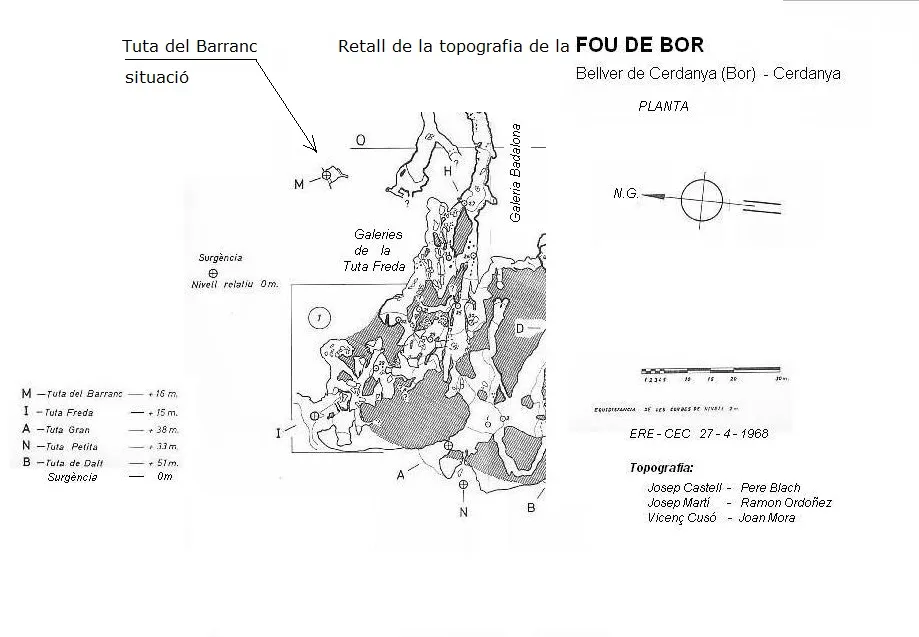
The Tuta Gran is the historic and most usual access to the system. Past the entrance (with the remains of an old grille), about 2.5 metres wide and with forms that reveal its action as a spring in past times, we find ourselves in a vestibule of regular dimensions with a floor that has been greatly modified by archaeological excavations. To continue we are presented with two main options: if we follow to the left we will go to the galleries of the Tuta Freda. If we continue straight we will access the best-known and most important sector of the system. There is still a third section, in a SW direction, ascending through a widened joint in the form of a chimney, reaching a small gallery that leads directly to the outside (TUTA DE DALT).
From the entrance hall and after about 25 metres the gallery bifurcates. Continuing straight we will access the lower galleries, while if we turn right, going up a short ramp, we will find ourselves at the start of the upper galleries. Both sectors meet again at the Sala Cerdanya after more or less complex routes.
The Galeries superiors: The first metres are narrow and it is necessary to crawl in some places. After a small downward step the gallery we are following has an intersection with another of larger dimensions which we will follow to the left, where the gallery widens, acquiring a section clearly determined by the bedding, presenting large blocks of parallelepiped shape, the major faces coinciding with bedding planes. The gallery opens at the upper part of the Sala Cerdanya, which is reached by descending a slippery ramp.
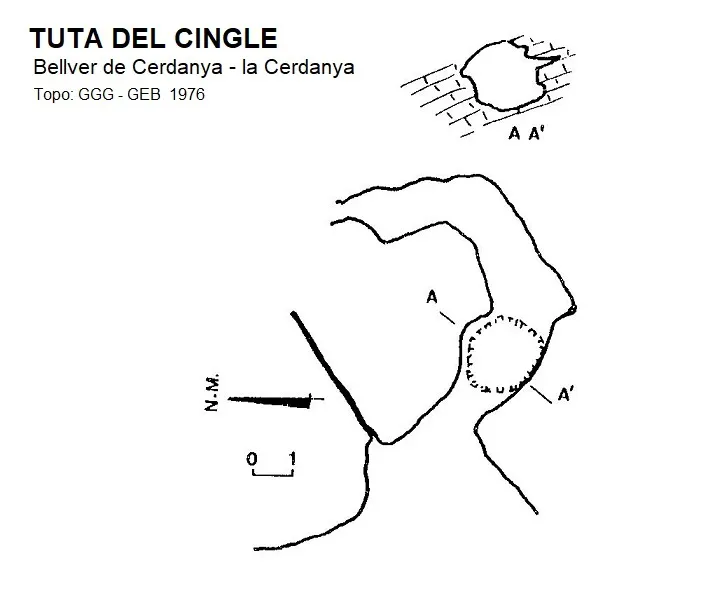
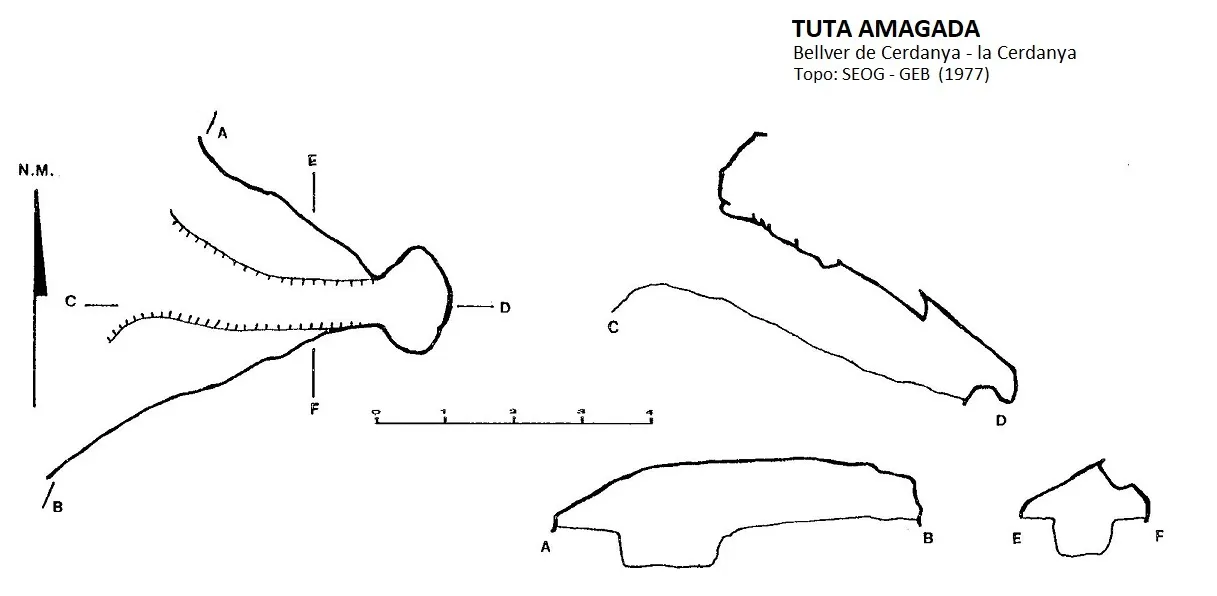
About 60 metres above the Tuta Gran is the TUTA DEL BOSC, a small cave known for a long time and which, after hard desobstruction work, could be advanced through a series of very narrow passages and some step that allows reaching the entrance of a 10-metre pit. At the same height as the entrance of the pit there is a window which, by means of a handrail, allows access to a beautiful ascending gallery that remains closed further on. In its central section is the level + 10 (with respect to the Tuta del Bosc, which is now level 0 of the system) the highest point of the whole system. At the base of the 10-metre pit a beautiful gallery with a perfect vault starts, with a narrow descending bifurcation on the left. Following the main gallery one reaches an inclined pit and further on a new narrow passage that had to be desobstructed. Once passed, one enters a descending tube and then a small room, a narrow passage and a mud slide, downclimb a 4-metre chimney and access a pronounced ramp that is already part of the Galeries superiors of the Tuta Gran.
Also, 5 metres above the Tuta del Bosc and shortly after entering it, there is a narrow impenetrable chimney that connects with the outside, the Tuta del Conill (level + 5).
The Galeries inferiors: It is a set of galleries of apparently irregular layout, with continuous widenings and narrowings, although the average sections are usually modest. After a relatively important route we will reach the lower part of the Sala Cerdanya by means of a passage clearly structured in a fault. This is a sector with a much more youthful morphology than the upper galleries; corrosive forms become evident as we approach the room.
The Galeria Canela: Its access is from the lowest point of the Sala Cerdanya, where we find a muddy small sump that must be emptied each time (it is quite a task to do so and in rainy periods it does not take long to fill up again). Once emptied, a short but unpleasant crawl places us on the other side (it should be said that in recent times the dimensions of the passage have increased and a flat board has been placed to allow the explorer's body to slide). Once the passage is passed, a room of considerable dimensions suddenly opens. The Galeria Canela consists of a main conduit from which some secondary branches emerge. It presents a first section of ascending layout and, after a 10-metre climb (which can be avoided by passing through some crawls), it becomes descending while its morphology changes, since the formations reach great spectacularity. The gallery ends filled with sediments, after having completed the most beautiful route of the whole cavity.
Just above the access to the Galeria Canela, at the highest part of the room, the so-called Galeria Martinet develops, which in total has a length of 92 metres.
The Tuta Freda: A wide entrance (6 x 2 m.) gives access to two galleries that join after a few metres. On the left the passage ends in a small room one metre high with the floor covered by abundant blocks. To the right is the crawl that was desobstructed in 1962 and once passed one enters a zone of blocks up to a small room of larger dimensions. An ascending conduit leads to the junction zone with the gallery that descends from the left of the entrance hall of the Tuta Gran. In this sector there are many bifurcations and crawls that lead to a set of quite labyrinthine galleries. Once one reaches the Galeria Badalona this presents a conduit that tends to become wider as one advances until reaching a room with a high vault where at its bottom is the sump. Its level is very variable depending on the rains. When these are very abundant it overflows and many times all the galleries of the Tuta Freda are flooded and the flow comes out through the cave entrance.
The whole flooded conduit begins with a descending gallery to later gain horizontality and then ascend. Further on it descends again and one reaches the point of maximum depth of the system (level – 196) from the entrance of the Tuta del Bosc (level 0). The route of the sump is estimated at 1050 metres.
Current speleometry of the whole system: Vertical range: 206 m. (- 196; + 10) Length: 4246 m.
Hydrology
The spring of la Fou flows at the foot of the Serrat de la Quera, its waters being channelled for use. The muddy small sump of the Galeria Canela must be emptied each time and in rainy periods it does not take long to fill up again. The level of the sump of the Galeria Badalona is very variable depending on the rains; when these are very abundant it overflows and many times all the galleries of the Tuta Freda are flooded and the flow comes out through the cave entrance. The route of the sump is estimated at 1050 metres.
Progression
The Tuta Gran is the historic and most usual access to the system. Past the entrance (with the remains of an old grille), about 2.5 metres wide and with forms that reveal its action as a spring in past times, we find ourselves in a vestibule of regular dimensions with a floor that has been greatly modified by archaeological excavations. To continue we are presented with two main options: if we follow to the left we will go to the galleries of the Tuta Freda. If we continue straight we will access the best-known and most important sector of the system. There is still a third section, in a SW direction, ascending through a widened joint in the form of a chimney, reaching a small gallery that leads directly to the outside (TUTA DE DALT).
From the entrance hall and after about 25 metres the gallery bifurcates. Continuing straight we will access the lower galleries, while if we turn right, going up a short ramp, we will find ourselves at the start of the upper galleries. Both sectors meet again at the Sala Cerdanya after more or less complex routes.
The Galeries superiors: The first metres are narrow and it is necessary to crawl in some places. After a small downward step the gallery we are following has an intersection with another of larger dimensions which we will follow to the left, where the gallery widens, acquiring a section clearly determined by the bedding, presenting large blocks of parallelepiped shape, the major faces coinciding with bedding planes. The gallery opens at the upper part of the Sala Cerdanya, which is reached by descending a slippery ramp.
About 60 metres above the Tuta Gran is the TUTA DEL BOSC, a small cave known for a long time and which, after hard desobstruction work, could be advanced through a series of very narrow passages and some step that allows reaching the entrance of a 10-metre pit. At the same height as the entrance of the pit there is a window which, by means of a handrail, allows access to a beautiful ascending gallery that remains closed further on. In its central section is the level + 10 (with respect to the Tuta del Bosc, which is now level 0 of the system) the highest point of the whole system. At the base of the 10-metre pit a beautiful gallery with a perfect vault starts, with a narrow descending bifurcation on the left. Following the main gallery one reaches an inclined pit and further on a new narrow passage that had to be desobstructed. Once passed, one enters a descending tube and then a small room, a narrow passage and a mud slide, downclimb a 4-metre chimney and access a pronounced ramp that is already part of the Galeries superiors of the Tuta Gran.
Also, 5 metres above the Tuta del Bosc and shortly after entering it, there is a narrow impenetrable chimney that connects with the outside, the Tuta del Conill (level + 5).
The Galeries inferiors: It is a set of galleries of apparently irregular layout, with continuous widenings and narrowings, although the average sections are usually modest. After a relatively important route we will reach the lower part of the Sala Cerdanya by means of a passage clearly structured in a fault. This is a sector with a much more youthful morphology than the upper galleries; corrosive forms become evident as we approach the room.
The Galeria Canela: Its access is from the lowest point of the Sala Cerdanya, where we find a muddy small sump that must be emptied each time (it is quite a task to do so and in rainy periods it does not take long to fill up again). Once emptied, a short but unpleasant crawl places us on the other side (it should be said that in recent times the dimensions of the passage have increased and a flat board has been placed to allow the explorer's body to slide). Once the passage is passed, a room of considerable dimensions suddenly opens. The Galeria Canela consists of a main conduit from which some secondary branches emerge. It presents a first section of ascending layout and, after a 10-metre climb (which can be avoided by passing through some crawls), it becomes descending while its morphology changes, since the formations reach great spectacularity. The gallery ends filled with sediments, after having completed the most beautiful route of the whole cavity.
Just above the access to the Galeria Canela, at the highest part of the room, the so-called Galeria Martinet develops, which in total has a length of 92 metres.
The Tuta Freda: A wide entrance (6 x 2 m.) gives access to two galleries that join after a few metres. On the left the passage ends in a small room one metre high with the floor covered by abundant blocks. To the right is the crawl that was desobstructed in 1962 and once passed one enters a zone of blocks up to a small room of larger dimensions. An ascending conduit leads to the junction zone with the gallery that descends from the left of the entrance hall of the Tuta Gran. In this sector there are many bifurcations and crawls that lead to a set of quite labyrinthine galleries. Once one reaches the Galeria Badalona this presents a conduit that tends to become wider as one advances until reaching a room with a high vault where at its bottom is the sump. Its level is very variable depending on the rains. When these are very abundant it overflows and many times all the galleries of the Tuta Freda are flooded and the flow comes out through the cave entrance.
The whole flooded conduit begins with a descending gallery to later gain horizontality and then ascend. Further on it descends again and one reaches the point of maximum depth of the system (level – 196) from the entrance of the Tuta del Bosc (level 0). The route of the sump is estimated at 1050 metres.
Current speleometry of the whole system: Vertical range: 206 m. (- 196; + 10) Length: 4246 m.
History
Cavity known since time immemorial. A first (partial) visit by people from the excursionist world was carried out on the first of October 1885 by members of the Associació Catalanista d'Excursions Científiques, led by Cèsar A. Torras and accompanied by people from the area and en Pau Mas, delegate of the Association in Puigcerdà who had already entered three times previously.
On 18 September 1896, E.A. Martel and his inseparable Armand, returned from their trip to Mallorca and a few days in Barcelona and Collbató, went together with members of the Centre Excursionista de Catalunya to explore the cova de la Fou de Bor. On the way they joined N. Font i Sagué and later Lluís Mª Vidal. They say that this meeting was the spark that turned Font into the initiator of speleology in Catalonia. On that occasion they say they explored 300 metres of galleries.
On 21 August 1910 it was visited by Jeannel, Racovitza and Mengel during their biospeleological research. They say that the cave is only 130 metres long.
In 1915, Mr. Pere Pons, teacher of Bor, says he explored 650 metres of galleries.
In 1922, the Institut d'Estudis Catalans carried out a first archaeological excavation in the entrance hall of the Tuta Gran.
In November 1934 a large group of members of the Club Muntanyenc Barcelonès carried out a partial exploration for lack of time. They returned on 29 July 1935 and, this time accompanied by Mr. Pere Pons, they were able to complete, over three days, the exploration and study of the Tuta Gran and other nearby tutes. Josep Closas published a complete and detailed study of the cave resulting from that exploration.
It is not until 1962 that novelties in exploration begin. The GE Badalona carries out hard desobstructions in the Tuta Freda that lead to the discovery of the Galeria Badalona and the final sump. The following year, the speleologists from Badalona with the support of colleagues from the SES Puigmal and the AE Muntanya, are able to desobstruct the connecting passage between the Tuta Gran and the Tuta Freda.
In 1964 the GE Badalona makes a first underwater prospection in the terminal sump.
In early August 1965, Josep Subils and Ferran Godoy (ERE – CEC; EDECA) undertake the exploration of the sump, but a dramatic accident made them pay with their lives. The tasks of recovering the bodies lasted a week.
Around 1966, different members of the ERE – CEC led by Josep Castell, begin the survey of the whole system known until then. This meticulous survey completes the interesting monograph: La Fou de Bor i cavitats de l'Alta Vall del Segre, published in 1970.
In early August 1970 the EIE of the Penya Cultural Barcelona carries out, by means of a generator group and a pump, an attempt to partially empty the sump, managing to lower it very little. It should be said that this, at least curious experience, was conceived by Salvador Pons (SIRE – UEC Sants) influenced by the work that some years earlier the speleologists from Nîmes were carrying out (with positive result) at the Fontaine de Nimes, located in the gardens of the Fontaine, in the urban centre of the city of Gard and where about 4500 metres of galleries have been explored.
In September 1974, members of the GE Badalona are able, after a long time dedicated to desobstruction, to pass the muddy sump at the bottom of the Sala Cerdanya which gave way to the beautiful Galeria Canela.
Between 1985 and 1986, Xavier Garza of the EC Gràcia, explores and surveys 278 metres of flooded galleries in the terminal sump.
Also in 1986, speleologists of the GIRES (Sant Esteve Sesrovires) carry out a climb to the ceiling of the Galeria Canela and explore 92 metres of new galleries (Galeria Martinet). At that moment the system of la Fou de Bor reaches 3265 metres of length.
In 1997, Xavier Garza returns again to the sump and reaches 376 metres of flooded route and 61 metres of depth.
In 2008, members of the Espeleo Club Sabadell begin to desobstruct the small Tuta del Bosc. After different working days and overcoming many narrows, they achieve the junction with the upper galleries of the Tuta Gran.
Since 2010, English cave divers of the Cave Diving Group, led by Chris Jewell and with the support of members of the GE Badalona, have been able to explore the continuation of the sump and so far they have covered 1050 metres of flooded galleries.
Bio
Pseudoscorpions: Neobisium cavernarum
Isopods: Stenasellus virei
Amphipods: Niphargus longicaudatus
Diplopods: Hispaniosoma racovitzai
Springtails: Pseudosinella intemerata
Beetles: Choleva fagniezi, Catops fuscus, Geotrechus seijasi, Troglophyes cenarroi
User Comments (0)
No comments yet.
Be the first to share your experience!
Registered Explorations (0)
No explorations registered yet.
Register your visit to this cave!
Bibliography
- AA (1987).- “Informació vària” (La galeria Martinet).- Fulls Periòdics d'Informació General (22): 2 pp. Federació Catalana d'Espeleologia. Barcelona.
- Borràs, J.; Miñarro, JM.; Talavera, F: (1978).- “Catàleg espeleològic de Catalunya. Vol. 1 (l'Alt Urgell i la Cerdanya)” Ed. Políglota. Barcelona
- Canals, M.; Ribera, C. Viñas, R. (1970).- La Fou de Bor i cavitats de l'alta vall del Segre., 98 pp. Centre Excursionista de Catalunya – Ed. Montblanch.
- Cardona, F. (1989).- Grans cavitats de Catalunya. Primer volum: La Serralada pirinenca. : 198 pp. Espeleo Club de Gràcia. Barcelona.
- Carreras, A.; Canela, R. (1962).- “Sistema Fou de Bor – Tuta Freda”. Memoria Espeleológica 1962: 6 pp. Grup d'Espeleologia de Badalona.
- Closas, J. (1935).- “La cova de la Fou de Bor”. Sota Terra (II):103-125. Club Muntanyenc Barcelonès.
- EC Gràcia (1990).- “La Cova de la Fou de Bor. Cent anys d'exploracions” Exploracions (14): 73-93. Espeleo Club de Gràcia. Barcelona.
- GEB i GGG (1979).- “Avance sobre las galerías descubiertas a partir de 1974 en la Cova de Bor (Cerdanya)”. Cavernas (21): 71-77. Grup d'Espeleologia de Badalona.
- Llenas, Manel (2009).- “Nova entrada i travessa espeleològica al sistema de la Fou de Bor. Tuta del Bosc. La Cerdanya. Lleida”. EspeleoCAT (7): 24-32. Federació Catalana d'Espeleologia. Barcelona.
- Valles, J. de (2009).- Catàleg Espeleològic de Catalunya. Vol. 3: 381 pp. Espeleo Club de Gràcia / Federació Catalana d'Espeleologia. Barcelona.
- Al blog: espeleobloc.blogspot.com.es trobareu tot un seguit d'apunts de tota mena sobre la cavitat i dels quals hem extret dades i fotografies.
- Altres fotografies han estat extretes del web (www.engarrista.com) de Marc Solé.
- (Els interessats en una bibliografia exhaustiva poden consultar el Catàleg Espeleològic de Catalunya, vol.3 (Jordi de Valles, 2009)
Nearby caves


Source: Espeleoindex (espeleoindex.com), modified. CC BY-NC 4.0, https://creativecommons.org/licenses/by-nc/4.0/