
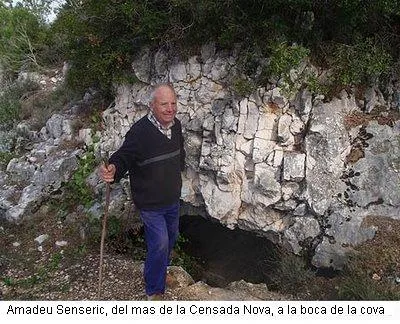
Cova de la Censada Nova
Interessant cova d'uns 265 m. de recorregut a Orpí (l'Anoia)
EspeleoWorld
Cova de la Censada Nova
Interessant cova d'uns 265 m. de recorregut a Orpí (l'Anoia)
Orpí · Anoia
Length: 265 m · Depth: 33 m
Updated record
https://espeleoworld.com/en/c/cova-de-la-censada-nova
Information can change. Always verify coordinates, access, weather, and cave conditions before setting out.
A cave of about 265 m of passage in Orpí (l'Anoia), with a single descending gallery occupied by clastic materials and no speleothems.
Topographic
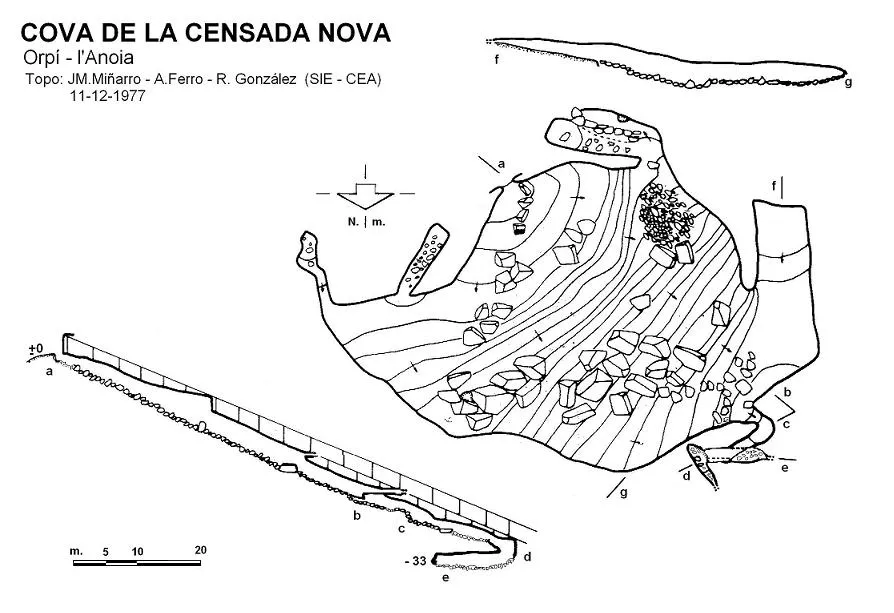

Espeleoindex · CC BY-NC 4.0, https://creativecommons.org/licenses/by-nc/4.0/ · Image © its author.
Photos

Espeleoindex · CC BY-NC 4.0, https://creativecommons.org/licenses/by-nc/4.0/ · Image © its author.
Description
Morphology
A rectangular entrance 2 by 1 metres, open at the foot of a 2-metre drop, giving way to a single descending gallery totally occupied by clastic materials. This gallery reaches a width of 55 metres at some points, and the ceiling maintains a height of between 2 and 4 metres in the central part, while on both lateral sides of the gallery the ceiling lowers noticeably and some conduits can be found that may appear independent, but are no more than stretches of the main gallery separated from it by piled-up blocks. The whole cave develops very close to the surface, and some roots can be seen hanging from the ceiling. At the final end of the gallery there is a small descending conduit between blocks, at the bottom of which the maximum depth is reached. The current morphology suggests that its genesis is due to a flow of materials favoured by the dipping of the anticline in which it is located. The substrate on which the limestones rest is made up of marls and gypsum of the Keuper, and its plasticity facilitated the displacement of the limestones. Infiltrations caused a loss of volume sufficient to trigger a collapse process, giving rise to this singular chemoclastic phenomenon.
Speleothems
The absence of reconstructive forms (speleothems) is total.
Progression
Establishing a total length in a cave of these characteristics is always somewhat subjective. J. Borràs (1982) gives it 150 metres (probably following the discontinuity criterion); other authors have estimated the length at 300 and 350 metres. If we follow the data of the 1977 survey (from which we have the data taken in situ) and follow the continuity criterion, we have that, if we add the entrance-bottom polygonal line (by the usual and logical itinerary), plus the polygonal line of the lower galleries, plus the distances from the main polygonal line to access the small lateral galleries and the length of these, the total real length gives us a result of 265 metres.
Other details
Survey and speleometry: The two published surveys of the cave do not have a plan and are simplified to a general elevation and some cross-sections. Here we attach two unpublished surveys (SIE, 1971 and 1977) which do have the plan drawn. We update the record (December 2016) by adding a hitherto unpublished survey, also with the plan, made by members of the GE Pedraforca and SE Gelera in 1973 and which has been rediscovered after 43 years in the folder of old papers by Alfred Montserrat, who has provided it to us.
History
It seems that the entrance to the cave was made in the decade of the 1920s during the work of extracting stone for the construction of the road. Josep Iglésies and Joaquim Santasusagna in their hiking guide: Les valls del Gaià, del Foix i del Miralles, Centre de Lectura, Reus (1934), mention the Cova gran de la Sensada Vella d'Orpí and say that it is about 80 metres deep, although everything suggests that they speak from others' references. On 25 March 1934, Francesc Español (possibly accompanied by Dr. Ricardo Zariquiey) visited the cave in his biospeleological research; lacking more information, they name it with the place-name of the site: Cova de la Serra de Can Virella. From the year 1949 the first visits of the GES – CMB took place and since then it has become a cave well known in the region.
Bio
Coleoptera: Troglocharinus variabilis españoli Zar. (F.Español, 25-3-1934) (formerly called Troglocharinus españoli and currently may have changed its denomination). According to what our friend Floren Fadrique tells us (February 2019), the current denomination of this beetle is: Troglocharinus (Troglocharinus) elongatus elongatus Zariquiey 1950.
User Comments (0)
No comments yet.
Be the first to share your experience!
Registered Explorations (0)
No explorations registered yet.
Register your visit to this cave!
Bibliography
- Beneito, A.; Borràs, J. (1983).- “ Dades per al coneixement d'una interessant cavitat (Cova de la Sensada)”. Sota Terra (4): 4-5. GES – CM Barcelonès.
- Montoriol, J.; Andrés, O. (1961).- “Estudio de una cavidad de origen quimioclástico”. Noticias y comunicaciones del Instituto Geológico y Minero de España (61): 235-244. Madrid.
- Coordenades, fotografies i altres dades extretes del blog: Espeleobloc (posts dels dies 20-3-2009 i 17-9-2012)
Nearby caves
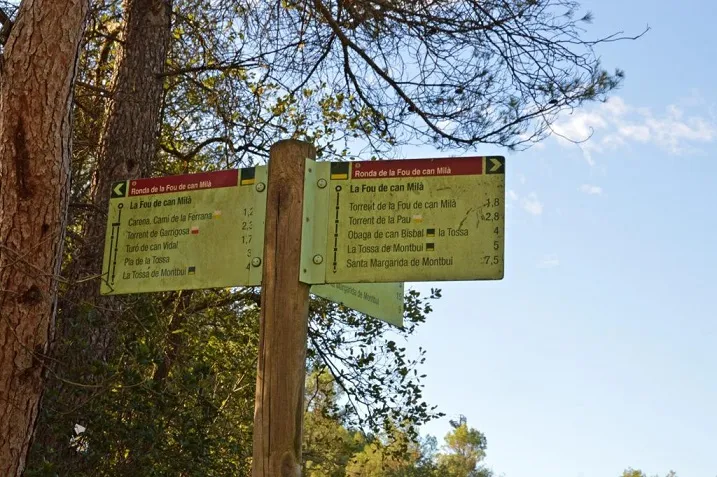
Fou de Can Milà
3.0 km · N
Santa Margarida de Montbui (Anoia)
1 topo.5 photos
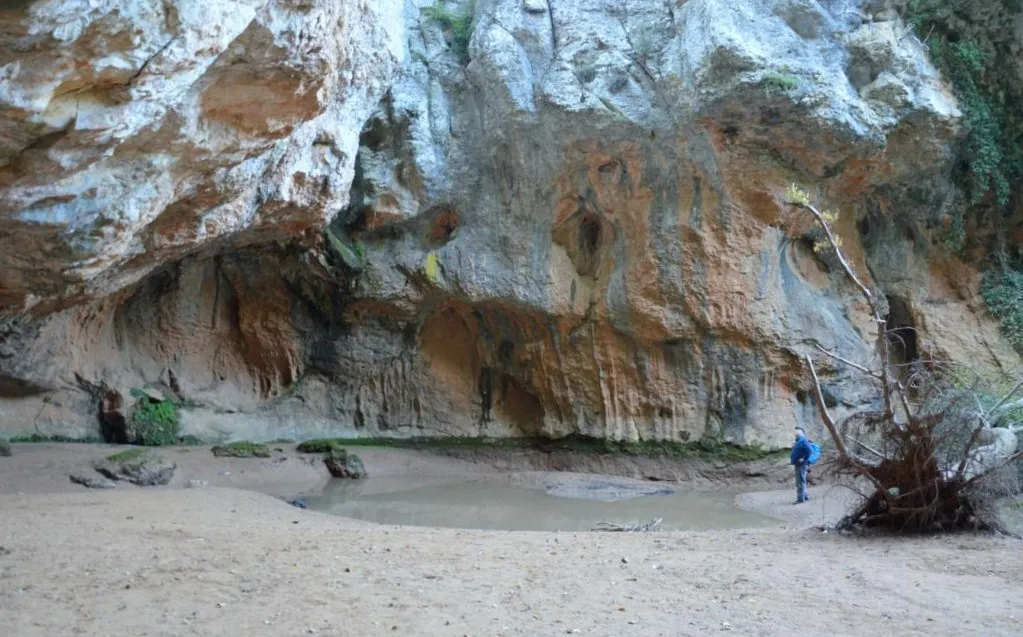
Balma de la Fou de Sant Martí de Tous
3.3 km · NW
Sant Martí de Tous (Anoia)
1 topo.2 photos
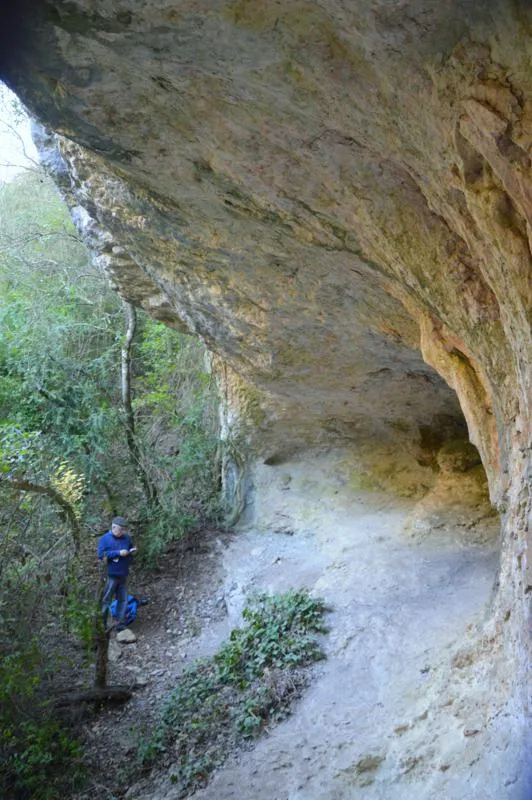
Balma Nº2 de la Fou
3.3 km · NW
Sant Martí de Tous (Anoia)
1 topo.1 photos
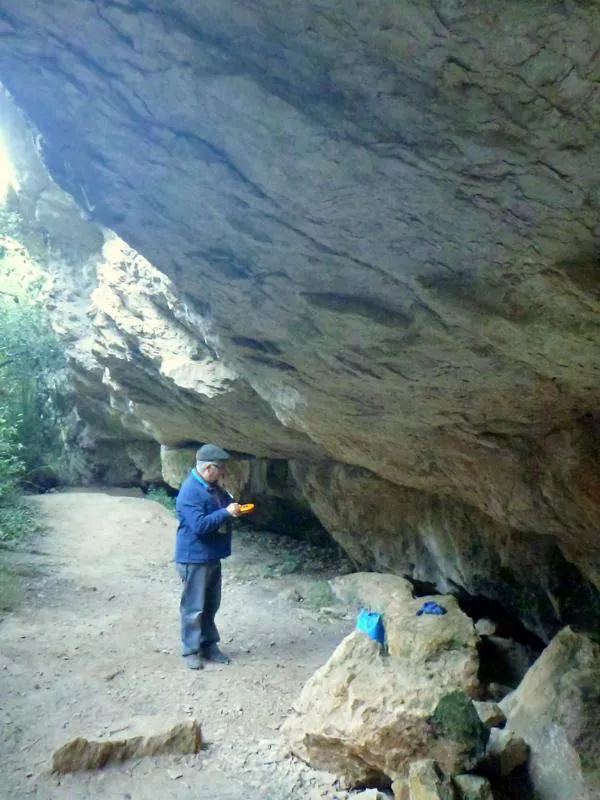
Cova del Diable
3.4 km · NW
Sant Martí de Tous (Anoia)
2 topo.4 photos
Source: Espeleoindex (espeleoindex.com), modified. CC BY-NC 4.0, https://creativecommons.org/licenses/by-nc/4.0/