
Cova de Carradon
Cova de 156 metres de recorregut a Alàs i Cerc (Alt Segre).
EspeleoWorld
Cova de Carradon
Cova de 156 metres de recorregut a Alàs i Cerc (Alt Segre).
Alàs i Cerc · Alt Urgell
Length: 156 m · Depth: 15 m
Updated record
https://espeleoworld.com/en/c/cova-de-carradon
Information can change. Always verify coordinates, access, weather, and cave conditions before setting out.
A cave with 156 metres of passage in Alàs i Cerc (Alt Segre), on the Tossal d'Obac, near Torres d'Alàs.
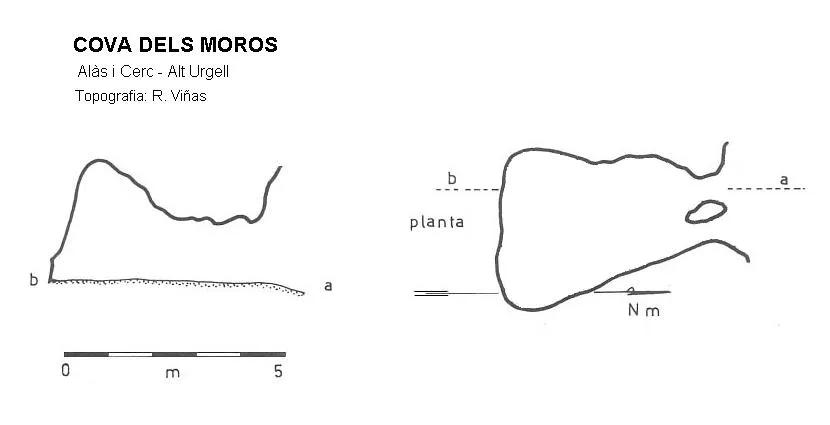
Topographic
Espeleoindex · CC BY-NC 4.0, https://creativecommons.org/licenses/by-nc/4.0/ · Image © its author.
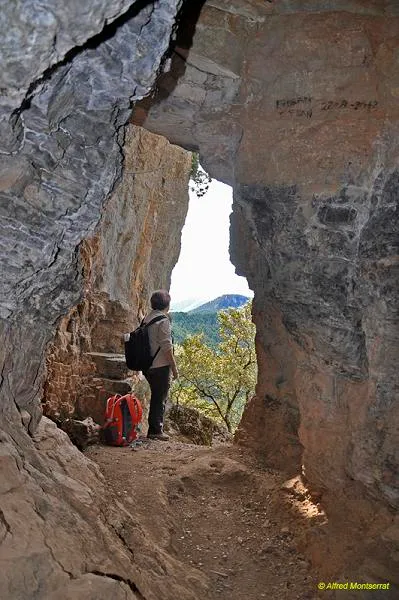
Photos
Espeleoindex · CC BY-NC 4.0, https://creativecommons.org/licenses/by-nc/4.0/ · Image © its author.
Description
Morphology
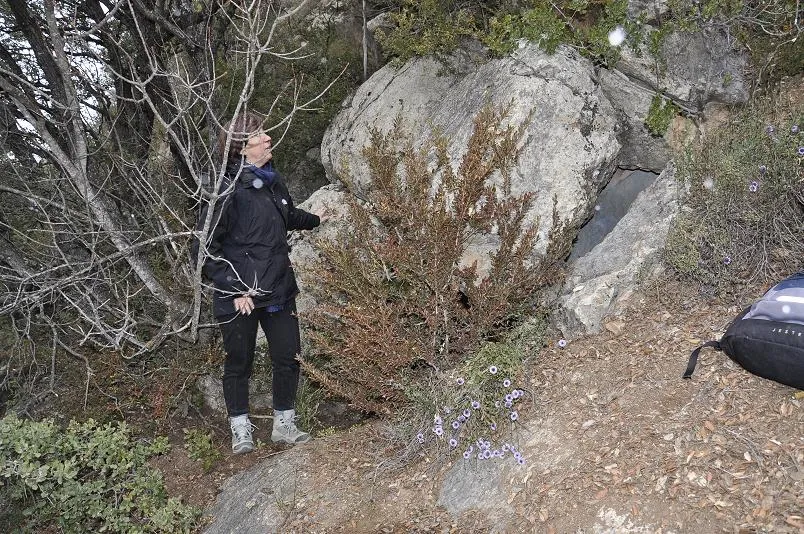
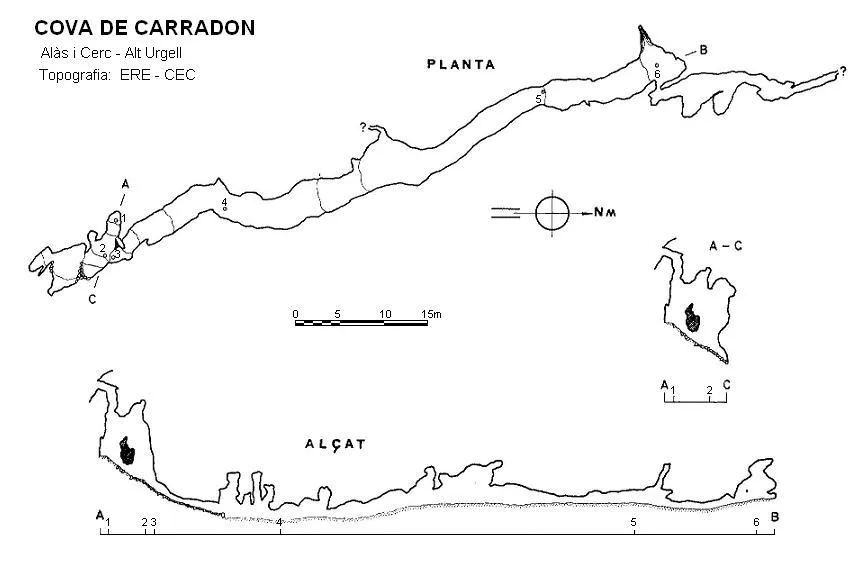
The 1.5 metre diameter entrance opens at the intersection of several fractures, which delimit large parallelepipeds of rock. A small gallery of circular section follows, leading to the entrance shaft 5 metres deep, structured on a joint of direction E20N, elongated in this same direction, and also on another joint of direction E20S, responsible for the greater development of the shaft. These two primitive cavities are still partly separated by a fairly thick rock partition that leaves a way through at the top and at the base of the shaft. This shaft leads into the main gallery and its bottom is occupied by clastic debris, which blocks the continuation in the downstream direction of the cavity; a clearance only allowed access into a chamber, being a simple stretch of gallery blocked by boulders.
The cavity follows a general NW-SE direction, the debris leaves free a narrow conduit that leads to a spacious gallery whose floor is occupied by a large quantity of bat guano, most of the year very dry.
This gallery with an average width of 3-4 metres and heights that vary between 1.5 and 4.5 metres continues towards the NW for some 70 metres; on the ceiling cavities elongated in the direction of transverse joints develop. The final stretch leads into a small high-ceilinged chamber and in the E wall we find a narrow crawl that gives passage to a parallel side gallery, separated from the previous one by a considerable deposit of clay that forms the floor and reaches to touch the lowest parts of the ceiling. After travelling 18 metres it is filled up by the same clay sediments.
Progression
In August 2019, members of the Espeleodijous visit the cave and find no impediment to accessing the innermost galleries; it was necessary to find the narrow connecting passage. They themselves explain: you must descend the shaft, continue descending along a ramp of sediments with a fairly low passage that is passed very crouched and you reach the first chamber where you again stand upright. To continue, you must turn left almost 180 degrees and pass, lying on the ground, a very low ceiling passage that is NOT obstructed, and you are already in the galleries. But if from the first chamber you continue straight on, you find another narrow passage and also low of ceiling through which you access a small chamber that is quite full of stones and which have every appearance of having been placed by hand, and here, for now, there is no continuation.
In the galleries the air was stale, with a somewhat sour and unpleasant smell, and with a lot of dust; in some points, on the ground, there was a good thickness of it.
Other details
Toponymy: The cave had always been known as Cova de Carradan, but our colleague Alfred Montserrat tells us that in the nearby village of Torres d'Alàs they call it Cova de Carrodon, which would be an old form of camp rodó. On a later visit by members of the ERE – CEC they ask again about the name of the cave and, this time, they make it very clear to them that the name would be Carredon.
Making the appropriate consultation of the Onomasticon Cataloniae by Joan Coromines, it refers to: Carradon, a district that appears in the boundary of Estamariu in the book Spill de Castellbó, (manuscript by Pere Tragó, 1519 and edited in 1982 by the monk of Montserrat, P. Cebrià Baraut). Coromines also explains that its etymology would be from Car= quer= pedra, and radon= rodó. Further up from the cave and towards the NE, the ICC cartography indicates a small hill called Pedra Rodona.
History
The only data we knew were those that appear in the book La Fou de Bor i cavitats de l'alta vall del Segre, the fruit of the campaign that the ERE of the CEC carried out in the area in the mid-1960s, very probably the exploration took place in 1966. We have no news of further explorations, except those carried out between 1983 and 1985 by a team from the Faculty of Biology of the UB to carry out a study on chiropterans.
In early March 2013 two members of the ERE – CEC visit the cave and, once the entrance shaft is passed, they find the passage barred by a block. They manage to pull it down the ramp but, when they reach the narrowest zone, they find another block of larger dimensions and in precarious equilibrium that bars their passage. The clearance seems feasible.
User Comments (0)
No comments yet.
Be the first to share your experience!
Registered Explorations (0)
No explorations registered yet.
Register your visit to this cave!
Bibliography
- Borràs, J.; Miñarro,JM.; Talavera, F: (1978).- Catàleg espeleològic de Catalunya. Vol. 1 (l'Alt Urgell i la Cerdanya): 166. Ed. Políglota. Barcelona.
- Canals, M.; Ribera, C. Viñas, R. (1970).- La Fou de Bor i cavitats de l'alta vall del Segre., 98 pp. Centre Excursionista de Catalunya – Ed. Montblanch.
- Serra, J. et. al. (1986).- “La cueva de Carradan. Refugio primaveral de una importante población de quirópteros”. Pirineos (128): 121-127. Monografías del Instituto de Estudios Pirenaicos. Jaca.
- Coordenades, situació, fotografies i altres dades facilitades per Alfred Montserrat (ERE – CEC)
- Actualització de dades i fotografies 2019 extretes de la web: espeleodijous.cat (Apunt del 3-8-2019)
Nearby caves


Source: Espeleoindex (espeleoindex.com), modified. CC BY-NC 4.0, https://creativecommons.org/licenses/by-nc/4.0/