
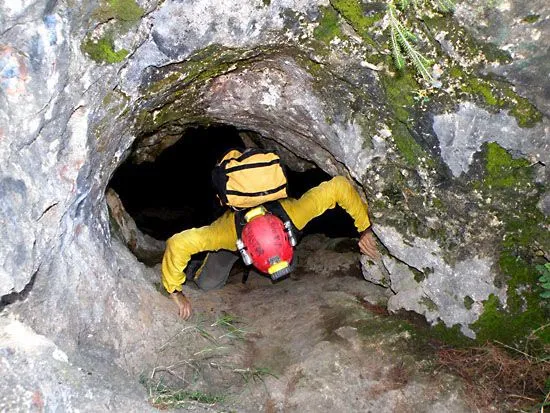
Cova d'en Merla
Conegudíssima cova de 61 m. de fondària i uns 180 m. de recorregut a Roda de Berà.
EspeleoWorld
Cova d'en Merla
Conegudíssima cova de 61 m. de fondària i uns 180 m. de recorregut a Roda de Berà.
Roda de Berà · Tarragonès
Length: 180 m · Depth: 61 m
Updated record
https://espeleoworld.com/en/c/cova-d-en-merla
Information can change. Always verify coordinates, access, weather, and cave conditions before setting out.
A pit 61 m deep with a passage of about 180 m in Roda de Berà, on the western slope of the Serra Llarga. Known since the 13th century, with visits in 1906 and 1908 and a detailed survey in 1972.
Topographic
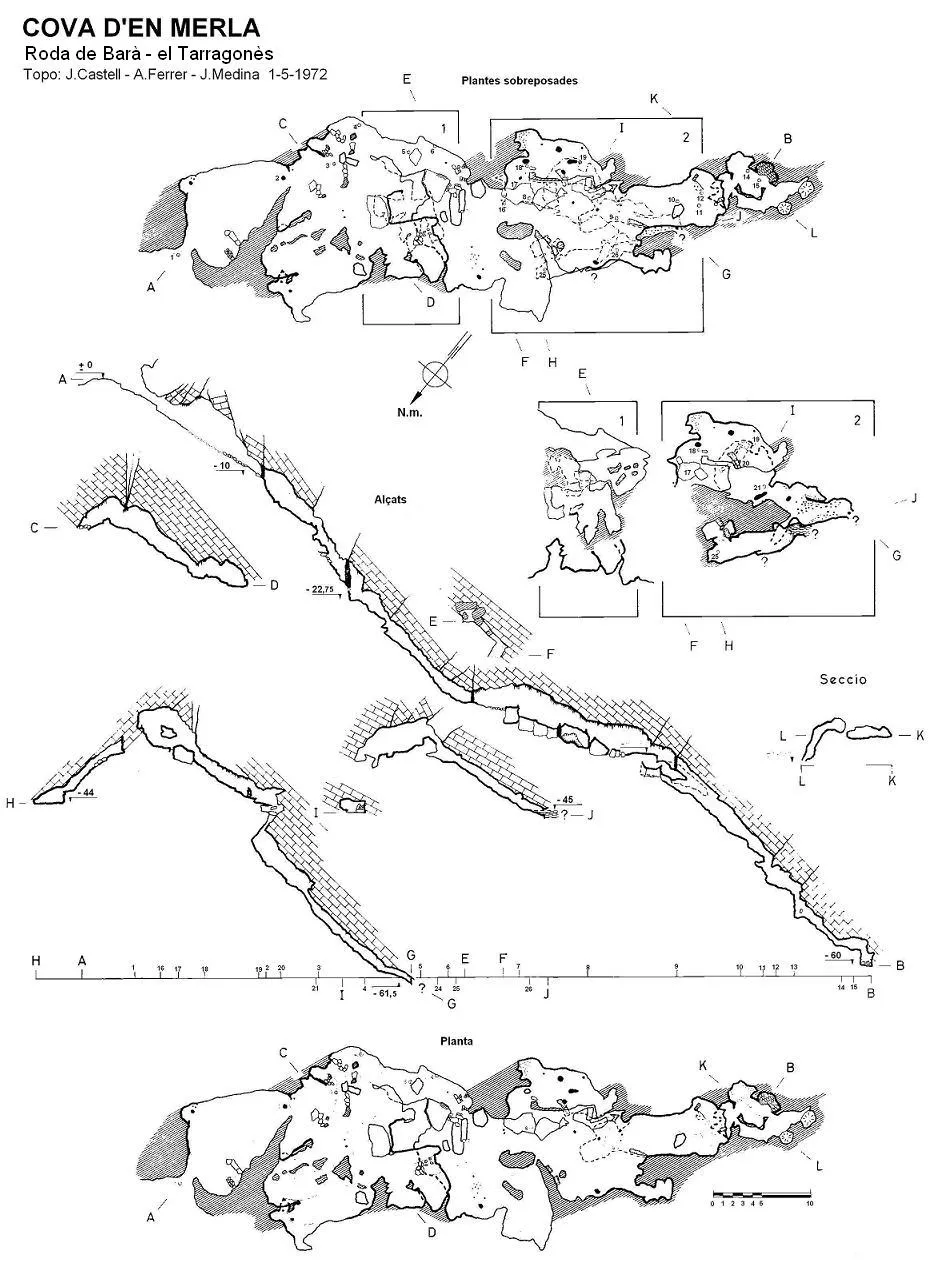
Espeleoindex · CC BY-NC 4.0, https://creativecommons.org/licenses/by-nc/4.0/ · Image © its author.
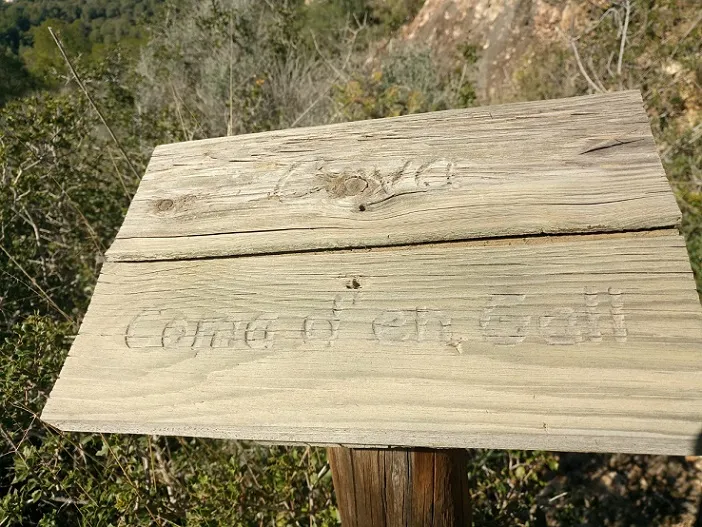
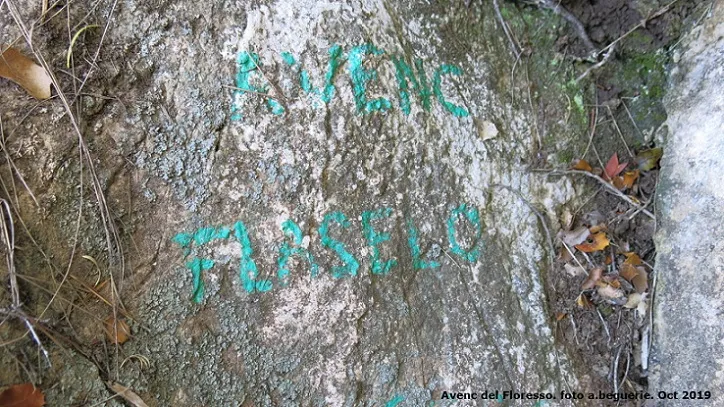
Photos
Espeleoindex · CC BY-NC 4.0, https://creativecommons.org/licenses/by-nc/4.0/ · Image © its author.
Description
Morphology
The entrance of the cavity faces N, as does the first chamber, which has a slope of 34º. Further on the direction changes, penetrating through a stalagmitic flow in what we could call the second chamber. Continuing to the left there is a ramp that descends, at the start between blocks, about 60º and then, through a stalagmitic flow that leads to a narrow passage, you reach the old Sala Blanca. From the centre of this chamber you can see, on the right, a large stalagmitic flow which behind leaves a narrow passage that gives access to a small lake where the route through this gallery ends. On the opposite side, after 7 metres of passage, you reach a narrow entrance between blocks, through which you enter the new Sala Blanca, at the end of which a narrow hole opens that allows progress for about 12 metres more until it becomes impassable.
Once back in the centre of the old Sala Blanca and at its back, you can follow through two passages to a 45º ramp that leads to what was previously the end of the cavity.
Speleothems
Stalagmitic flow in the second chamber, stalagmitic flow that leads to a narrow passage towards the old Sala Blanca, and a large stalagmitic flow in the centre of this chamber.
Hydrology
A small lake where the route through this gallery ends.
Progression
The entrance of the cavity faces N, as does the first chamber, which has a slope of 34º. Further on the direction changes, penetrating through a stalagmitic flow in what we could call the second chamber. Continuing to the left there is a ramp that descends, at the start between blocks, about 60º and then, through a stalagmitic flow that leads to a narrow passage, you reach the old Sala Blanca. From the centre of this chamber you can see, on the right, a large stalagmitic flow which behind leaves a narrow passage that gives access to a small lake where the route through this gallery ends. On the opposite side, after 7 metres of passage, you reach a narrow entrance between blocks, through which you enter the new Sala Blanca, at the end of which a narrow hole opens that allows progress for about 12 metres more until it becomes impassable. Once back in the centre of the old Sala Blanca and at its back, you can follow through two passages to a 45º ramp that leads to what was previously the end of the cavity.
Other details
The authors of the most detailed survey of the cavity (1972) state in the speleometric data that the total passage is 100 metres. At a simple glance at the survey elevation it is very clear that this estimate of the passage is very restrictive, perhaps because they considered it from the projected plan or perhaps it is a typographical error in the article published in Speleon nº 20, of which we have observed more than one throughout the text. A more rigorous speleometry could certainly appreciate a passage of more than 200 metres.
Due to the popularity of the cave, it receives a great number of visits and its condition is quite deplorable because of visitors who have no respect for the subterranean environment.
The proximity to the Tren d'Alta Velocitat tunnel means that every time a train passes, a fairly notable din is heard inside the cave.
History
Ferrer et al. (1973) say that it is already mentioned in the 13th century in the Cartulari de Sant Cugat II, p. 392, where it is said that it formed part of the ancient domains of the castle of Albinyana.
It appears in all the old catalogues (Mallada, Puig y Larraz, Font i Sagué) in which a description quite close to reality is made. Font i Sagué, in his Catàlech (1897) records two cavities with the same name, one in Roda de Barà of which he makes no comment and another in Sant Vicenç de Calders of which he gives the same description that had been made previously. There is no doubt that they are the same cavity.
Faura i Sans visits it in 1906 (he attributes 180 metres of passage to it) and two years later, in 1908, it is also visited by Joan Ferraté and his companions, making an extensive reference and sketch in his work: Espeleologia de les comarques tarragonines (Reus, 1918). In this note, Ferraté comments that the cave had been discovered about 30 years earlier (this would invalidate the 13th-century citation) and that it took its name from the malnom of the owner of the estate. This supports that the most correct name would be Cova d'en Merla, and not all the others that appear: Cova del Merla, Cova de la Merla and, even less, the most recent of all, Avenc del Merla, which appears in the citations of the Roda de Barà town council and on the ICC maps.
Archaeological work has been carried out in different stages.
Bio
Pseudoscorpions
Troglobisium racovitzai Ellingsen (Jeannel i Racovitza, 12-10-1910)
(Escolà, 7-6-1964 / 27-2-1966)
User Comments (0)
No comments yet.
Be the first to share your experience!
Registered Explorations (0)
No explorations registered yet.
Register your visit to this cave!
Bibliography
- Ferrer, A.; Castell, J.; Herrera, JA.; Albalate, A.; Medina, J. (1973).- “Datos para el estudio de la zona de Roda de Berà – Albinyana – Les Pesses” Speleon (20): 103-115. Centre Excursionista de Catalunya. Barcelona.
· Coordenades, fotografies i altres dades extretes del blog: Espeleobloc (post del 25-10-2010)
Nearby caves


Source: Espeleoindex (espeleoindex.com), modified. CC BY-NC 4.0, https://creativecommons.org/licenses/by-nc/4.0/