
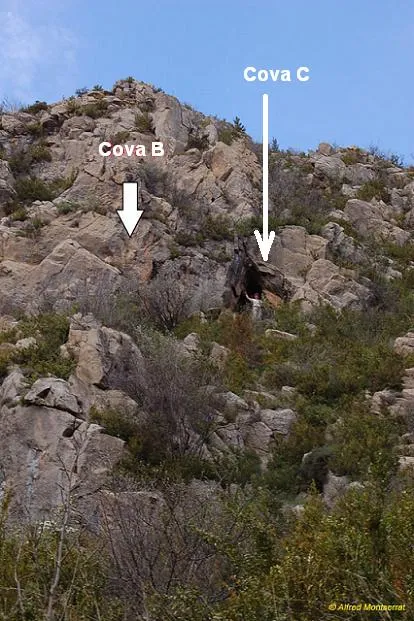
Cova B d'Olopte
Cova de 134 m. de recorregut prop d'Olopte (Isòvol).
EspeleoWorld
Cova B d'Olopte
Cova de 134 m. de recorregut prop d'Olopte (Isòvol).
Isòvol · Cerdanya
Length: 134 m
Updated record
https://espeleoworld.com/en/c/cova-b-d-olopte
Information can change. Always verify coordinates, access, weather, and cave conditions before setting out.
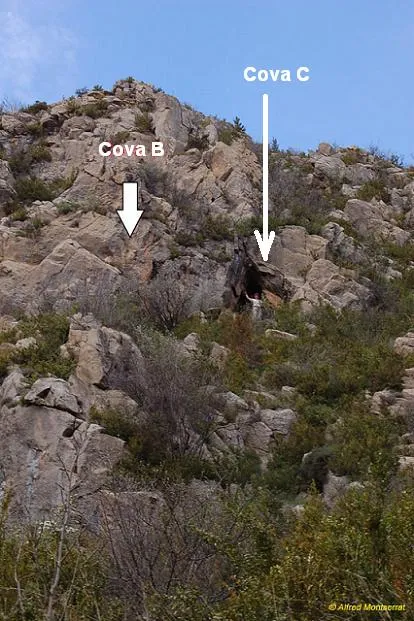
A 134 m long cave near Olopte (Isòvol), with two entrances closed in 2021 to protect the archaeological heritage. A fossil resurgence of the system of the cova Gran or cova A d'Olopte.
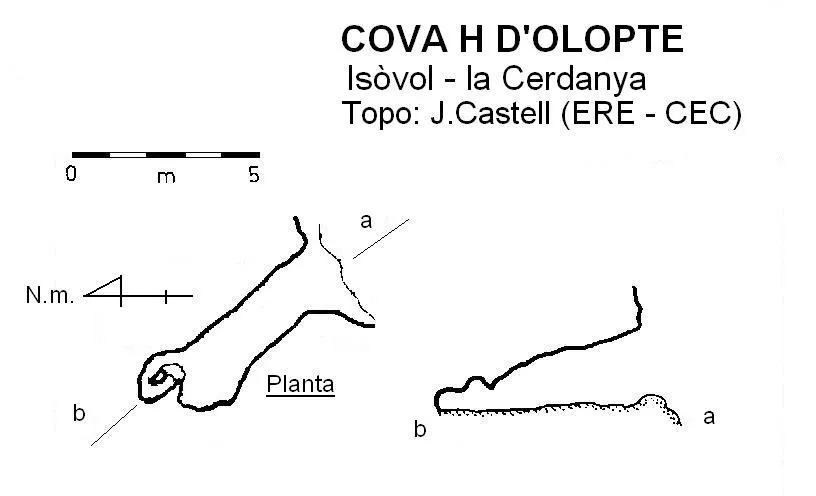
Topographic
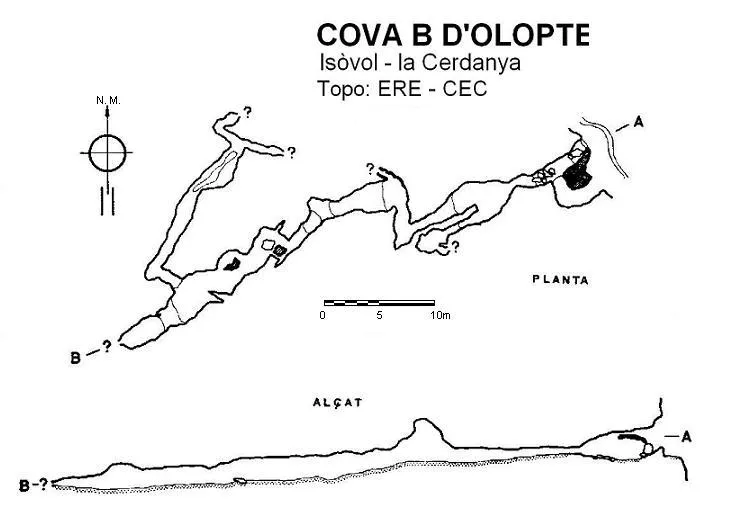
Espeleoindex · CC BY-NC 4.0, https://creativecommons.org/licenses/by-nc/4.0/ · Image © its author.
Photos
Espeleoindex · CC BY-NC 4.0, https://creativecommons.org/licenses/by-nc/4.0/ · Image © its author.
Description
Morphology
The two entrances of the cave join within a few metres into a low gallery, with the floor occupied by clayey and detrital sediments partly covered by a layer of concretion. This gallery leads into a small chamber with sediments that has a side passage to the left, structured on a parallel joint. The gallery continues with an oval lobulated section, which testifies to several phases of circulation, and leads into a high section, structured on a joint orthogonal to the general system (SW-NE). The gallery continues to be high, with beautiful dissolution formations. There are no clastic and almost no lithogenic processes until reaching a very narrow crawlway that gives way to a final small chamber, through which a perceptible air current emerges. This point is 54 metres of passage from the entrance.
About 8 metres from the end, towards the NW, a narrow gallery opens, at the base of which interesting sediments of rounded pebbles, mainly of slate and cemented sands, can be seen; after 3 metres it forms an elbow and heads to the NE, until at 17 metres it bifurcates into two short passages. The section of this gallery is oval and flattened.
Speleothems
The gallery continues to be high, with beautiful dissolution formations.
Hydrology
It is a fossil resurgence that forms part of the same drainage system as the cova Gran or “A”.
Other details
One must denounce the lamentable state in which this cave is found, 134 metres of passage and with quite interesting morphologies; unfortunately it is full of plastic bags, some still full of soil, broken light bulbs, rusty butane gas cartridges, as well as various rubbish, very probably produced by the various archaeological excavations.
History
Although the caves of Olopte have been known since time immemorial and are mentioned very much in passing in some works of a hiking and archaeological nature, it is not until the campaigns that members of the ERE – CEC carry out in a systematic way from the year 1966 to 1970 in different areas of Cerdanya, that they are widely disseminated.
The caves of Olopte have been the object of different archaeological campaigns in which various materials have been collected from the Neolithic, Bronze Age and up to medieval times.
Bio
Coleoptera
Troglophyes riberai Español
User Comments (0)
No comments yet.
Be the first to share your experience!
Registered Explorations (0)
No explorations registered yet.
Register your visit to this cave!
Bibliography
- Borràs, J.; Miñarro,JM.; Talavera, F: (1978).-Catàleg espeleològic de Catalunya. Vol. 1 (l'Alt Urgell i la Cerdanya): 166. Ed. Políglota. Barcelona.
- Canals, M.; Ribera, C. Viñas, R. (1970).-La Fou de Bor i cavitats de l'alta vall del Segre, 98 pp. Centre Excursionista de Catalunya – Ed. Montblanch.
- Valles, Jordi de (2009).-”Berguedà, Cerdanya, Garrotxa, Ripollès”. Catàleg Espeleològic de Catalunya (vol.3):1-381. EC Gràcia/FCE.
- Revisió de coordenades i fotografies facilitades per Alfred Montserrat i Mariona Vázquez (ERE – CEC). (Notesdecamp.blogspot.com) post del 20-08-2014.
- Situació, revisió coordenades i altres fotos facilitades per Juli Serrano (SIE-CEA) i Francesc Rubinat (ERE-CEC). Actualització octubre de 2021.
Nearby caves
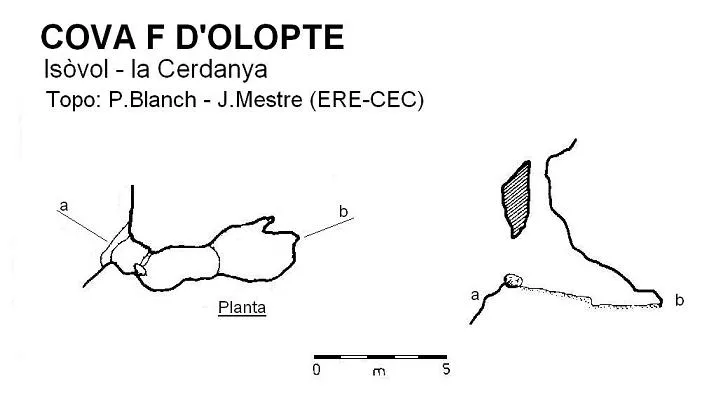


Source: Espeleoindex (espeleoindex.com), modified. CC BY-NC 4.0, https://creativecommons.org/licenses/by-nc/4.0/