
Botet de Casa Rei
A 1579-metre-long cave in Tremp, Serra de Lleràs, with a total height difference of 41 metres and a route that includes several sumps and the Sala de la Família.
EspeleoWorld
Botet de Casa Rei
A 1579-metre-long cave in Tremp, Serra de Lleràs, with a total height difference of 41 metres and a route that includes several sumps and the Sala de la Família.
Tremp · Pallars Jussà
Length: 1579 m · Depth: 41 m
Updated record
https://espeleoworld.com/en/c/botet-de-casa-rei
Information can change. Always verify coordinates, access, weather, and cave conditions before setting out.
A 1579-metre-long cave in Tremp, Serra de Lleràs, with a total height difference of 41 metres and a route that includes several sumps and the Sala de la Família.
Topographic
Espeleoindex · CC BY-NC 4.0, https://creativecommons.org/licenses/by-nc/4.0/ · Image © its author.
Photos
Espeleoindex · CC BY-NC 4.0, https://creativecommons.org/licenses/by-nc/4.0/ · Image © its author.
Description
Morphology
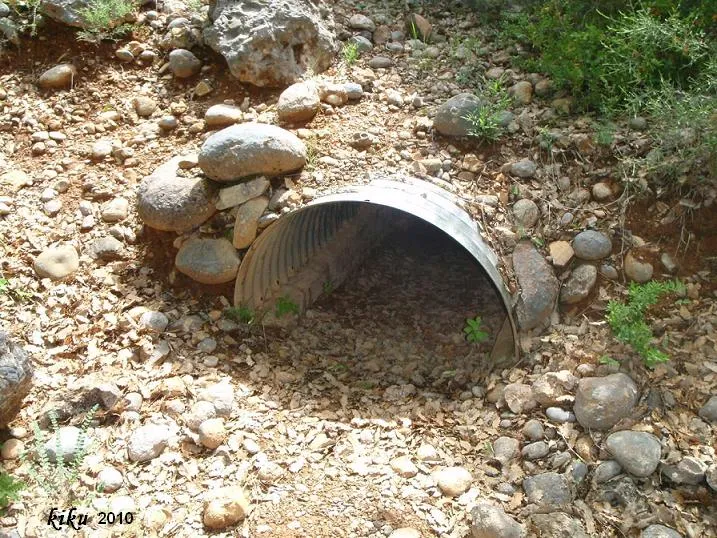
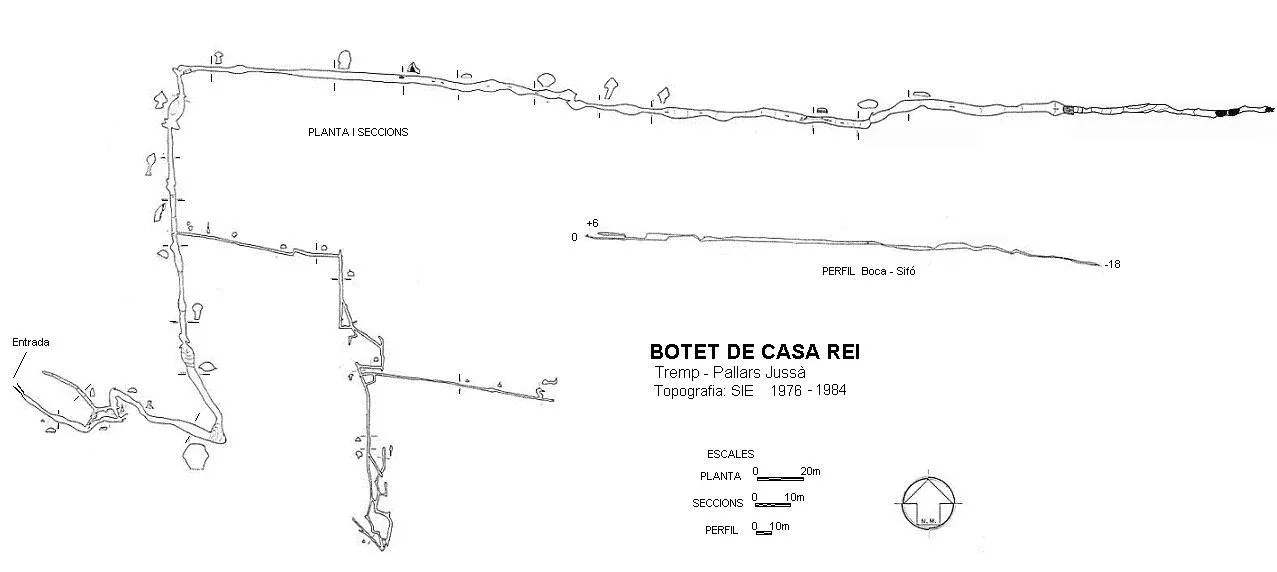
The entrance is accessible via a steel tube about 4 metres long and less than 1 metre in diameter, installed to prevent its obstruction as a result of landslides from the slope of the track that passes above the cave. Once past the tube we find a very narrow passage for a couple of metres. In the first 80 metres the gallery has reduced sections, with a subhorizontal layout, the floor presenting pebbles and lutitic materials. At 54 metres we find an ascending branch 32 metres long. At 80 the gallery widens almost suddenly, acquiring a width of 5 metres and a height of 10. This is the widest sector of the entire cave. A little further on we must overcome an ascending step of 4 metres between some flowstones; just here, the cave makes a 90-degree turn taking a N direction. After overcoming a short narrow section, the gallery continues with a height of 6 metres, which will be the general norm in a large part of the cave. We begin to find important accumulations of sand, which along the cave will alternate with rounded pebbles. At 240 metres, the cave turns sharply again at a right angle, heading towards the E. The dimensions remain similar to the previous ones, although the ceiling sometimes lowers momentarily. Sections in forced conduit are frequent, but we also observe sections in “keyhole”. Further on the cave begins to have a slightly descending layout, at the same time as it loses height and the accumulations of sand are increasingly abundant. At 540 metres from the entrance, the roof lowers and the gallery is almost covered by water. Shortly after this point we reach the first sump, where the cave was initially considered to end. This sump is 1 metre long and -2 metres deep. On the other side of the sump, the gallery continues very low and with the floor full of sand; the second sump is overcome, 12 metres long and -2 metres deep, with a low point in a descending tube of -6 metres (-18 m with respect to the entrance mouth), shortly afterwards reaching the third sump which has a length of 8 metres and a maximum depth of 2.5 metres. Once overcome, an ascending gallery continues that maintains the same dimensions and shapes as the previous stretches, then finding a very unstable descending ramp that gives way to a narrow stretch; at this point in theory we would find the fourth sump, but on the date the exploration was carried out (18-11-2017) due to the drought the passage was dry. Past this crawlway we quickly access a large chamber Sala de la Família of 11x7 metres and a height of 21 metres, making it the largest chamber of the cave. At the final part, after the chamber we find a pit of -2 metres where a new sump begins (S5). On 30-09-2018 a team of divers made up of Juanjo Gonzalez and Javier Monedero made a further push past sump number 5 and reached a new chamber “Jean Marcel Eon” where at its end a new conduit emerges that leads to a new sump, S6, pending exploration; the heavy rains at the end of the year have raised the levels making explorations impossible. The network of crawlways is located 200 metres from the entrance mouth; at this point we find on the right a small conduit that is the access to the network. This is formed by a series of rectilinear conduits with two dominant orthogonal directions, all of them of minimal sections, making their exploration very difficult. The total length of this network exceeds 400 metres. In September 2019 access is made again to try to force sump S6; the team would be made up of two divers, Juanjo González and David Martínez, which implies that logistically 4 bags must be moved for each diver; once they reached the last chamber explored the previous year Sala Jean Marcel Eon, with all the effort that this implies, on starting the exploration of S6 and at 3 metres depth they find an impenetrable laminator; after trying to clear it they decide to leave it due to the narrowness and danger it involves, since the water quickly becomes turbid with the amount of sediment it accumulates, despite the clear evidence of continuity. The rest of the team was divided into two main tasks, one to carry the material and give assistance to the diving team and the other to finish the pending work in the dry zone; thus the entire survey of the cave could be completed, including the parts that remained pending, as well as the review of all the unknowns of the crawlways, clearing some stretches such as those known as Refrigerios which had good expectations, but which finally ended in a new small stretch. The total height difference of the cave is 41 metres; this figure is obtained from the sum of the elevations (–18 and +23). The current length is 1579 metres.
History
The first incursion into the Botet de Casa Rei was made on 5 October 1975 by a team made up of members of the SIE-CEA and the ERE-CEC who, accompanied by one of the last inhabitants of Sapeira, were guided to the Botet d'Esplugafreda, that of Rejums and the Casa Rei, in which an incursion of some 250 metres was made that same day. In the following weeks those from the SIE devoted themselves to the exploration and survey of the cave, reaching a sump that temporarily closed the way. Shortly afterwards, members of the ERE were able, with underwater means, to overcome the terminal sump and reach a little more than 100 metres beyond, up to the next sump that definitively closed the way. In March 1984, on a visit made by members of the SIE, they observed that the level of the sump that had blocked their way eight years earlier presented an air chamber and in very few metres they were able to overcome it, continuing to open their way between sediments and some other flooded passage, finally reaching the last sump which does not seem, a priori, feasible to overcome. On 3 and 4 October 1992, the GELL of the CE de Lleida with the collaboration of members of the SIS of the CE Terrassa and the sponsorship of the Federació Catalana d'Espeleologia, carried out the repair of the cave entrance, since for some time it had been periodically covered by earth landslides coming from the track. A corrugated iron semi-tube was connected, well seated on a row of cemented bricks, all “lengthening” and protecting the entrance. In March 2017 the SIES began a series of interventions in order to overcome the terminal sump, having to excavate some 8 metres of sediments to be able to reach the first sump; once the passage was opened on 10-06-2017 David Martínez (Proteus) made the first push overcoming the two already known sumps and also the third, finishing the exploration in a fairly unstable ramp that gave way to a narrow stretch with signs of continuity. On 18-11-2017 two divers, Juanjo Gonzalez and David Martínez overcame the previous point where there is a very painful flooded crawlway that they were able to overcome without the diving equipment, accessing the Sala de la Família, being stopped for lack of material in a pit of -2 metres where a new sump begins. In September 2019 again, Juanjo Gonzàlez and David Martínez access sump S6, but at -3 metres depth they are stopped before a narrow passage with a lot of sediment that quickly muddies the water; this makes them give up continuing due to the danger it involves, despite the evidence of continuation. At the same time the pending points in the cave are finished being explored and the survey is completed. Toponymy: The toponym botet seems a synonym of cave or spring, very localized in this sector of the Pallars Jussà. During the first explorations, people from the area explained to the members of the SIE that it was called lo botet because when water came out through the entrance it did so suddenly and all in jumps. A much more academic explanation can be found by consulting the monumental Diccionari etimològic i complementari de la llengua catalana by Joan Coromines, going to the entry: BOTÀS and its variants BOTERA, BOTERAL, BOTANAL, BOTERN, with the sense of 'sluice', 'leap of a sluice, etc.', 'flood of a current of water', and the verb DESBOTAR, 'to overflow or discharge suddenly a liquid or any enclosed or contained mass'. Almost at the end of the entry it specifies that in the Pallars Pyrenees the word boter is used, but that its correspondent, from Esplugafreda, refers to botet and indicates the Hort dels Botets, the Barranc dels Botets and the Botet de Rejums.
User Comments (1)

April 5, 2026
Nosaltres vam anar el dia 4 d'abril del 2026 i, entre el bassal i el primer sifó (S1) de la galeria principal, hi ha una important acumulació de sorra fina que a moments d'ara impedeix arribar fins el sifó. La sorra arriba pràcticament fins a nivell de sostre (deuen haver-hi uns 10cm d'espai) i, pel que es deixa veure, sembla que el tap de sorra fa al menys 3 o 4 metres de longitud. La bona notícia és que treure la sorra sembla bastant fàcil de fer amb una pala. Nosaltres mateixos vam aconseguir obrir uns 2 metres de camí només treient sorra amb les mans, però vam desistir perquè la posició en la que t'obligava a treballar el sostre tant baix feia que la feina fos molt extenuant.
Registered Explorations (0)
No explorations registered yet.
Register your visit to this cave!
Bibliography
- Borràs,J.; Miñarro,JM.; Talavera,F.(1979).-”El Pallars Jussà”. Catàleg Espeleològic de Catalunya (Vol.3): 1-211. Ed Políglota.Barcelona.
- Cardona i Oliván, Ferran.(1989).-”La Serralada Pirinenca” Grans Cavitats de Catalunya (1):160-163. Espeleo Club de Gracia. Barcelona.
- SIE.(1976).-”Botet de Casa Rei”. EspeleoSie (18):73-81. SIE- CE Àliga. Barcelona.
- SIE.(1976).-”Novetats a la Serra de Lleràs”. EspeleoSie (27):98-100. SIE- CE Àliga. Barcelona.
- SIES A l'Avenç CC (2018).-Memòria d'activitats 2017. SIES. Esplugues de Llobregat.
- Valles, Jordi de (2008)-.”Alta Ribagorça, Pallars Jussà, Pallars Sobirà, Val d'Aran”. Catàleg Espeleològic de Catalunya (vol.1):59-62. Espeleo Club de Gràcia/Federació Catalana d'Espeleologia.
- Zapater i Barros, Valentí.(1994).-”L'ERE a Catalunya: 1972-1992”. Espeleòleg (40):22-27. ERE- CE Catalunya. Barcelona.
- Diverses fotografies extretes del blog (espeleobloc.com.es) post del dia 2-11-2010.
- Topografia i fotografies zona sifons i dades actualitzades a gener de 2019, facilitades per Pere Rodriguez (SIES l'Avenç CC).
- Dades actualitzades el juny de 2020. Topografies actualitzades i dades facilitades per Pere Rodriguez (SIES l'Avenç CC).
Nearby caves


Source: Espeleoindex (espeleoindex.com), modified. CC BY-NC 4.0, https://creativecommons.org/licenses/by-nc/4.0/