
Baumes del Borrasser
A 764-metre cave in Molló with three entrances, galleries, crawls, shafts and chambers such as the Sala d'Espera, the Sala del Llac and the Sala Juderias. Known since ancient times, with Bronze Age and Medieval remains.
EspeleoWorld
Baumes del Borrasser
A 764-metre cave in Molló with three entrances, galleries, crawls, shafts and chambers such as the Sala d'Espera, the Sala del Llac and the Sala Juderias. Known since ancient times, with Bronze Age and Medieval remains.
Molló · Ripollès
Length: 764 m · Depth: 24 m
Updated record
https://espeleoworld.com/en/c/baumes-del-borrasser
Information can change. Always verify coordinates, access, weather, and cave conditions before setting out.
A 764-metre cave in Molló with three entrances, galleries, crawls, shafts and chambers such as the Sala d'Espera, the Sala del Llac and the Sala Juderias. Known since ancient times, with Bronze Age and Medieval remains.
Topographic
Espeleoindex · CC BY-NC 4.0, https://creativecommons.org/licenses/by-nc/4.0/ · Image © its author.
Photos
Espeleoindex · CC BY-NC 4.0, https://creativecommons.org/licenses/by-nc/4.0/ · Image © its author.
Description
Morphology
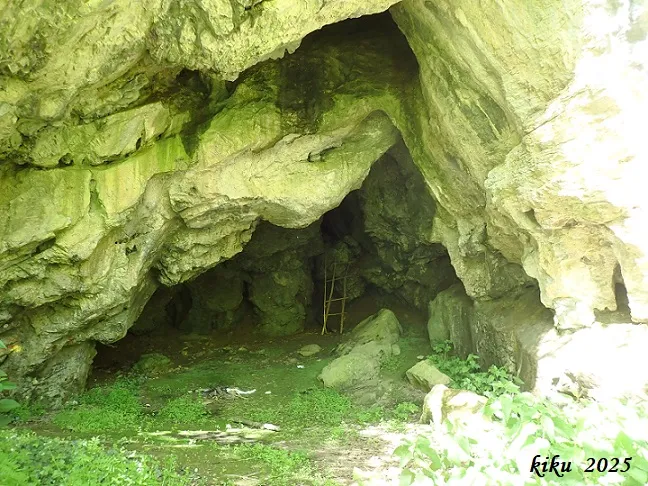
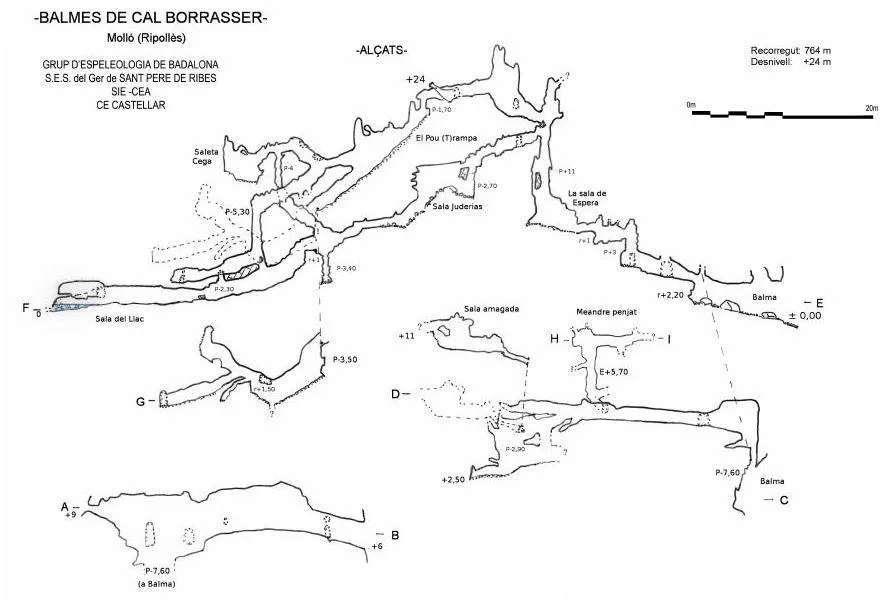
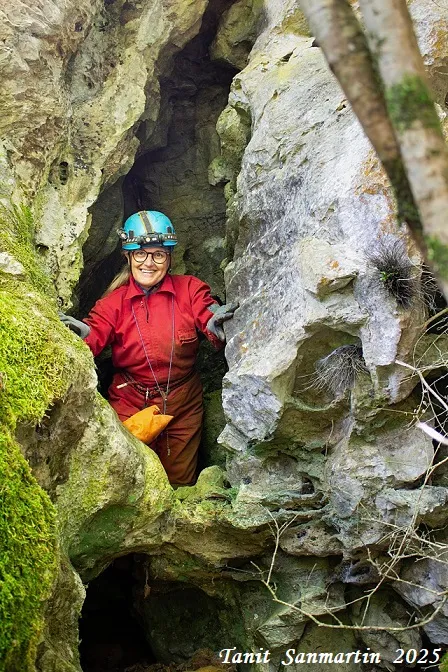
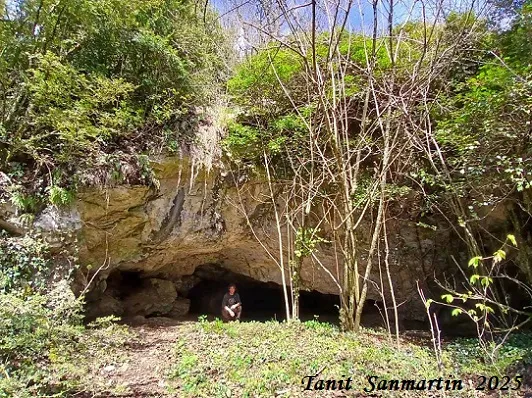
LOWER SECTOR, The cavity has three entrances, marked on the survey plan as 1, 2 and 3. The main one, number 1, is the large bauma about 10 metres wide by 4 high and about 12 metres deep, through which one can enter the system via a gallery, after overcoming an r+2.20 m; it also has a gallery hanging from the ceiling that communicates with the system and with entrance 2. If from entrance 1 we move about ten metres to the right we find the two entrances of the independent bauma. It is a small cave that does not connect with the system. About ten metres further to the right, and having overcome a slope, we reach entrance 2. This is formed by 3 entrances; we enter through the middle or main one, one metre wide and 2.80 high. We climb about 7 metres up this gallery, which suddenly turns left in a S direction. Opposite, a small meander allows us to advance about 3 metres until it becomes impracticable.
The gallery going south is of good proportions, 1.30 wide by 4.40 high. We advance about thirty metres until reaching two conduits that lead to the ceiling of the main bauma, already mentioned above. Continuing south we find a fissure on our left (P-7.60) that also drops into the main bauma. On our right, a small step (r+1.40) takes us to an interesting gallery. But if we continue forward south, we will glimpse a little light; we climb about ten metres to reach entrance 3; it is a small entrance of 20x30 cms, currently impracticable; it is really a den through which small animals enter; surely widening it a little would make the passage of the explorer feasible. Returning to the gallery of the step, after about 4 metres we find a gallery on the right that goes to join with the one coming from the (r+2.20) of the main bauma. Nine metres further on we find a crawl on the right and another on the left, both ending a few metres beyond. We continue two metres and find an ascending crawl on the right, with parietal coatings and flowstone. This crawl is key to accessing the sala d'espera from this sector. Continuing along the gallery a couple more metres we find a crawl ahead and two others to right and left; the correct one is the left one, since the other two end immediately. Through here we access a diaclase; at 3 metres we find an (r-2.90), which we descend without problems; here the ceiling is 6 metres high and the width is 0.70 metres. Continuing SE about 2.60 metres on a ramp the gallery becomes narrower, turning right and then left through crawls full of mud, for we have reached the base level of the cavity. To access the Sala Amagada, we must return to the head of the (r-2.90); from here we will see a crawl on the left, which we enter carefully. This crawl, after a turn to the right, opens into a chamber, where collapses are evident and which measures about 7 metres long by about 2 metres wide, the maximum height being 3.70 metres. At the back of the Sala Amagada we find a narrow hole through which, by patiently clearing, it would be possible to continue the exploration. Returning to the ascending crawl mentioned before, we climb it with difficulty about 6 metres; the dimensions are 0.80 wide by 1.50 high; the crawl continues, but at this point we find a chimney through which, also with difficulty, we climb 6.50 metres to access the 'meandre penjat'. The dimensions are tight, 0.50 wide by 0.90 high. At 1.40 metres it suddenly turns left; 1.50 metres further on the meander bifurcates; along the right branch the continuation forward and a shaft downwards can be seen, but it cannot be accessed. The left conduit is no larger, the narrowness of the passage preventing exploration, although it can also be seen to continue. If we return to the base of the chimney, we will find an (r-1) and continue 1.50 metres more; through a crawl of 0.50x0.50 metres we reach a small tubular shaft 0.50 metres in diameter and 1.90 deep. Having descended this (P-1.90), at 2.70 metres we find a small crawl on the left and another shaft, this one of -2.90 metres. Having descended this, we find a crawl of 1.80 metres that narrows and connects (acoustically and topographically) with another conduit of the cave that we will explain later. Returning to the crawl, this leads us to a gallery 0.60 metres wide by 1.10 metres high. If we go left 1.70 metres, we find an (r-1.90) and the crawl also continues ahead without descending the small shaft; we advance 1.60 metres; here we find on the right a crawl of 1.70 metres that becomes impenetrable. On the left we can advance a scant 1.22 metres and the crawl also closes up. Returning to the small shaft of the (r-1.90), if we descend it we find an impracticable crawl, but one that gives access to the Sala d'Espera. The impracticable crawls mentioned before may also connect with the Sala d'Espera.
Returning to the gallery, at the point where we come out of the crawl, we head right, advance 3.50 metres and turn right through a crawl 0.50 metres wide by 0.80 metres high. Three metres further on we come out into a small room through an (r-2.50). This small room has various branches that end within a few metres; it also has a crawl on the left that communicates with the Sala d'Espera, and on the right a P-3 metres that goes to the main bauma. One of these mentioned branches is the one that links acoustically and topographically with the crawl of 1.80 metres that we spoke of before.
THE SALA D'ESPERA. The Sala d'Espera is key to accessing the upper sector. The direct route to the aforementioned chamber would be to climb the (r+2.20) of the Bauma Principal; we ascend a gallery about 3 metres until intercepting the other gallery; on the left we can advance about 10 metres more. Above and to our left, and overcoming a step, we link with the gallery that we mentioned at the beginning. If we go right, we advance 2 metres to turn left and overcome an (r+0.60). Two metres further on we find on the left a window (P+3) that will take us to the small room before the Sala d'Espera. Continuing we will find a beautiful descending gallery full of gours that ends at 5 metres. Already in the Sala d'Espera, we find a space about 15 metres long by about 4 metres wide. At base level, on the left we find some crawls that link, but which are not practicable, with the crawls mentioned before. Continuing left at the very end, several clearings are made and one advances a few metres through crawls where the continuation is sensed. The most interesting part of the Sala d'Espera is the ceiling, since we are at the base of a vertical conduit that, once climbed, turned out to be a (P+11) and that gives us access to an interesting upper sector.
UPPER SECTOR. Undoubtedly the most interesting part of the cave. We will access it by climbing a (P+11). At 7.40 metres of ascent we observe a lateral route that we will speak of at the end. Having reached the head of the shaft, it widens and continues upwards 5 metres more in a dome with a question mark; we see various continuations; in a W direction we find an ascending ramp that is quite slippery and soon turns left and links with a gallery that we will describe next. To the E a gallery ends at 3 metres. We will find the continuation to the S, an ascending and muddy conduit 0.70 metres wide and 1.50 metres high; it takes us to a more comfortable transit gallery, where on the right and overcoming an (r+1.40) a crawl takes us to the ramp already mentioned that gives onto the shaft. On the right we find a small gallery one metre high by 0.80 wide that at 3 metres turns left; we advance 3 metres more until intercepting a small diaclase that on the left has an impenetrable fissure 2.30 metres long and 20 cms wide that continues downwards. Continuing along the main gallery, on the left we find a small gallery that returns to the main one after 3 metres. Further on on the left another ascending branch emerges that, zigzagging, ends at 5 metres. A few metres further on, continuing along the main gallery, we find a half-collapsed small room where we see the contact with the slates; on the right it ends at 3 metres, and on the left, at 1.50 metres we suddenly find the mouth of a shaft (the Pou T). A vertical of -2 metres places us on a slippery ramp of -45º. The descending gallery is about 2.50 metres high and 1.20 metres wide. We descend 5 metres; on the left we find a small step that gives onto an impenetrable shaft 0.15 metres in diameter. Five metres later we find a branch on the right and another on the left. Continuing downwards 4 metres, here the dimensions are 1x1 metres, we find a P-3.50. After descending, the ramp continues descending 6 metres more through a gallery 2 metres high by 0.70 wide. We reach a small room where below there is an impenetrable sink. To continue the exploration we will climb a ramp 2.60 metres and overcome an r+1.50 metres. From here, on the right a conduit ends at 2 metres. On the left, climbing about 5 metres, we find a chimney that after climbing we see has no continuation. Continuing along the main gallery, a muddy ramp that at 4 metres turns left to turn right 1.50 metres further on. The gallery is 1.10 metres high by 0.50 metres wide. It turns left again 1.50 metres further on. We advance 2.60 metres and reach a narrow final diaclase, where on the left it ends at 4 metres and on the right at 1.90 metres. We are at point G of the survey. Turning back, at the point where we found branches. If we go left (downward direction) in an E direction we find an ascending and clayey passage that ends at 7.50 metres. Beside it, and in a S direction, we find a large window that leads 3.50 metres higher to a large oval shaft of 3x2.60 metres; this shaft is inclined and connects through various windows with the lower sector that we will describe later, 11 metres further down. On the left of the shaft a mouth can be seen, which after making the appropriate handrail is found to have no continuation. The inclined shaft goes to connect with the shaft (T) further down the ramp. Turning back, at the point of the branches, if we go right, a gallery 3.20 metres high by 0.90 wide takes us on the left to a small ascending ramp that, bifurcating, ends at 2.50 metres. On the right we find a shaft one metre in diameter, and further right a muddy room. Situated in this room, on the right we will ascend a few metres through a gallery that ends suddenly. Also on the right we find a small shaft that accesses some conduits that end in narrownesses a few metres later. On the left side of the room there is a cylindrical shaft one metre in diameter. This shaft (P-4) is one of the access routes to the Sala del Llac and to the Saleta Cega. Returning to the other shaft one metre in diameter, it is a descending gallery, with some impenetrable small shafts in the floor; we will descend about 5 metres, and on the left we find a gallery that at 3.50 metres turns right, running parallel to the main one on a steep slope, and at 5 metres turns right to return to the main gallery, which on the left has an impenetrable fissure 2.30 metres long and 20 cms. wide that continues downwards. This gallery, on its left, has a couple of windows that give onto the oval shaft of 3x2.60 metres. Along the main gallery we find a P-5.30 which, once descended, leaves us in a gallery where on the left it links with the parallel one that we described before; in the floor we have a (P-3) that is impenetrable, but gives onto the lower gallery that leads to the sala del Llac. We will continue 5 metres more along the gallery and find a crawl on the left, of 0.40x0.60 metres; we advance 3 metres more and the gallery turns left to end a few metres further on. This stretch has some small crawls and diverticula without continuation. Returning to the crawl, we will pass through it and access a chamber that has a (P-2.30) which, once descended, places us in the gallery of the Llac. Going in a S direction about 8 metres we find the Sala del Llac. The chamber, with a low ceiling, is about 10x4 metres. On the right there is a small room accessed through a door, (r+08) and (r-0.60), and it is 2.20x1.50x1.30 metres. At the back of the Sala del Llac we find a water level that continues through a gallery that turns towards the O and ends at 6 metres in a narrow sink. Returning to the base of the (P-2.30) the gallery continues about ten metres until reaching an (r+1); having overcome this, on the left we find a small gallery uphill and bifurcated, which ends within a few metres. If after the step we take the right-hand gallery that goes up, we will reach a place where on the right of the gallery there is a blind shaft of -3.40 metres; on the left and overcoming an (r+2.60) we will go up through a muddy crawl about 5 metres; here we find an impenetrable small shaft, but the continuation is upwards (r+1.40); having overcome the step we reach the base of a shaft full of mud one metre in diameter. This shaft (P-4), if we come from above, is the connection that goes to the pou T(ramp). If we go to the head of this shaft, we also find a small gallery that leads us, after 2 metres and an (r-1.90), to a small room (the saleta Cega) about 4 metres long and about 3 metres high. Returning to the place of the gallery that comes from the sala del Llac and where the P-3.40 is found, having passed this, we continue along an ascending gallery about 4 metres to turn right for 1.50 metres. Here on the right, a small ascending meander becomes impracticable at 3 metres, and on the left we advance 3 metres to intercept another gallery that on its left ends at 5 metres. On the right it continues about 3 metres and, having overcome some small steps, we climb in a N direction to the Sala Juderias; the chamber is triangular, about 10x10x10 metres and about 2.40 metres high, sloping towards the E. From this chamber we will find the continuation through a small gallery hanging to the NE; we advance 1.70 metres and on the right we find a P-2.70 that returns to the Sala Juderias, and on the left, after an (r-1) and an (r+0.80), we will continue a few metres until reaching 4.50 metres from the head of the (P+11) of the Sala d'Espera, through a kind of parallel shaft, thus completing an interesting circuit. About 5 metres before this connection, if we go right we will find a shaft of about 8 metres that links with the entrance galleries of the lower zone.
Hydrology
At the back of the Sala del Llac we find a water level that continues through a gallery that turns towards the O and ends at 6 metres in a narrow sink.
History
Known since ancient times in the area, the bauma was a human dwelling for many centuries, a circumstance confirmed by finds from the Bronze Age (-1800/-650) and Medieval (400/1492). The cave is inventoried as part of the archaeological heritage of Catalonia.
Speleologically, the first mention of the cavity appears in the Catàlech (1897) by Font i Sagué, who mentions it as: la Cova, in Molló, adding that it is difficult to access.
There is no specific news until the exploration carried out by members of the GES-CMB (Ll. Muntán, J. Montoriol, and R. Pasant), who visited and surveyed it on 26 August 1953, during a brief campaign in the area; they gave it a length of 157 metres and a height difference of +15 metres.
Around 2001/2002, Pablo García, a former member of GEFOMA and who had also been Ecology spokesperson of the Catalan Federation of Speleology, and who at that time had gone to live in Camprodon, informed us that he had explored a new sector of the cavity with new galleries that gave the cave more length.
Several years would still have to pass before Josep Cuenca (GEB) and Ferran Cardona (ECG) began to explore the cavity, joined later by the SIE-CEA; C.E. Castellar; SES del GER and more members of the GEB, upon confirming that the cavity was larger than it seemed at first. In these explorations, it was verified that the lower entrances (Balma Independent) do not link with the Bauma principal, as seemed at first from the 1953 survey. Later, systematic exploration added new branches to the system, and finally the location of an old knotted rope in a small room, probably from the explorations carried out by Pablo García, facilitated access to a new and important network of galleries, which required 4 trips to complete the exploration and survey of the cavity.
User Comments (0)
No comments yet.
Be the first to share your experience!
Registered Explorations (0)
No explorations registered yet.
Register your visit to this cave!
Bibliography
Borràs, J.; Miñarro, JM.; Talavera, F.(1980).-'el Ripollès, la Garrotxa i l'Alt Empordà'. Catàleg Espeleològic de Catalunya. (vol. 4):1-296. Ed. Políglota. Barcelona.
Montoriol, J.; Muntan, L. (1963).-'Sobre la espeleogénesis de les baumes d'en Borrassé (Molló)'. Circ. CMB: 275-277. Club Muntanyenc Barcelonès.
Valles, Jordi de (2009).-'Berguedà, Cerdanya, Garrotxa i Ripollès'. Catàleg Espeleològic de Catalunya (vol.3):1-381. E C Gràcia/FCE.
Fotografies facilitades per Alfred Montserrat (ERE-CEC), aparegudes al seu blog: notesdecamp.blogspot.com
Actualització de dades, fotografies i topografies extretes del blog: espeleobloc.blogspot (Apunt del dia 1-4-2013) Text fitxa: Enric Porcel (GEB)
Actualització de dades i coordenades. Espeleoíndex, juny de 2025.
Nearby caves


Source: Espeleoindex (espeleoindex.com), modified. CC BY-NC 4.0, https://creativecommons.org/licenses/by-nc/4.0/