
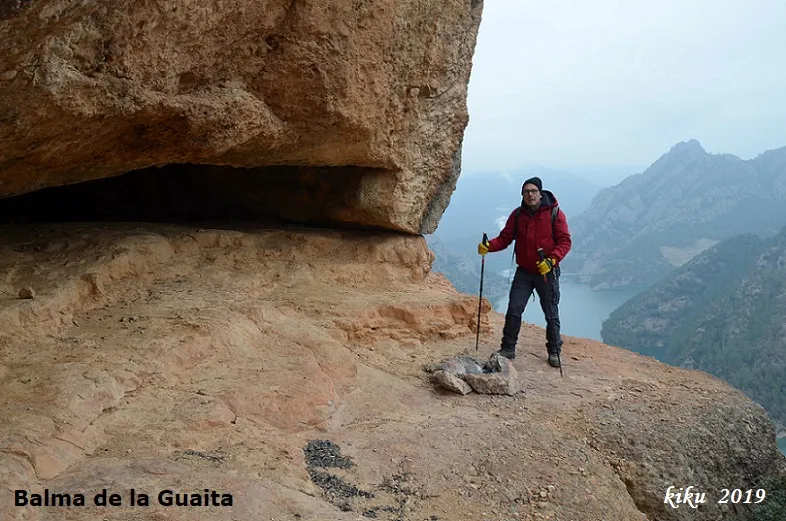
Balmes del Cingle de Lord
A group of small caves and rock shelters beneath the sanctuary of Lord, made up of 8 cavities that follow the same bedding plane.
EspeleoWorld
Balmes del Cingle de Lord
A group of small caves and rock shelters beneath the sanctuary of Lord, made up of 8 cavities that follow the same bedding plane.
Sant Llorenç de Morunys · Solsonès
Length: 15 m
Updated record
https://espeleoworld.com/en/c/balmes-del-cingle-de-lord
Information can change. Always verify coordinates, access, weather, and cave conditions before setting out.
A group of small caves and rock shelters beneath the sanctuary of Lord, made up of 8 cavities that follow the same bedding plane.
Topographic
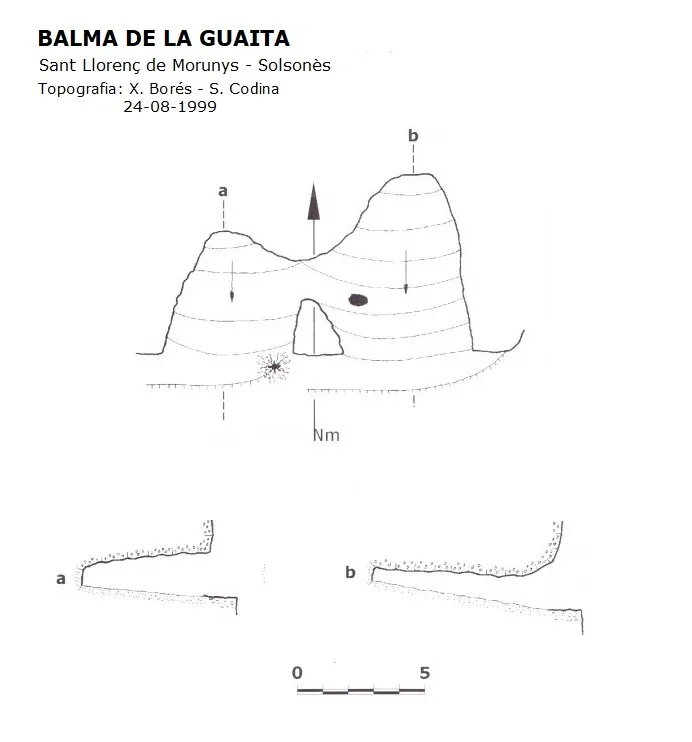

Espeleoindex · CC BY-NC 4.0, https://creativecommons.org/licenses/by-nc/4.0/ · Image © its author.
Photos

Espeleoindex · CC BY-NC 4.0, https://creativecommons.org/licenses/by-nc/4.0/ · Image © its author.
Description
Morphology
It is a group of small caves and rock shelters that are almost touching one another but independent of each other, most of them following the same bedding plane. This group is made up of 8 cavities: Balma de la Guaita, Cova del Verger, Cova de la Font, Balmes del Verger, Balma de l'Amagatall, Balma de les Cabres, Balma de l'Esquerda de Lord and Balma del Rebost. The coordinates given correspond to the Balma de la Guaita, which is the first one we find going along the path that runs along the terrace or rua where the caves are located. The route given corresponds to the longest of them, this being the Balma del Rebost.
Balma de la Guaita: It consists of two chambers joined in the middle, the more southerly one 5X5X1.5 metres, and the more northerly one 5X7X2 metres, on a slight slope. The total length is 13 metres.
Cova del Verger: A small entrance half a metre by half a metre continues as a crawl until it becomes impenetrable. It has a length of 10 metres.
Cova de la Font: At the 0.30X0.40 metre entrance we find an exterior plunge pool; the chamber is 9X3X0.4 metres.
Balmes del Verger: Four entrances. The leftmost one is the largest and has the flattest floor, with a length of 15 metres and a maximum width of 10 metres, with an entrance of 7X3 metres. The second is fairly similar to the first but smaller; one can be seen from the other, but the passage is impassable; the entrance is half blocked by fallen blocks and stones that act as a natural door. The third communicates with the second through a very low passage 0.50 metres high; it is 9 metres deep by 6 wide and has an average height of one metre. The fourth communicates with the third through two different places about 24 centimetres high respectively; it has two entrances, the one facing S measures 3X1 metres and the one facing E is 6X1 metre; the plan of the chamber is almost square (9X9 m) with an average height of 0.40 metres.
Balma de l'Amagatall: Small rock shelter 5X3X0.40 metres that serves as a hiding place.
Balma de les Cabres: Towards the left, it has a long, low chamber 9X2X0.5 metres. Behind the box trees there is a small chamber almost blocked by lithogenic formations.
Balma de l'Esquerda de Lord: It has a tetrahedral shape with a 5X5 metre plan. At the foot of the base, on the right, we find a small entrance 1.5X0.5 metres that gives access to a chamber 7X5 metres with a height of 0.80 metres.
Balma del Rebost: It consists of a single chamber 15X9 metres, with an average height of half a metre, the height of the entrance being one metre.
Speleothems
There are small lithogenic formations in the Cova del Verger. In the Balma de les Cabres, behind the box trees there is a small chamber almost blocked by lithogenic formations. The chamber of the Balma de l'Esquerda de Lord is full of lithogenic formations. In the middle of the chamber of the Balma del Rebost we find small lithogenic formations.
Hydrology
The Cova de la Font has a spring, normally dry. At the 0.30X0.40 metre entrance we find an exterior plunge pool that serves as a reservoir to collect the water that comes down as a cascade from the different small interior pools of the 9X3X0.4 metre chamber. The Balma de les Cabres has small pools. The chamber of the Balma de l'Esquerda de Lord has quite a few pools. In the middle of the chamber of the Balma del Rebost we find small pools.
Progression
Following the terrace or rua in a S direction, we reach the first of the cavities, which is the Balma de la Guaita; it opens above the path and we must go back a little to position ourselves at the entrance. From the Balma de la Guaita we return to the path that runs along the terrace in a SW direction; after a few metres and at the base of the cliff we find the small Cova del Verger. From the Cova del Verger we continue a few metres ahead where we find the spring, normally dry, on the right. We continue along the terrace a few more metres, making a turn to the right, and directly above we find the four entrances of the Balmes del Verger. From the Balmes del Verger, we follow the wall where we find a small rock shelter about 5 metres deep, situated in a triangular crack in the rock; from here we must descend to the terrace and a few metres further on, on the right, and behind a large fallen block we find the Balma de l'Amagatall. From the Balma de l'Amagatall, the terrace becomes wider and gradually turns towards the W, but the path marked with yellow paint climbs towards the Mola de Lord through a narrow and difficult gully; at this point we can observe the rock shelters on the other side of the gully on the cliff walls; we continue without a path, traversing the terrace, carefully crossing the head of a small gully that will bring us close to the foot of the wall where we find the Balma de les Cabres. From the Balma de les Cabres, we descend again to the terrace beside the cliff, and continuing a few more metres to the spot where there is a large crack in the wall, we climb up towards the Balma de l'Esquerda de Lord; it is climbed by some steps cut in the rock itself between a holm oak and a large fig tree. We descend again among holm oaks to the terrace or rua, which gradually narrows until it runs right beside the wall, and further on continues as a dangerous ramp, which is hidden by a monolith formed by two large superimposed blocks that block our way; at the point where the terrace passes beside the wall, about four metres above hangs a savin, where we find the Balma del Rebost; access is difficult since a small climb has to be made on a very broken wall.
Other details
In front of the first entrance of the Balma de la Guaita we find a hundred-year-old holm oak. The whole group of the Balmes del Verger was used to keep sheep, reaching more than a hundred; even today we find remains of xerri, which is the name given to the droppings produced by these flocks. The Balma de les Cabres has its wall covered with ivy, with a fig tree and box trees that make it go unnoticed.
History
Known and used since time immemorial. Explored and surveyed by Salvador Codina (CE Solsonès).
User Comments (0)
No comments yet.
Be the first to share your experience!
Registered Explorations (0)
No explorations registered yet.
Register your visit to this cave!
Bibliography
- Codina, Salvador (201801).-”Balmes del Santuari de Lord”. Corriol (120):10-11. CE Solsonès.
- Valles, Jordi de (2009).-”Alt Urgell, Noguera, Pla d'Urgell, Segarra, Solsonès, Urgell). Catàleg Espeleològic de Catalunya (vol.2):1-384. ECG/FCE.
Nearby caves
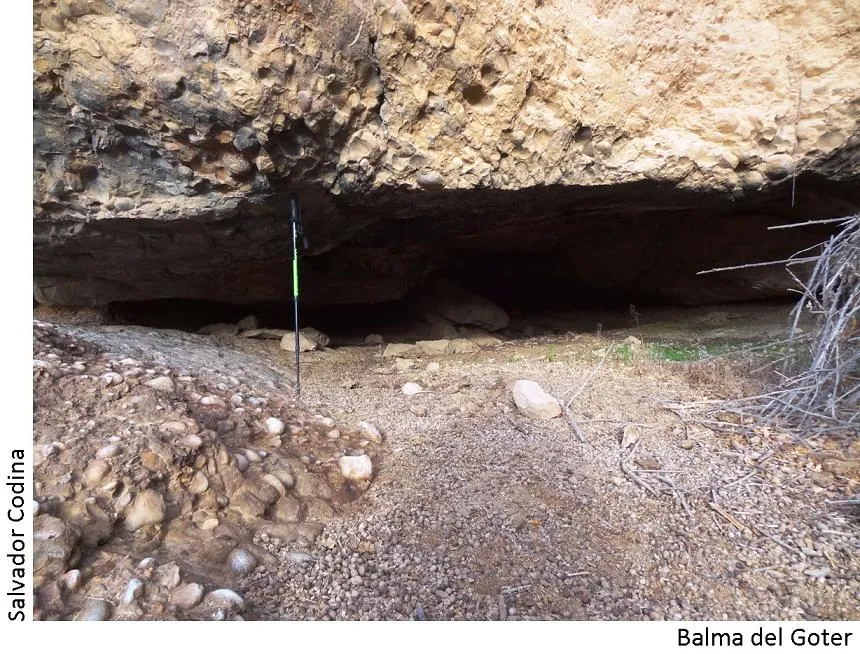
Balma del Goter
0.3 km · W
Sant Llorenç de Morunys (Solsonès)
1 topo.3 photos
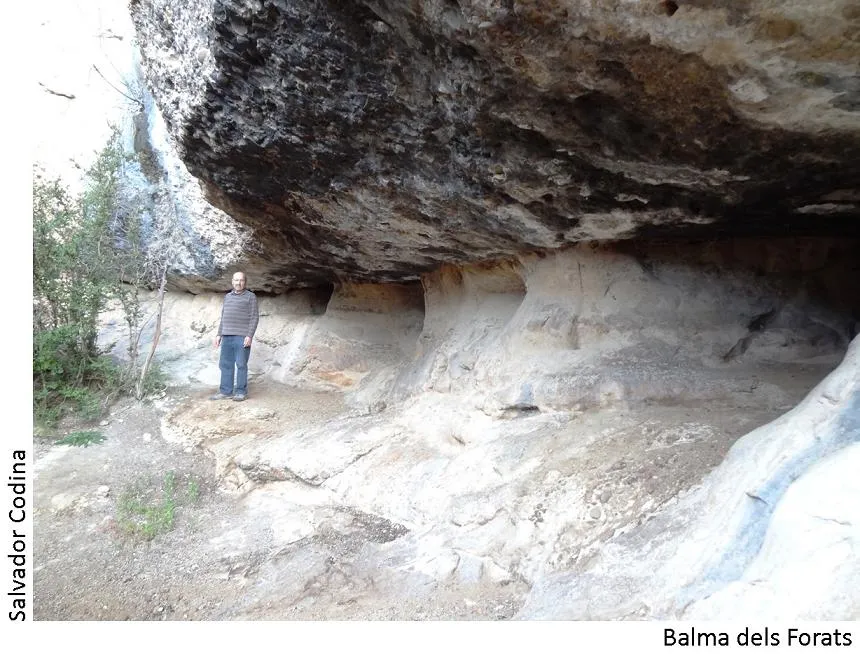
Balma dels Forats
0.5 km · W
Sant Llorenç de Morunys (Solsonès)
1 topo.3 photos
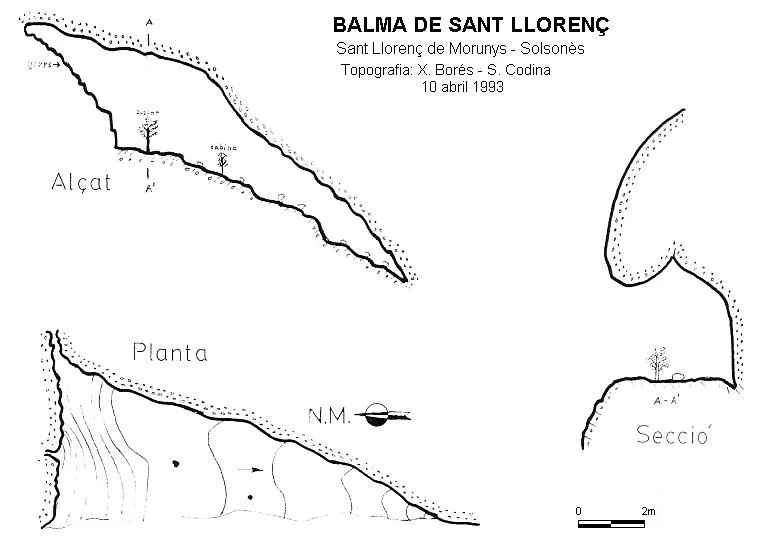
Balma de Sant Llorenç
1.5 km · NW
Sant Llorenç de Morunys (Solsonès)
1 topo.
Cova de les Esglesietes
1.7 km · W
Navès (Solsonès)
1 topo.2 photos
Source: Espeleoindex (espeleoindex.com), modified. CC BY-NC 4.0, https://creativecommons.org/licenses/by-nc/4.0/