
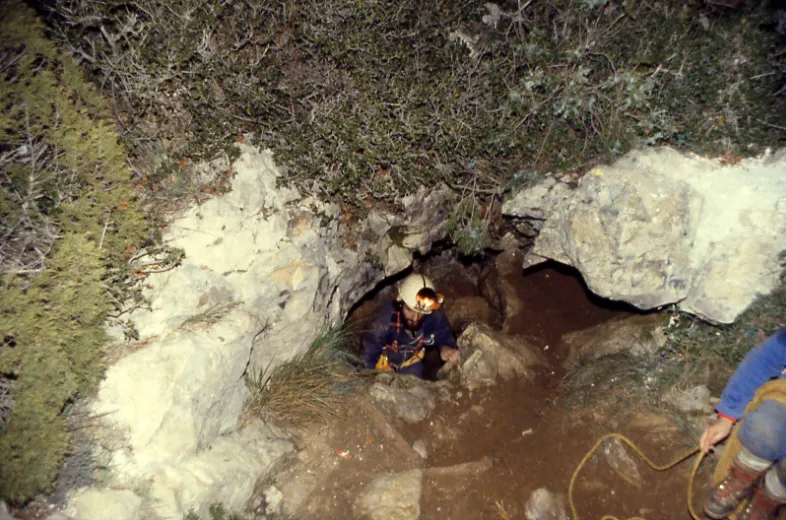
Avenc Pompeu Fabra
Avenc de 104 metres de desnivell al municipi de Vallirana.
EspeleoWorld
Avenc Pompeu Fabra
Avenc de 104 metres de desnivell al municipi de Vallirana.
Vallirana · Baix Llobregat
Length: 360 m · Depth: 104 m
Updated record
https://espeleoworld.com/en/c/avenc-pompeu-fabra
Information can change. Always verify coordinates, access, weather, and cave conditions before setting out.
A pit of 104 metres of vertical drop in the municipality of Vallirana.
Topographic
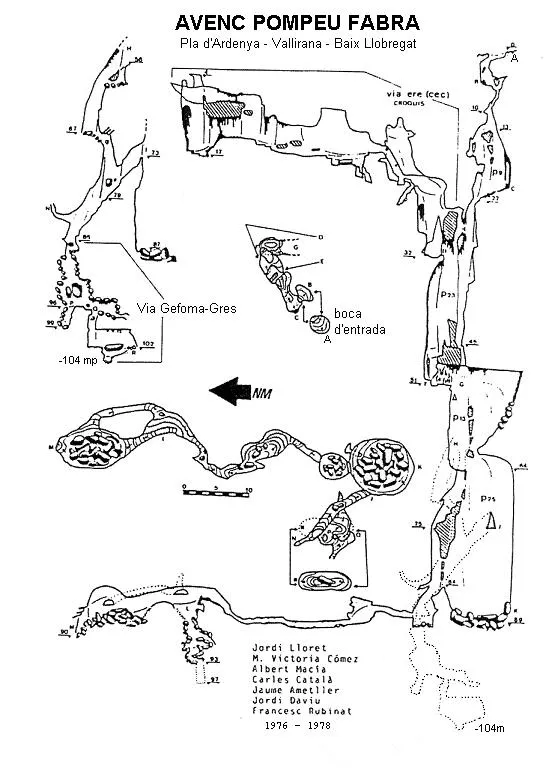
Espeleoindex · CC BY-NC 4.0, https://creativecommons.org/licenses/by-nc/4.0/ · Image © its author.
Photos
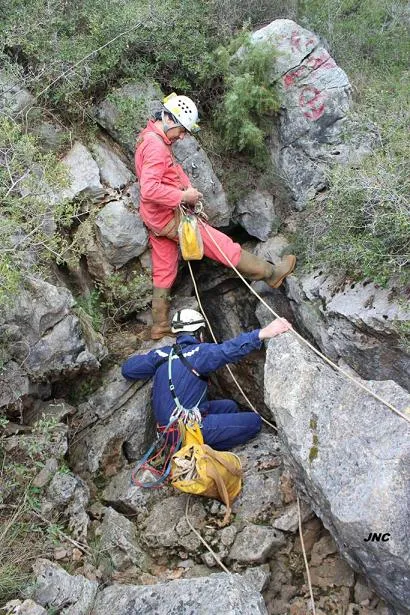
Espeleoindex · CC BY-NC 4.0, https://creativecommons.org/licenses/by-nc/4.0/ · Image © its author.
Description
Morphology
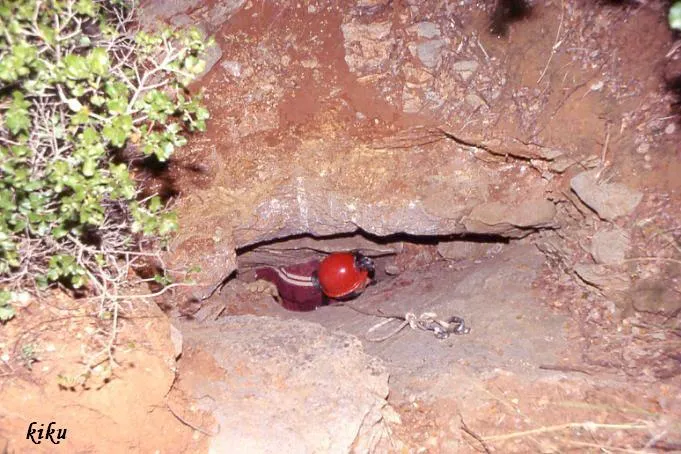
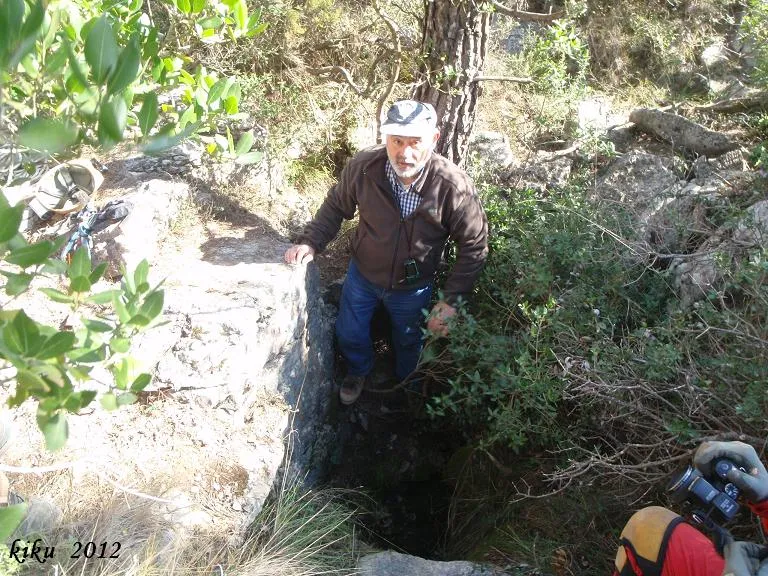
The entrance opens in the middle of the limestone pavement in a small depression. A first pit of 5 metres followed by a narrow passage and a few small drops, the last of 3 metres, lead to the first partition of pits; the more southerly one reaches 9 metres (level -22 m), joining the other by means of two vertical openings and one horizontal one. Then comes a pit of 23 metres. At the base of the pit of -23 metres there are three continuations: a small pit that ends at 4 metres, another that possibly connects with the lower cavities but that becomes impenetrable, and a third that in two drops of 2 and 4 metres gives onto a small chamber with much formation. From here a pit of 12 metres starts that places one on a balcony at -64 metres, from where the last vertical of 25 metres and up to 10 metres in diameter of this “normal” route starts. On the wall of this pit, a couple of metres below the aforementioned balcony at -66 metres a window opens that communicates with a side chamber that, after four drops of one metre each on average, leads towards another pit parallel to the one of 25 metres and that goes on to communicate with it in the upper part of the cone of debris that piles up on one of its walls 5 metres from the bottom. Going up these same 5 metres from the base of the pit and going down the vertical formed on the opposite slope, one reaches a small side chamber at -88 metres, on the wall of which, 1'6 metres from the floor, is found the entrance to a series of crawls and tiny chambers that have 64 metres of passage, ending in a chamber of 8x5 metres. A few metres before the chamber one can descend between blocks in precarious balance down to -93 metres, the end point of the “normal route”. Located again on the balcony at -64 metres and climbing about 3 metres above it one finds a chamber with much inclination, structured on the same joint as the pit of 12 metres. In this chamber there are the following continuations: a pit of 7 metres that leads to the roof of the chamber situated 2 metres below the aforementioned balcony and whose floor led to the pit parallel to the one of 25 metres; an upper entrance of this same pit, 28 metres above its floor; another small pit of 3 metres that is a dead end and almost at its side the entrance of a new vertical of 8 metres that communicates with another pit of 9 metres; after the last vertical there is a gallery with a strong inclination where at its highest part a window opens 16 metres from the floor of the pit of 25 metres. Going down the sloping gallery where there is some small drop of scant height difference, one reaches a narrow passage and after a series of openings divided by blocks one accesses a chamber at -95 metres with clay deposits, where half hidden is found the entrance of the last pit of 5'5 metres that will lead to a chamber at -102 metres; then a short descending crawl will place one at -104 metres, the point of maximum depth of the Gefoma-Sandstone route and of the cavity.
Progression
When we have descended about 5 metres of the pit of 23 metres we can make a traverse to the other side of the pit where, climbing a little, we will find a very narrow window that will give us access to the ERE route.
History
Between 1969 and 1970 members of the ERE of AEC and speleologists resident in Cervelló and Vallirana carried out a series of campaigns during which they discovered this cavity. Later the ERE of the CEC located and explored the ERE route. In 1976 the GEFOMA and the GRES located and explored the deepest route of the cavity. In the proceedings of the II Symposium of speleology a survey is published in which the authors attributed -120 metres to it.
User Comments (0)
No comments yet.
Be the first to share your experience!
Registered Explorations (0)
No explorations registered yet.
Register your visit to this cave!
Bibliography
- Lloret Prieto, Jordi (1978).-“L'Avenc Pompeu Fabra” SIS (6):6-11. SIS-CET. Terrassa.
- Rubinat, F.(1978).-“Avenc Pompeu Fabra” GOURS (5):47-51. GEFOMA. Barcelona.
- Rubinat, F.(1980).-“Avenc Pompeu Fabra” GOURS (7):43-45. GEFOMA. Barcelona.
Nearby caves
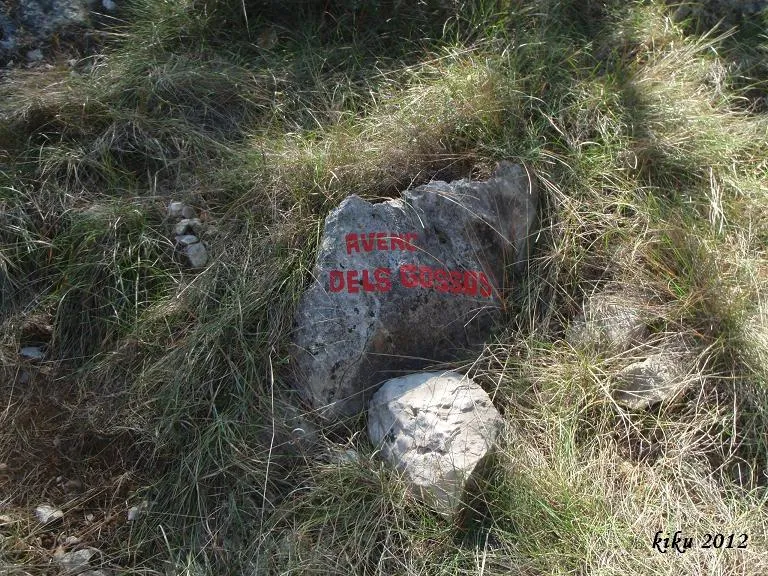


Source: Espeleoindex (espeleoindex.com), modified. CC BY-NC 4.0, https://creativecommons.org/licenses/by-nc/4.0/