
EspeleoWorld
Cueva del Piscarciano
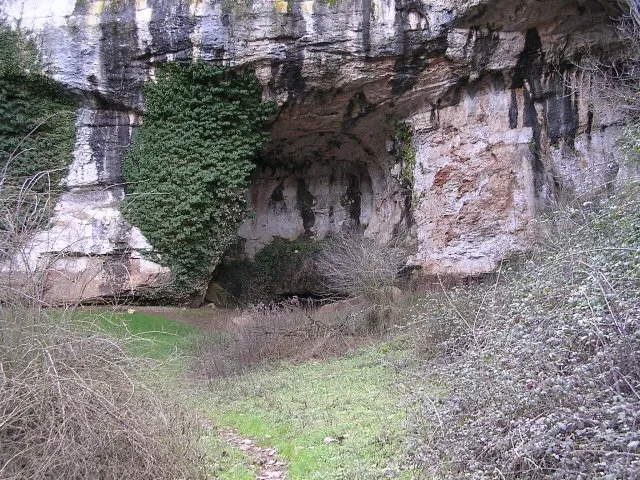
Cueva del Piscarciano, in Hoz de Arreba (Valle de Valdebezana, Burgos): an almost horizontal cavity with about 13.4 km surveyed, the largest of a complex that includes the Cueva de Las Vacas and Cueva de Las Arenas.
Valle de Valdebezana
Länge: 13430 m · Tiefe: 101 m
Aktueller Datensatz
https://espeleoworld.com/de/c/cueva-del-piscarciano-valle-de-valdebezana
Informationen können sich ändern. Koordinaten, Zugang, Wetter und Höhlenbedingungen vor dem Aufbruch immer prüfen.
Cueva del Piscarciano, in Hoz de Arreba (Valle de Valdebezana, Burgos): an almost horizontal cavity with about 13.4 km surveyed, the largest of a complex that includes the Cueva de Las Vacas and Cueva de Las Arenas.
Topografie
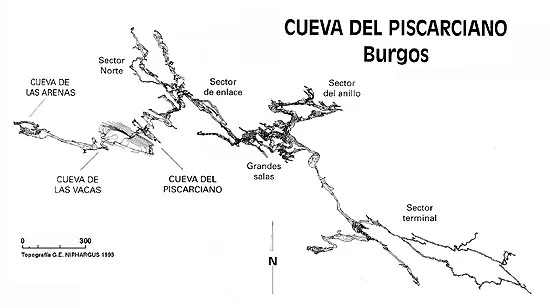
© Grupo Espeleologico Niphargus · CC BY-SA 3.0, https://creativecommons.org/licenses/by-sa/3.0/ · Grottocenter: piscarciano · https://grottocenter.org/ui/documents/15322
Fotos
© Grupo Espeleológico Niphargus · none-stated · Grupo Espeleológico Niphargus · https://www.niphargus.net/piscarciano_vacas_arenas.htm
Beschreibung
Morphologie
The cave is divided into six sectors according to the Grupo Niphargus: Entrada, Norte, Enlace, Grandes Salas, Anillo and Terminal. The Terminal sector contains more than 2 km of narrow passages. Named places include the Galería del Cristal, the Laberinto de los Balcones, the Laberinto de la Cuerda, the Sala de los Gigantes and the Gran Cañón.
It opens in Upper Cretaceous limestone (Coniacian–Turonian). The development is almost entirely horizontal, with wide galleries and large chambers.
Relative to the entrance, the vertical range goes from about -25 m to about +80 m, with an average of about +20 m.
Speläotheme
There are areas with flowstone, stalactites and helictites, such as the Galería del Cristal, and large chambers with mud, sand and gravel fills. In the survey by the exploring group, chambers covered by deposits of periglacial origin can also be seen.
Hydrologie
The Cueva de Las Vacas is usually the sink of the system and the Cueva de Las Arenas its usual spring. The cueva del Piscarciano, by contrast, functions as a spring during most of the year, except at low water.
According to Wikipedia, the río de las Hoces rises in this cave and flows into the Trifón. The main sump is the upstream end of the river and divers have not passed it.
The water comes from the infiltration of rain on the Cubillos del Rojo plateau and on the heights surrounding Hoz de Arreba. With very heavy rain the Hoya de Piscarciano floods, because water comes out of the cave. The flow varies greatly with the season.
Befahrung
Visiting the cave requires permission, because the entrances are protected as an archaeological site.
It is a large cave with mud. The water level and the time of year strongly influence any trip, and some passages require getting completely wet.
The Grupo Edelweiss notes that with little water only part of the cave can be explored. It adds that, after a recent flood, there is more mud at the entrance.
Weitere Einzelheiten
The figures depend on what is counted. The 2003 record gives 13430 m for the cueva del Piscarciano on its own. The 1993 survey by the Grupo Niphargus and the Federación de Castilla y León record give 14552 m and 105 m of vertical range for the complete complex, with Las Vacas and Las Arenas. A tourist guide gives 14300 m without a date. What is known about the origin of the name is a legend: a bandit nicknamed Piscarciano is said to have hidden in these caves, although the Grupo Niphargus señala that no documents prove it. The nearby Trifón spring was cleared by this group in September 2002.
Geschichte
The first known account is from 1927 and describes a trip to the cueva de Las Vacas. In 1961 a local newspaper reported the visit of speleologists from Bilbao.
The Centro Excursionista de Alcoy began work in 1968 and returned in 1971 and 1972. In July 1970 an expedition from the University of Lancaster made the first extensive survey, which remained incomplete because of a flood. In 1973 the national camp "Piscárciano-73" was held. In 1974 a team from Levante and Málaga surveyed the final gallery.
The Grupo Espeleológico Niphargus, of Burgos, has directed exploration since 1975. In 1984 it began a new survey. Between 1985 and 1986 the surveyed length exceeded 10 km. In 1987 it organized a national camp. In 1988 the survey was finished, with more than 13 km. In 1990 it considered its work concluded and in 1995 it published a monograph on the complex.
The diver Fidel Molinero attempted the main sump in 1994 and 1998 and stopped at 18 m. In 2009 a team advanced 25 m through a bedding-plane squeeze in the Terminal sump.
Benutzerkommentare (0)
Noch keine Kommentare.
Seien Sie der Erste, der seine Erfahrung teilt!
Registrierte Erkundungen (0)
Noch keine Erkundungen registriert.
Registrieren Sie Ihren Besuch in dieser Höhle!
Höhlen in der Nähe


Enthält Informationen aus Grottocenter (Wikicaves), grottocenter.org, bereitgestellt unter der Open Database License (ODbL 1.0, https://opendatacommons.org/licenses/odbl/1-0/), verändert. · https://grottocenter.org/ui/entrances/19923 · Datenstand 2026 · Text von Espeleoworld aus öffentlichen Quellen verfasst. Bitte frag uns, bevor du ihn weiterverwendest. · Text von Grupo Espeleológico Niphargus (El complejo kárstico de Piscarciano – Vacas – Arenas), Grupo Espeleológico Edelweiss (Cuevas del Piscarciano y Las Vacas), José Mari Rey García (recopilación) (Piscarciano (Burgos)), Federación de Castilla y León de Espeleología (Ficha de cavidad C. Kárstico Piscarciano-Vacas-Arenas), Roberto F. García (Cueva de Piscarciano. Exploración del Sifón Principal), Wikipedia (Valle de Valdebezana (Wikipedia, es)), Loreto Wallace (Cueva de Piscarciano (2 al 11 agosto 1974)), Burgos sin irnos lejos (Las Palancas y la cueva del Piscarciano) · bearbeitet von Espeleoworld (normalisiert, übersetzt); die Bearbeitung steht unter der Lizenz Our own text, written from public sources. Please ask us before reusing it. · Die abgeleiteten Daten sind auf Anfrage unter der ODbL erhältlich: [email protected]