
EspeleoWorld
Coves d'Arta
The Cuevas de Artá is a cave with a huge entrance portal and chambers including the Pilar Chamber, the Salon de la Reina de las Columnas with its 25 m high stalagmite, and Hell.
Capdepera
Länge: 450 m
Aktueller Datensatz
https://espeleoworld.com/de/c/coves-d-arta-capdepera
Informationen können sich ändern. Koordinaten, Zugang, Wetter und Höhlenbedingungen vor dem Aufbruch immer prüfen.
The Cuevas de Artá is a cave with a huge entrance portal and chambers including the Pilar Chamber, the Salon de la Reina de las Columnas with its 25 m high stalagmite, and Hell.
Fotos

The original uploader was Pr at German Wikipedia. · Public Domain Mark 1.0, https://creativecommons.org/publicdomain/mark/1.0/ · Wikimedia Commons · https://commons.wikimedia.org/wiki/File:Covesdarta.jpg
Beschreibung
Morphologie
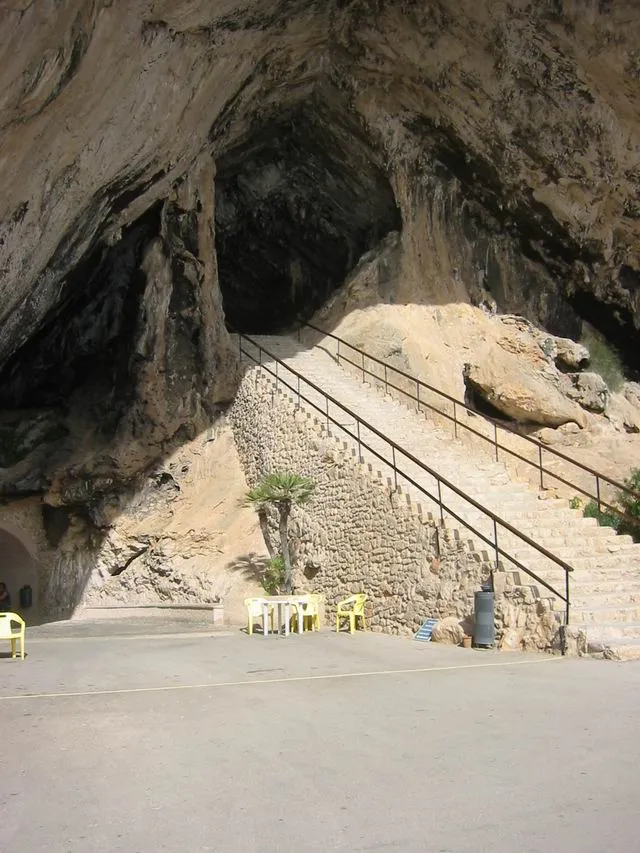
The Cuevas de Artá has a huge entrance portal, a long stone staircase leads up to the cave entrance. The cafeteria and ticket office were built inside the huge portal. After entering the cave, the first chamber is called Entrance Hall or Antechamber. A stone staircase leads down to the floor, a trail leads to the next chamber called Pilar Chamber, because of the huge number of stalagmites. At the other end is the passage leading to the Salon de la Reina de las Columnas (Chamber of the Pilar Queen). It was named after the huge, 25 m high stalagmite in the middle.
Speläotheme
The most beautifully decorated chamber is called Hell. It has all kinds of speleothems including stalactites, stalagmites, and draperies. Several more chambers are part of the tour, like the Theatre, the Mallorcan Artisans, and the Chamber of the Bells. The last was named after the bell like sound the stalactites here produce, when they are hit with a stick.
Hydrologie
This cave was formed by brackish water corrosion, a special form of mixture corrosion. The salt water entering the cracks in the rocks from the sea mixes with the sweet water from the ground water body. Where it mixes the ability of the water to dissolve limestone increases. As a result the cave formation is rather fast along the coast.
Weitere Einzelheiten
In 1941 a British society tried to buy this stalagmite for GBP 25,000.
Geschichte
The Cuevas de Artá are known for a long time and were used as show caves since the 19th century. The cave was visited by numerous famous people, Jules Verne, Victor Hugo, Alexandre Dumas and Sarah Bernhardt are listed in its guestbook.
Benutzerkommentare (0)
Noch keine Kommentare.
Seien Sie der Erste, der seine Erfahrung teilt!
Registrierte Erkundungen (0)
Noch keine Erkundungen registriert.
Registrieren Sie Ihren Besuch in dieser Höhle!
Höhlen in der Nähe
Enthält Informationen aus Grottocenter (Wikicaves), grottocenter.org, bereitgestellt unter der Open Database License (ODbL 1.0, https://opendatacommons.org/licenses/odbl/1-0/), verändert. · https://grottocenter.org/ui/entrances/32786 · Datenstand 2026 · Quelle: Show Caves of the World (Jochen Duckeck) (www.showcaves.com), verändert. CC0 1.0, https://www.showcaves.com/english/TermsOfUse.html Show Caves of the World (showcaves.com), Jochen Duckeck · Text von Jochen Duckeck (Cuevas de Artá) · bearbeitet von Espeleoworld (normalisiert, übersetzt); die Bearbeitung steht unter der Lizenz CC0 1.0, https://www.showcaves.com/english/TermsOfUse.html · Länge, Namen, Beschreibung · abgerufen am 2026-11-21 · Datenstand 2026 · Die abgeleiteten Daten sind auf Anfrage unter der ODbL erhältlich: [email protected]