
EspeleoWorld
Cueva de los Murcielagos
The Cueva de los Murciélagos in Córdoba, Spain, is the largest cave in the province, home to an enormous number of bats and known for its imposing stalagmites and Neolithic rock paintings.
Zuheros
长度: 3300 m · 深度: 65 m
最新资料
https://espeleoworld.com/zh/c/cueva-de-los-murcielagos-zuheros
信息可能会变化。出发前请务必核对坐标、通行情况、天气和洞穴状况。
The Cueva de los Murciélagos in Córdoba, Spain, is the largest cave in the province, home to an enormous number of bats and known for its imposing stalagmites and Neolithic rock paintings.
照片

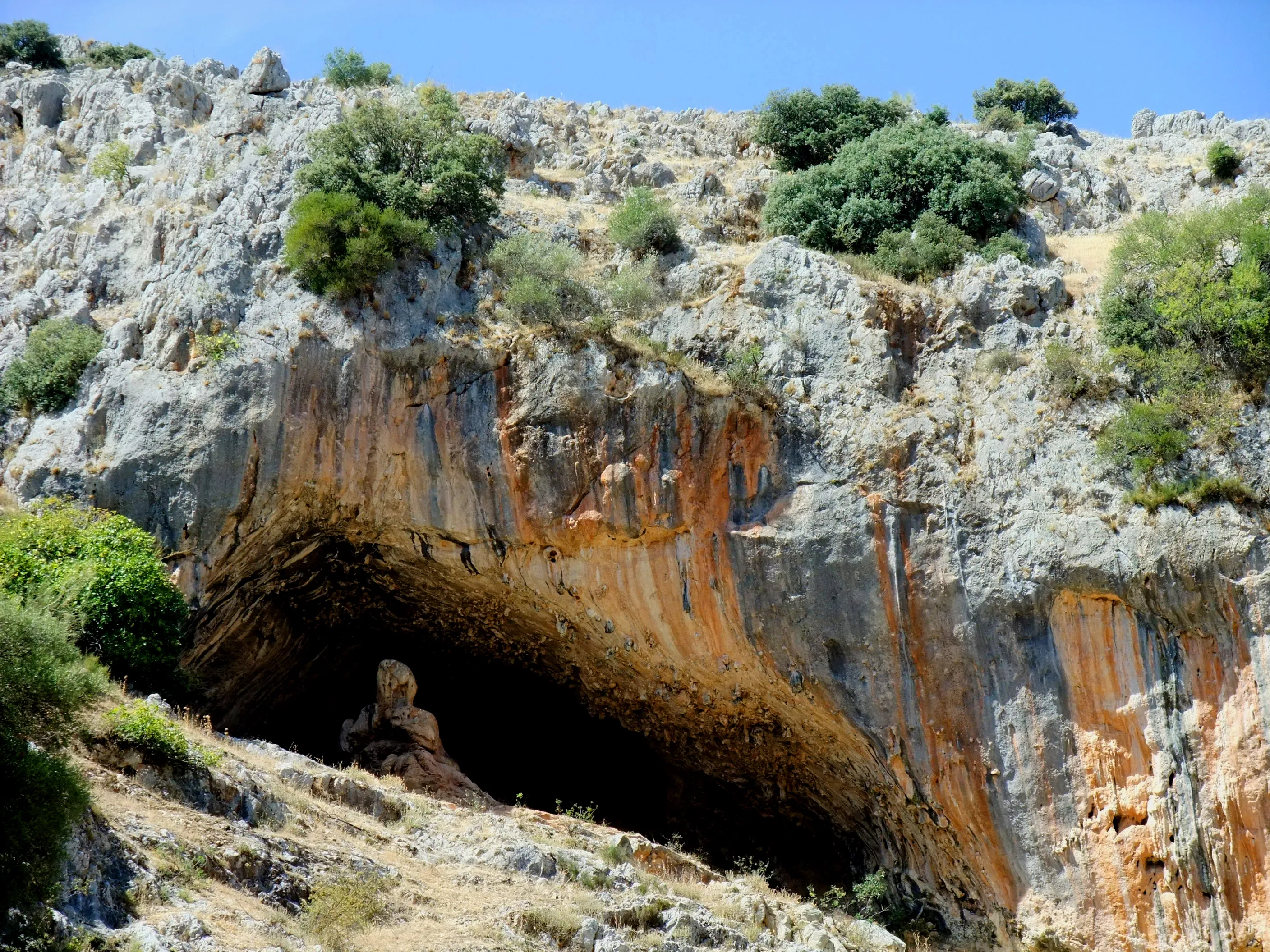
© Nikater · CC BY-SA 3.0, https://creativecommons.org/licenses/by-sa/3.0/ · Wikimedia Commons · https://commons.wikimedia.org/wiki/File:Auge_des_Mauren01.jpg
描述
形态
The extensive cave is the largest cave in the province of Córdoba. The entrance section of the cave is called Vestíbulo de la Cueva Grande (Vestibule of the Great Cave). Deeper inside the cave is the santuario (sanctuary) or zona religiosa (religious area). The cave was surveyed in 2014 by a local caving club, which resulted in a total length of 3.3 km. Only a section of less than 450 m is developed for the show cave, but the tourist trails in this section have a total length of more than 2 km; that is the reason why there are different numbers given on different webpages.
洞穴次生沉积物
The cave has some quite imposing stalagmites. The Sala de las Formaciones (Chamber of Formations) and the Sala del Organ (Organ Chamber) both have numerous speleothems. The most famous is called El Espárrago (Asparagus), for obvious reasons: it is 4 m high but only 10 cm in diameter.
其他详情
The Cueva de los Murciélagos (Bat Cave) is one of hundreds or probably thousands of bat caves all over the world, including the one which was used by Batman as a hideout. This one is actually home to an enormous number of bats. Nevertheless, renaming the cave Cueva de Zuheros would probably avoid a lot of problems.
历史
The cave is known for millennia and was inhabited from the mid-Paleolithic period through to Roman times, but generally only the entrance section was explored. The Neolithic inhabitants lived in the Vestíbulo de la Cueva Grande, which was in the reach of outside light and warmth. During excavations tools, bones and "almagra" ceramics, named after the red colour almagro (iron oxide), were found, as well as necklaces and bracelets made of sea shells. The fact that the Andalusian Neolithic began a millennium in advance of what was believed at that time was one result of the excavations. The santuario or zona religiosa contains several Neolithic and Chalcolithic cave paintings. On the first exploration of the cave in 1938 a human skeleton was discovered in its deepest parts. In 2018, the DNA of this skeleton was analyzed; it is said to be one of the first farmers in the Iberian Peninsula with an age of 7,245 years.
生物
The cave is inhabited by four species of bats: small horseshoe bat (Rhinolophus hipposideros), large horseshoe bat (Rhinolophus ferrumequinum), split-eared bat (Myotis emarginata), and the greater mouse-eared bat (Myotis myotis).
用户评论 (0)
暂无评论。
成为第一个分享体验的人!
已记录的探索 (0)
暂无探索记录。
记录您对这个洞穴的访问!
附近洞穴
来源:REDIAM, Junta de Andalucía – Inventario Andaluz de Cavidades (2000)(portalrediam.cica.es),已修改。 CC BY 4.0, https://creativecommons.org/licenses/by/4.0/ REDIAM, Junta de Andalucía · 2000年数据 · 来源:Show Caves of the World (Jochen Duckeck)(www.showcaves.com),已修改。 CC0 1.0, https://www.showcaves.com/english/TermsOfUse.html Show Caves of the World (showcaves.com), Jochen Duckeck · 文本作者:Jochen Duckeck (Cueva de los Murciélagos) · 由 Espeleoworld 改编(规范化、翻译);改编内容依据 CC0 1.0, https://www.showcaves.com/english/TermsOfUse.html 许可 · 长度, 描述 · 获取于 2026-11-19 · 2026年数据