
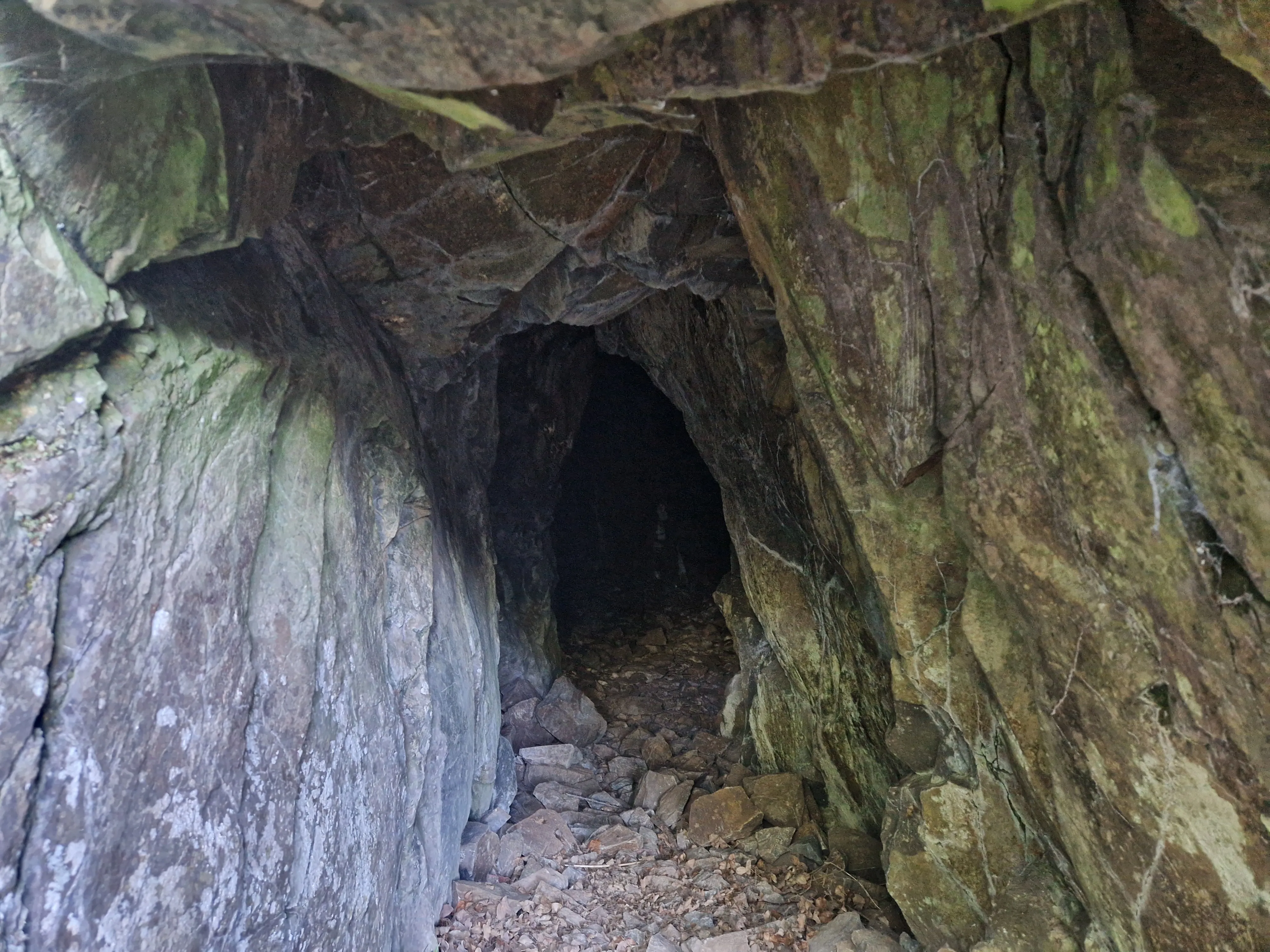
Schinderhannes-Höhle
The Schinderhanneshöhle is a very small, 13 m long cave in shale in the Hunsrück near Nack, formed by tectonic forces rather than karstification.
EspeleoWorld
Schinderhannes-Höhle
The Schinderhanneshöhle is a very small, 13 m long cave in shale in the Hunsrück near Nack, formed by tectonic forces rather than karstification.
Wendelsheim
Sviluppo: 13.5 m · Profondità: 2.1 m
Scheda aggiornata
https://espeleoworld.com/it/c/schinderhannes-hoehle-wendelsheim
Le informazioni possono cambiare. Verifica sempre coordinate, accesso, meteo e condizioni della cavità prima di partire.
The Schinderhanneshöhle is a very small, 13 m long cave in shale in the Hunsrück near Nack, formed by tectonic forces rather than karstification.
Foto
© Dozzemer · CC BY-SA 4.0, https://creativecommons.org/licenses/by-sa/4.0/ · Wikimedia Commons · https://commons.wikimedia.org/wiki/File:Schinderhannesh%C3%B6hle_Teufelsrutsch_Wendelsheim_2026.jpg
Descrizione
Morfologia
The Schinderhanneshöhle is very small, only 13 m long, and it is hard to imagine that anyone could have spent a long time here. The cave is located in shale, a rock that cannot karstify, and was formed by tectonic forces. Erosion caused a rock package to slide and a fissure to open up. Such caves are rare and usually very small.
There are several other caves nearby with a similar geology: the Dümpelhardt Cave with a length of 5 m, the Adrenalin Cave, also 5 m long, and the Cave of Saint Castor. The last one is only 2.7 m long and is therefore not considered a cave. Caves are normally only included in the cadastre if they are 5 m long or longer, but this one was included anyway because of its cultural and historical significance as a hermit’s hermitage and place of pilgrimage.
Altri dettagli
In other words, this is only one of several Schinderhannes caves in the Hunsrück. For example, there is a tunnel only one metre high in the Soonwald, near the former Hoxmühle inn northeast of Seesbach. Likewise, a short slate mining gallery from the 19th century near Selters in the Taunus, between Haintchen and Eisenbach. Due to its geology, the region is very poor in caves, and so former mining tunnels were often interpreted as caves when, after a few generations, the mining history was forgotten.
Storia
It got its name because it is said to have been the hiding place of the notorious robber, Schinderhannes. The Schinderhannes was actually named Johannes Bückler; he got his nickname because he had an apprenticeship as a Schinder, an old German word meaning knacker, at Nastätten. He was born in the Hunsrück and also did his mischief here; his actual place of residence was the Schmidtburg above the Hahnenbach brook. This cave is said to have served him only as a hiding place in case of danger. The cave again served as a hideout, according to legend, for a deserter during the First World War.
Johannes Bückler, the son of a knacker, committed some thefts and fell into the company of sinister journeymen. After a short time, he himself was the leader of the gang called Schinderhannes (Schinder=knacker, Hannes short of Johannes). The gang also robbed and murdered, but the charm and humour of Schinderhannes made him popular with the people, a kind of German Robin Hood. He had a relationship with the landlady of the Hoxmühle, who repeatedly hid him from justice. He also hid in the Schinderhannes Cave, 1.5 km from the Hoxmühle, which, according to legend, he was able to leave through a secret exit. But in the end the French gendarmes caught him, this was during the time of the French occupation, and he was executed on 21-NOV-1803 on the heights of Weisenau (Mainz) amidst lively public interest. Even today, a circle of 19 poplars with a stately tree in the middle marks this spot. In the Hunsrück, you can still visit many places that are said to have had a connection to his life. There are several Schinderhannes caves, prisons from which he is said to have escaped, and the Schinderhannes Tower in Simmern.
While Schinderhannes and his band of robbers existed, the legends about him were mostly invented. This began shortly after his imprisonment in 1802, when two supposedly authentic biographies were published. They were almost entirely fabricated. The best-known portrayal of the noble robber is the book Schinderhannes by Carl Zuckmayer from 1927.
Commenti degli utenti (0)
Nessun commento ancora.
Sii il primo a condividere la tua esperienza!
Esplorazioni registrate (0)
Nessuna esplorazione registrata.
Registra la tua visita a questa grotta!
Grotte vicine

Contiene informazioni da © OpenStreetMap contributors, www.openstreetmap.org, rese disponibili con la Open Database License (ODbL 1.0, https://opendatacommons.org/licenses/odbl/1-0/), modificate. · https://www.openstreetmap.org/node/4756491769 · dati aggiornati a 2026 · Fonte: Show Caves of the World (Jochen Duckeck) (www.showcaves.com), modificato. CC0 1.0, https://www.showcaves.com/english/TermsOfUse.html Show Caves of the World (showcaves.com), Jochen Duckeck · Testo di Jochen Duckeck (Schinderhanneshöhle) · adattato da Espeleoworld (normalizzato, tradotto); l'adattamento è rilasciato con licenza CC0 1.0, https://www.showcaves.com/english/TermsOfUse.html · profondità, sviluppo, descrizione · ottenuti il 2026-11-19 · dati aggiornati a 2026 · I dati derivati sono disponibili su richiesta con licenza ODbL: [email protected]