
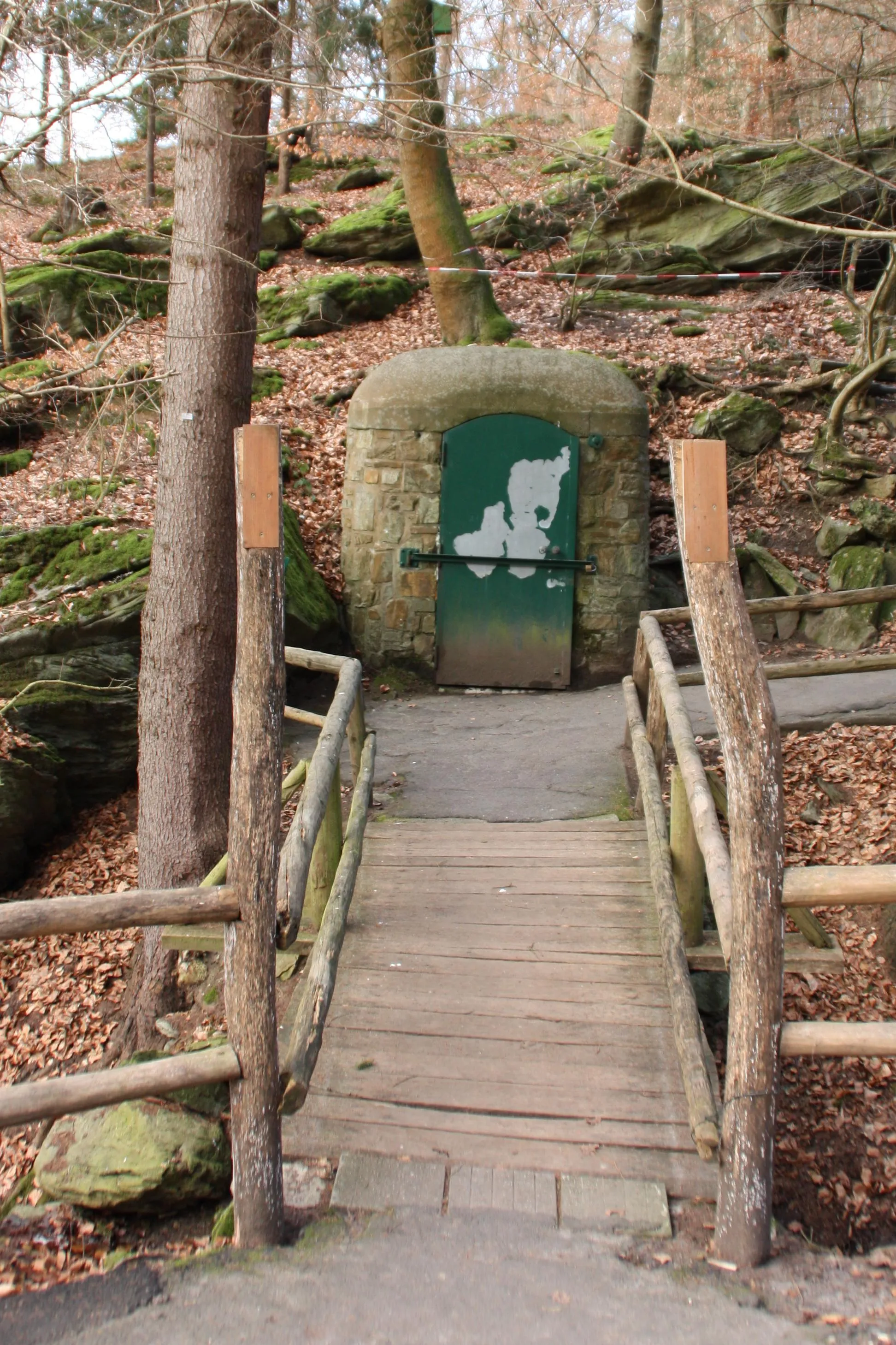
Leichtweißhöhle
The Leichtweißhöhle in Wiesbaden's Nerotal is originally a small natural cave, hardly more than a large rock overhang, a so-called abri.
EspeleoWorld
Leichtweißhöhle
The Leichtweißhöhle in Wiesbaden's Nerotal is originally a small natural cave, hardly more than a large rock overhang, a so-called abri.
Wiesbaden
Scheda aggiornata
https://espeleoworld.com/it/c/leichtweisshoehle-wiesbaden
Le informazioni possono cambiare. Verifica sempre coordinate, accesso, meteo e condizioni della cavità prima di partire.
The Leichtweißhöhle in Wiesbaden's Nerotal is originally a small natural cave, hardly more than a large rock overhang, a so-called abri.
Foto
© Oliver Abels ( SBT ) · CC BY-SA 3.0, https://creativecommons.org/licenses/by-sa/3.0/ · Wikimedia Commons · https://commons.wikimedia.org/wiki/File:Wiesbaden_Leichtweish%C3%B6hle.jpg
Descrizione
Morfologia
The Leichtweißhöhle is originally a small natural cave and not much more than a large rock overhang, a so-called abri. The local slate rock is not a rock suitable for karstification. No other caves are found.
During the expansion by the Wiesbadener Verschönerungsverein in 1856, a second entrance was created, a room situated to the side and a niche padded with moss that was declared a sleeping place. These changes were so extensive that the original state is hardly recognizable today.
Idrologia
The Schwarzbach, which comes from the Rabengrund and runs past the cave, received an artificial waterfall, and a wooden bridge was built for crossing the stream.
Altri dettagli
Its name is due to the poacher Heinrich Anton Leichtweiß, who used the cave as a shelter from 1789 to 1791. Forest workers discovered the cave and Leichtweiß because of rising smoke.
The cave fell into oblivion until Wiesbaden gained an international reputation as a spa resort and the cave developed into a popular excursion destination. It represented one of the new attractions that were to be offered to visitors to Wiesbaden. The Wiesbadener Verschönerungsverein expanded the cave in 1856. The cave was also decorated accordingly, among other things with old weapons and pictures. A romanticization followed. Above the cave an observation pavilion was created, and the access paths to the cave were equipped with railings and the cave entrance with a wooden porch.
With the decline of the Wiesbaden spa, especially after the end of the Second World War, the cave lost importance and was closed. Vandalism and lack of care took a heavy toll on the outdoor facilities. The cave was often used as a shelter. In 1983 the entrance was renewed in massive form. Since then the cave has been regularly made accessible to visitors twice a year.
Storia
In 1905 Emperor Wilhelm II visited the cave with his wife.
In 1934 the Gestapo used the Leichtweißhöhle as a torture cellar.
Commenti degli utenti (0)
Nessun commento ancora.
Sii il primo a condividere la tua esperienza!
Esplorazioni registrate (0)
Nessuna esplorazione registrata.
Registra la tua visita a questa grotta!
Grotte vicine


Contiene informazioni da © OpenStreetMap contributors, www.openstreetmap.org, rese disponibili con la Open Database License (ODbL 1.0, https://opendatacommons.org/licenses/odbl/1-0/), modificate. · https://www.openstreetmap.org/node/505161174 · dati aggiornati a 2026 · Fonte: German Wikipedia – article leads (cave descriptions) (de.wikipedia.org), modificato. CC BY-SA 4.0, https://creativecommons.org/licenses/by-sa/4.0/ Wikipedia contributors (de.wikipedia.org), CC BY-SA 4.0 · Testo di Wikipedia contributors (Leichtweißhöhle) · adattato da Espeleoworld (normalizzato, tradotto); l'adattamento è rilasciato con licenza CC BY-SA 4.0, https://creativecommons.org/licenses/by-sa/4.0/ · descrizione · ottenuti il 2026-11-13 · https://de.wikipedia.org/wiki/Leichtwei%C3%9Fh%C3%B6hle · dati aggiornati a 2026 · I dati derivati sono disponibili su richiesta con licenza ODbL: [email protected]