
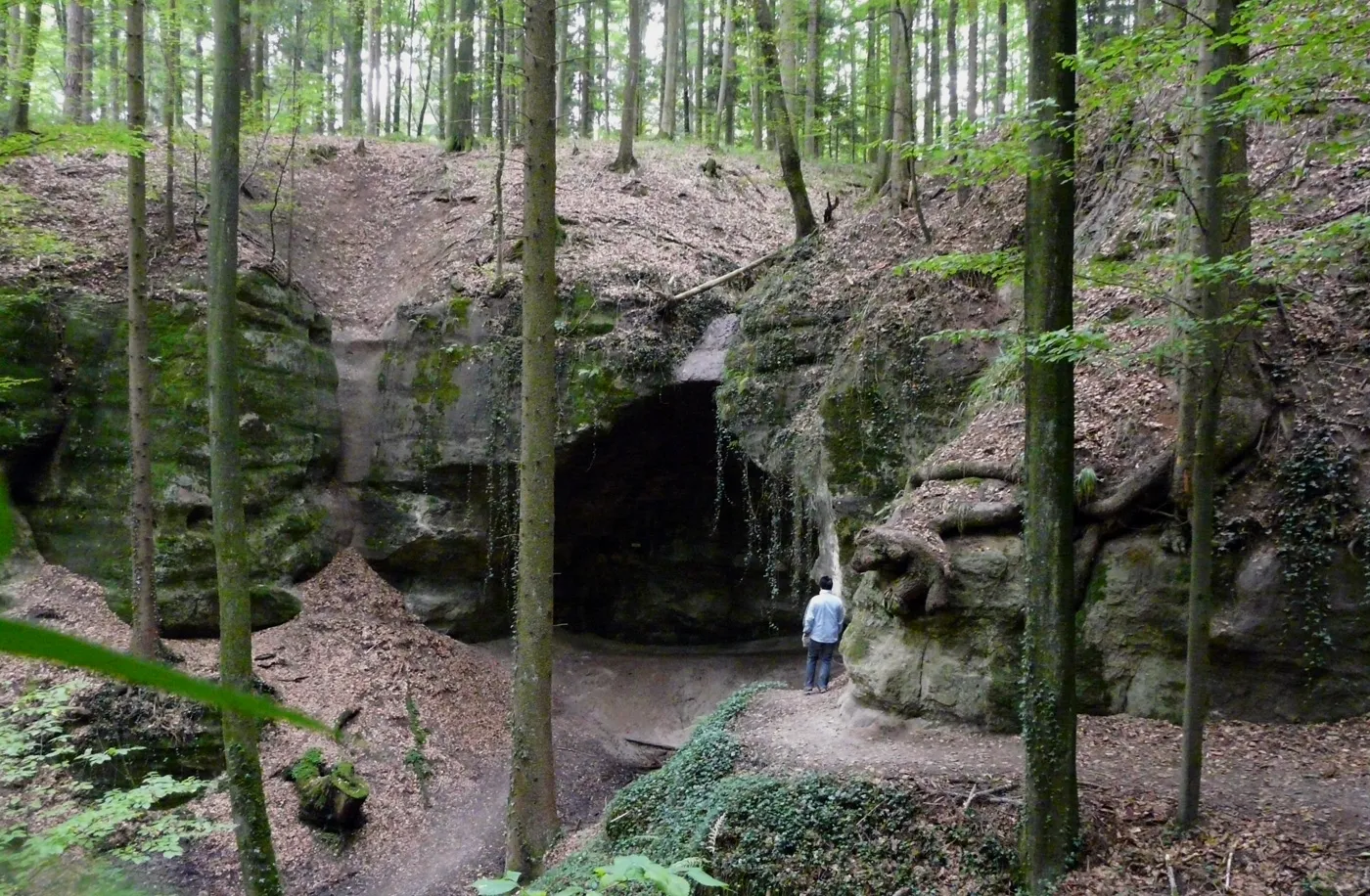
Kesselgrotte
The Kesselgrotte is a waterfall cave, a type of erosional cave formed where a waterfall drops over a resistant rock layer and carves out a hollow.
EspeleoWorld
Kesselgrotte
The Kesselgrotte is a waterfall cave, a type of erosional cave formed where a waterfall drops over a resistant rock layer and carves out a hollow.
Welzheim
Scheda aggiornata
https://espeleoworld.com/it/c/kesselgrotte-welzheim
Le informazioni possono cambiare. Verifica sempre coordinate, accesso, meteo e condizioni della cavità prima di partire.
The Kesselgrotte is a waterfall cave, a type of erosional cave formed where a waterfall drops over a resistant rock layer and carves out a hollow.
Foto

© Frank Goller / http://www.fgoller.de · CC BY-SA 3.0 DE, https://creativecommons.org/licenses/by-sa/3.0/de/ · Wikimedia Commons · https://commons.wikimedia.org/wiki/File:KESSELGROTTE.JPG
Descrizione
Morfologia
The Kesselgrotte is a waterfall cave, a special type of erosional cave formed by a waterfall. The waterfall flows over a resistant layer of rock and then drops down a step. The kinetic energy released carves out a hollow which fills with water, called a plunge pool, whilst the spray erodes the wall behind it. As this layer of rock is softer and less resistant, a small cave forms here. It does not really matter what type of rock it is; the weathering is mechanical, caused by the water itself and by frost action. The spray ensures that the crevices are always full of water and freeze in winter; as the water expands, it shatters the rock. Further away, where the spray does not reach, the crevices are often not filled with water and there is significantly less frost action.
Altri dettagli
Such waterfall caves are very common; most waterfalls have them. However, they are often very inconspicuous and rather unspectacular. In Germany, only this one is currently listed. However, this type of cave is quite common in the Upper Stubensandstein, which is therefore also known as ‘cave sandstone’. The term Baldachinbildung (canopy formation) is also used when it is not a proper waterfall, but merely a trickle of water cascading over a rock ledge, constantly moistening the recessed groove. In this case, erosion is almost entirely absent and the formation is caused by frost action. As already mentioned, there are a number of similar caves in the area. They have names such as the Gallengrotte, Hohler Stein, Geistein and Schillergrotte.
Commenti degli utenti (0)
Nessun commento ancora.
Sii il primo a condividere la tua esperienza!
Esplorazioni registrate (0)
Nessuna esplorazione registrata.
Registra la tua visita a questa grotta!
Grotte vicine
Fonte: Geotopkataster Baden-Württemberg (Regierungspräsidium Freiburg – LGRB) (services.lgrb-bw.de), modificato. Data licence Germany – attribution – version 2.0 (dl-de/by-2-0), https://www.govdata.de/dl-de/by-2-0 Datenquelle: Regierungspräsidium Freiburg - LGRB, www.lgrb-bw.de · dati aggiornati a 2026 · Fonte: Show Caves of the World (Jochen Duckeck) (www.showcaves.com), modificato. CC0 1.0, https://www.showcaves.com/english/TermsOfUse.html Show Caves of the World (showcaves.com), Jochen Duckeck · Testo di Jochen Duckeck (Kesselgrotte) · adattato da Espeleoworld (normalizzato, tradotto); l'adattamento è rilasciato con licenza CC0 1.0, https://www.showcaves.com/english/TermsOfUse.html · descrizione · ottenuti il 2026-11-19 · dati aggiornati a 2026