
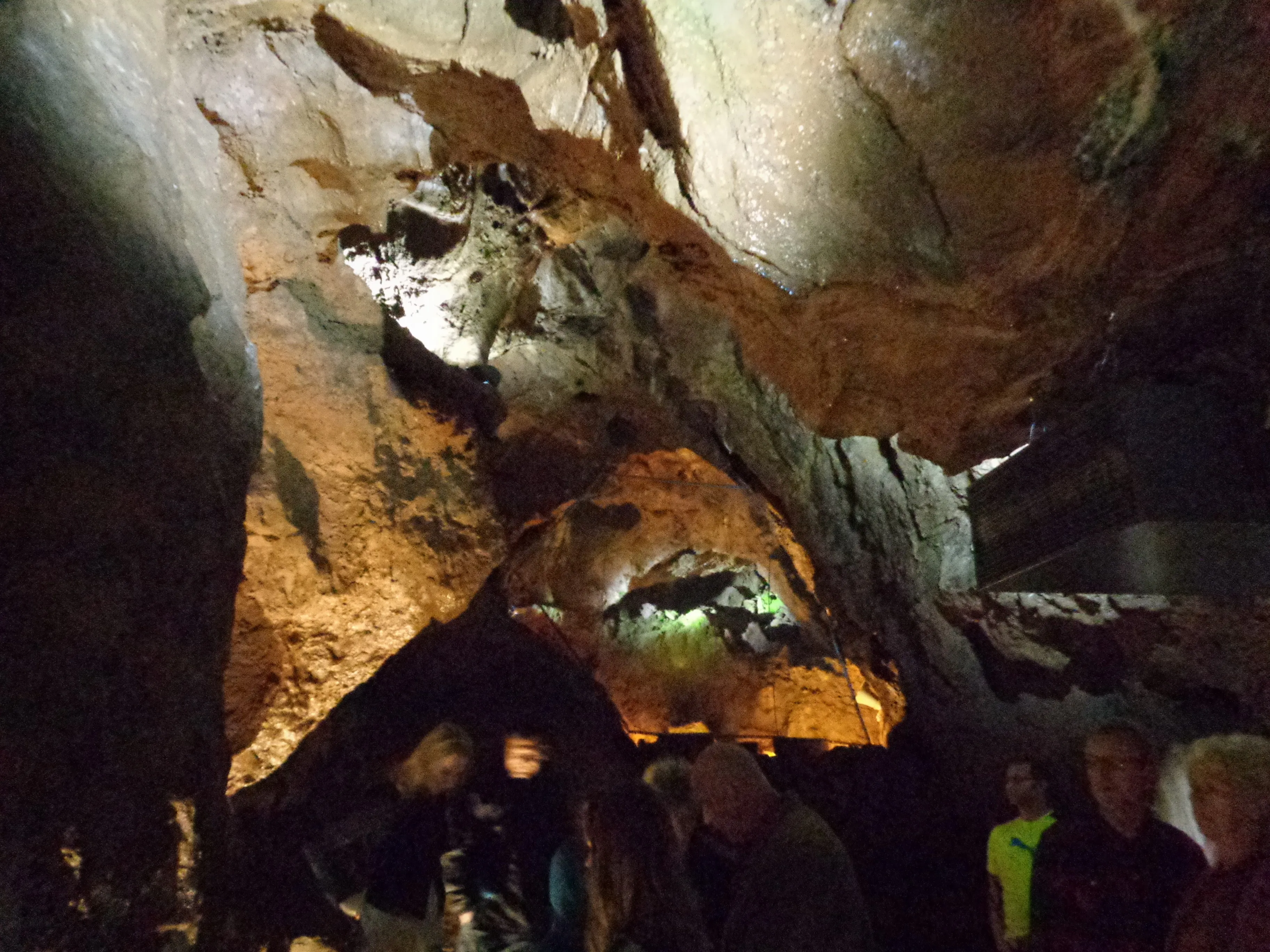
Iberger Tropfsteinhöhle
A historic show cave in the Harz, rather small and formed inside the Iberg mountain, with no extraordinary dripstones despite its name.
EspeleoWorld
Iberger Tropfsteinhöhle
A historic show cave in the Harz, rather small and formed inside the Iberg mountain, with no extraordinary dripstones despite its name.
Bad Grund (Harz)
Sviluppo: 220 m · Profondità: 27 m
Scheda aggiornata
https://espeleoworld.com/it/c/iberger-tropfsteinhoehle-bad-grund-harz
Le informazioni possono cambiare. Verifica sempre coordinate, accesso, meteo e condizioni della cavità prima di partire.
A historic show cave in the Harz, rather small and formed inside the Iberg mountain, with no extraordinary dripstones despite its name.
Foto

© Siegbert Brey · CC BY-SA 4.0, https://creativecommons.org/licenses/by-sa/4.0/ · Wikimedia Commons · https://commons.wikimedia.org/wiki/File:Iberger_Tropfsteinhoehle.jpg
Descrizione
Morfologia
The Iberger Tropfsteinhöhle was named after its location and was formed inside the Iberg mountain (563 m asl). The Iberg is a geologic anomaly, a small island of limestone surrounded by crystalline and metamorphic rocks. Like the other karst areas of the Harz, it is a former reef of the Devonian sea. The organisms which formed the reef had skeletons and shells of limestone, while the sediments deposited around the reef in the deeper sea are devoid of limestone. As always in such small and isolated karst areas, the limestone is karstified by water which flows on the surface until it reaches the limestone and goes underground. Containing little limestone, the water is able to dissolve a lot of rock, thus forming caves. When it reappears at the lower end of the limestone area in a karst spring, it is saturated with limestone.
But there is a second extraordinary geologic feature of this small karst area. Generally caves are formed by atmospheric or biogene carbon dioxide, which is taken up by the water while it is raining down to the surface and while it seeps through the top soil. But here, the CO2 was produced locally, inside the rock, as a by-product of siderite weathering. Siderite is an iron carbonate and is transformed into iron oxide and CO2 by the oxygen in the ground water. This CO2 increases the amount of limestone solution drastically. The residual iron oxide formed huge layers inside the caverns. During the Middle Ages the area was intensively mined, and the miners were looking for the so-called mulmige Brauneisenerze (soft iron ore) inside the caves.
A special detail of this mechanism are the specific water marks. The transformation of siderite into iron oxide was a continuous process, and so always a certain amount of CO2 was dissolved in the water and able to dissolve the limestone of the cavern walls, even if there was no supply from the surface. Because of this, the water marks make a sort of upside-down steps, and the room becomes a little bigger below each water mark. In normal karst caves, water marks look more or less like horizontal ditches. The solution is restricted to the area around the water surface, where mixture corrosion with dripping water dissolves some limestone.
The Iberg Dripstone Cave is a historic show cave, and rather small. Despite the name, there are no extraordinary dripstones. The name was coined in the 19th century; at this time the name dripstone cave was used for any karst cave, and it was actually more common.
Concrezioni
The third specialty of the cave are coloured speleothems in one chamber, coloured blue green by copper minerals. In many karst areas, only iron oxides are available for colouring, and most formations look white to brown or sometimes yellowish or reddish. Limestone is a marine sediment, which contains only the minerals typically deposited in such an environment, iron and manganese. But if the limestone was altered by heavy tectonic action, like here in the Harz mountains during the uplift of the whole area, sometimes ores are deposited in the cracks. The whole process is started by the ascension of magma forming a plutonite, like the nearby Brocken mountain. The hot magma, stuck inside the earth, heats its surroundings and the ground water, which continually dissolves small amounts of various minerals and metals in surrounding rocks and re-deposits the ores in cracks. It forms polymetallic ores which were mined all over the Harz.
The most impressive formation, named König Hübich (King Hübich), is a huge and massive stalagmite with a thinner and pointy tower on top, about 40 cm high. If you know where to look, it is easy to see that the slim top does not belong to this place. It is a part of another stalagmite, probably even a stalactite, which was placed here a long time ago, during the 19th century. There is water dripping at this place, depositing limestone, and so the top is today fused with the base.
Idrologia
The dripping water from the crack in the ceiling is collected in a small artificial pool.
Progressione
The cave tour was also changed; the cave is entered by a newly constructed 160 m long tunnel which leads up to the Hauptmann Spatzier Stollen. The tunnel is used for an exhibition showing the geologic development of the Harz, the limestone and the karst. It reaches the old entrance tunnel right behind the old entrance. Visitors take their time to walk uphill through this tunnel, have a look at the exhibition, and finally meet their guide at the Hauptmann Spatzier Stollen.
The first natural cave of the tour was discovered in 1911, during the construction of the entrance tunnel. There are some nice speleothems and fossils on exhibition, and also some speleothems on the ceiling. After the remaining part of the tunnel, the main chamber of the cave is reached at its deepest point. A wide staircase leads up to a first plateau, where the impressive watermark can be seen. The tour follows some side passages to meet the upper part of the main chamber. The main stalagmite is found here, called König Hübich (King Hübich). Here is a steep and narrow staircase leading to the former exit, which is actually the oldest entrance to the cave. It is closed now; the visitors go back to the lower part of the main chamber and then back to the entrance through the tunnels.
Altri dettagli
The caves of the Iberg were discovered by the miners of the Middle Ages. They mined the iron ore, used some to fill in overburden, then closed them and forgot about them. What later became the show cave was never forgotten: it was first mentioned in 1734, was shown to interested visitors, and finally in 1874 paths and stairs were built. This is the date when it became a show cave. At this time there was only one entrance at the upper end of the cave, almost unchanged since early mining. In 1911 a new 78 m long entrance tunnel was built by Hauptmann Spatzier and named after him. It became the new entrance of the cave, the old entrance was used as exit and the tour became a one-way tour. It was even extended by a new cave discovered while digging the tunnel.
This way the tour stayed almost 100 years; in 2008 the cave was transformed again and renamed HöhlenErlebnisZentrum. Before the renovation the cave entrance was located above the parking lot in the wood, reached on a short walk uphill. The exit was even higher up on the hill. Both can be seen on the older images on the gallery page. The cave entrance is now located on the parking lot, where a two storey entrance building was erected. The ground floor contains the ticket office, a small shop, café and mineral exhibition. The second floor contains the archaeological museum dedicated to the Lichtensteinhöhle, which is a famous archaeological site nearby and not open to the public. The exhibition includes a model of the cave, which gives a good impression of the original cave. It also shows that the cave is actually rather small; the lowest point of the model is only 80 cm high. Not suitable for every tourist, as it requires stooping and crawling, but great fun for children.
Before Germany was united in the early 1990s, this was the only well developed tourist cave in the western part of the Harz. Then the much bigger caves of the eastern part became accessible and the importance and visitor numbers diminished. In order to stop this process, the cave was completely restructured and transformed into what is called HöhlenErlebnisZentrum Iberger Tropfsteinhöhle. The extensive renovation, including the construction of a 160 m long tunnel and the erection of a two storey building, cost 3.85 Million Euro. It was financed by the European Union, the county Osterode am Harz, the Niedersachsen government, the Sparkassenstiftung and other foundations. It was executed by the county Osterode am Harz. The result is astonishing: almost 60.000 visitors during the first half year.
Commenti degli utenti (0)
Nessun commento ancora.
Sii il primo a condividere la tua esperienza!
Esplorazioni registrate (0)
Nessuna esplorazione registrata.
Registra la tua visita a questa grotta!
Grotte vicine
Fonte: Geotope Niedersachsen (Landesamt für Bergbau, Energie und Geologie, LBEG) (nibis.lbeg.de), modificato. LicenseRef-LBEG-no-licence-stated Landesamt für Bergbau, Energie und Geologie (LBEG), NIBIS Kartenserver · dati aggiornati a 2026 · Contiene informazioni da Grottocenter (Wikicaves), grottocenter.org, rese disponibili con la Open Database License (ODbL 1.0, https://opendatacommons.org/licenses/odbl/1-0/), modificate. · sviluppo · ottenuti il 2026-11-13 · https://grottocenter.org/ui/entrances/23594 · dati aggiornati a 2026 · Contiene informazioni da © OpenStreetMap contributors, www.openstreetmap.org, rese disponibili con la Open Database License (ODbL 1.0, https://opendatacommons.org/licenses/odbl/1-0/), modificate. · https://www.openstreetmap.org/node/3213191649 · dati aggiornati a 2026 · Fonte: Show Caves of the World (Jochen Duckeck) (www.showcaves.com), modificato. CC0 1.0, https://www.showcaves.com/english/TermsOfUse.html Show Caves of the World (showcaves.com), Jochen Duckeck · Testo di Jochen Duckeck (Iberger Tropfsteinhöhle) · adattato da Espeleoworld (normalizzato, tradotto); l'adattamento è rilasciato con licenza CC0 1.0, https://www.showcaves.com/english/TermsOfUse.html · profondità, nomi, descrizione · ottenuti il 2026-11-21 · dati aggiornati a 2026 · I dati derivati sono disponibili su richiesta con licenza ODbL: [email protected]