
Coves del Rufino
A cavity with 430 metres of passage and five entrances, in l'Arbolí.
EspeleoWorld
Coves del Rufino
A cavity with 430 metres of passage and five entrances, in l'Arbolí.
Arbolí · Baix Camp
Sviluppo: 430 m · Profondità: 28 m
Scheda aggiornata
https://espeleoworld.com/it/c/coves-del-rufino
Le informazioni possono cambiare. Verifica sempre coordinate, accesso, meteo e condizioni della cavità prima di partire.
A cavity with 430 metres of passage and five entrances, in l'Arbolí.
Topografia
Espeleoindex · CC BY-NC 4.0, https://creativecommons.org/licenses/by-nc/4.0/ · Immagine © del suo autore.
Foto
Espeleoindex · CC BY-NC 4.0, https://creativecommons.org/licenses/by-nc/4.0/ · Immagine © del suo autore.
Descrizione
Morfologia
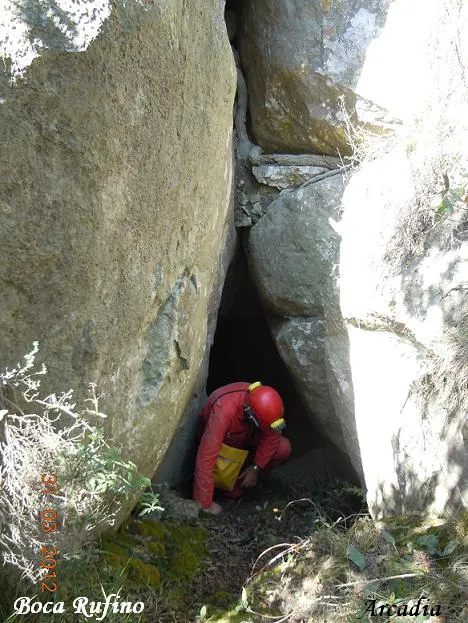
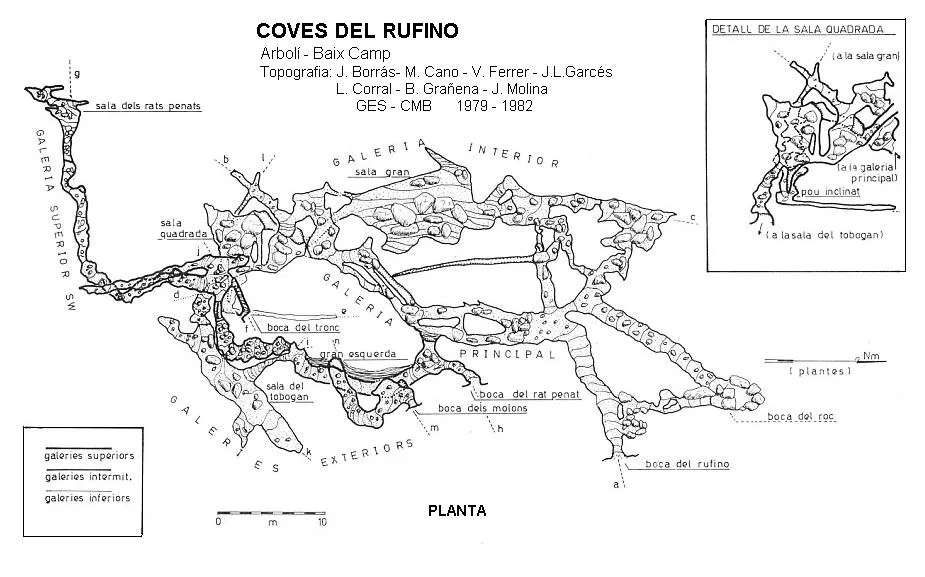
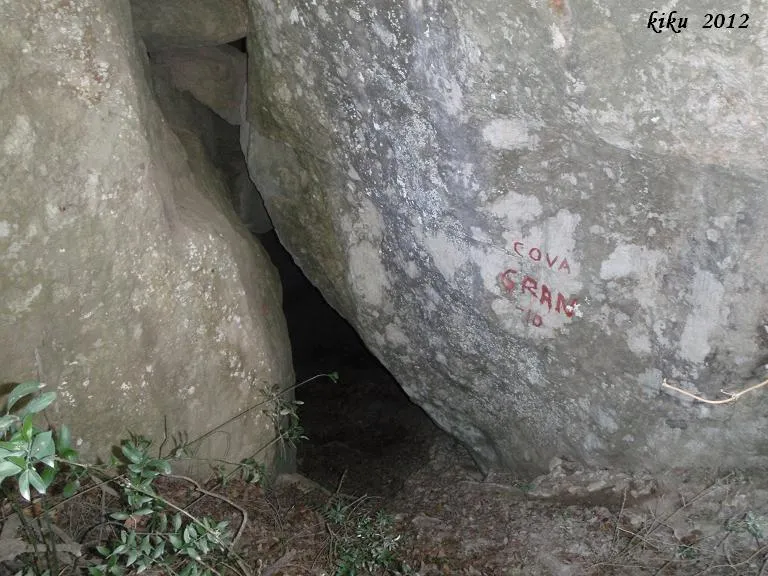
The coves del Rufino are a consequence of the union of five cavities close to one another: Cova del Rufino, Avenc del Roc, Avenc del Rat Penat, Avenc dels Molons and Avenc del Tronc. The entrance situated furthest N corresponds to the avenc del Roc, which opens directly onto a small secondary gallery a few metres from the main entrance, opened below it; this main entrance is the cova del Rufino, the entrance one metre wide by 2 high, gives way to a descending gallery that comes to reach about 20 metres of ceiling height. After 14 metres of passage, this turns 90º to the S and appears to be closed by an accumulation of blocks, forming at this point a chamber, from which three continuations set off. The first is a barely visible fissure half obstructed by a large block, which allows access to an ascending gallery with characteristics similar to that of the entrance of the cave, after 20 metres it passes by the base of the pit of the avenc del Roc and comes out again at the entrance of the cova del Rufino. Returning again to the chamber at the accumulation of blocks, above it the gallery continues totally occupied by blocks, with lower passages between them. At its end, one reaches a new and narrower perpendicular gallery, which on the S side leads to the Sala Quadrada and on the N reaches a large chamber elongated in an N-S direction; from the end of this a gallery between blocks sets off that reaches again the first branch we mentioned of the main gallery, near the entrance. Situated in the Sala Quadrada we will observe that it communicates at different points between the blocks that occupy it with the terminal part of the main gallery, as well as an interesting inclined pit that gives access to a curious lower small room. The entrance of an ascending conduit also opens that heads to the SE that connects it with the Sala del Tobogan, 10x3 metres and oriented SO-NE. A strongly inclined fracture in its N wall forms a channel that allows one to reach along its upper side one end of a large fissure that makes us think of the joints, with more than 10 metres of height and closed by steep slopes of blocks at both ends. On the N side and after climbing these blocks, one reaches a pit of -10 metres, which is no more than a hole in the ceiling of the main gallery described earlier. A few metres further on one comes out to the exterior through the entrance of the avenc Rat Penat, situated 12 metres to the SSO of the entrance of the cova del Rufino. A few metres to the S, but a little higher up, we find the avenc dels Molons, which gives way to a zigzag gallery where two pits open above the lower Gran Esquerda. Climbing the blocks on the S side of the Gran Esquerda, just above the point of contact with the Tobogan, one reaches a conduit between blocks that reaches an upper chamber from which two superimposed galleries set off towards the S, the more important being the lower of them, which after 10 metres turns to the O, until reaching after about 30 metres the upper part of a chamber occupied by an interesting colony of Rat-penat. In the chamber mentioned earlier, where these last galleries had their origin, there also exists another slide, a strongly ascending channel that comes out to the exterior in the form of a veritable pit, this is the avenc del Tronc, which is situated to the SO of the previous entrances.
Storia
Although long known to the local people, the first visit of which there is a record is the one carried out in 1929 by the man from Reus Salvador Vilaseca Anguera; he carried out archaeological studies in a series of caves situated in the Cingle Blanc, calling them coves d'Arbolí and cataloguing them alphabetically with the letters from A to N; he published these studies in 1934. The so-called cova C, also called 'del Rufino', one of the first caves explored by this team of excavators, brought about a serious problem when, due to a fortuitous accident, a block of stone slipped and slightly injured M. Mata and seriously injured P. Rius, whose left hand Vilaseca had to amputate in situ. In more modern times the cavity received the sporadic visit of speleologists, thus we have a record of the visit of the GEE de Reus in the year 1973. The GES del CMB during 1979 explored all the cavities of the Cingle Blanc, publishing the results in 1980 in the magazine Sota Terra 1. In the survey of the Cova del Rufino, they attribute to it 270 metres of passage and 23 metres of depth. In 1982 they return again and manage to connect three other cavities with the cova del Rufino and the avenc del Roc, whose connection was already known; the new survey gives 430 metres of passage and -28 of depth. Most of the cavities catalogued by Vilaseca with the letters of the alphabet have been renamed again given the difficulty of knowing the corresponding letter of each of them. The system is known as Coves del Rufino; currently the municipality of l'Arbolí is incorporated into the comarca of Baix Camp, but at different periods it had been in the Conca de Barberà and also in that of the Priorat.
Commenti degli utenti (0)
Nessun commento ancora.
Sii il primo a condividere la tua esperienza!
Esplorazioni registrate (0)
Nessuna esplorazione registrata.
Registra la tua visita a questa grotta!
Bibliografia
- Borrás, J.;Miñarro, JM.;Talavera, F.(1984).-”el baix camp, el priorat i la ribera d'ebre”. Catàleg Espeleològic de Catalunya (vol. 7):1-283. Ed. Políglota. Barcelona.
- Cardona i Oliván, Ferran.(1990).-”El sistema mediterrani i la depressió central” Grans Cavitats de Catalunya (Segon Volum):1-484. ECG. Barcelona.
- Ferrer, V.; Cano, M.; Borràs, J.; Garcés, JL.(1982).-”Coves del Rufino (els Motllats). Sota Terra (3):59-64. GES – CMB. Barcelona.
- Montoriol, A.(1980).-”Noves cavitats obertes als Motllats”. Sota Terra (1):28-38. GES – CMB. Barcelona.
- Massó Carballido, Jaume.-”Salvador Vilaseca i la Prehistòria d'Arbolí. Notes Biogràfiques”. Aplec de treballs (14).
- Vilaseca Anguera, Salvador.(1934).-”les Coves d'Arbolí (Conca de Barberà)” butlletí Arqueològic (èpc.III,47):317-328. Societat Arqueològica Tarraconense
Grotte vicine


Fonte: Espeleoindex (espeleoindex.com), modificato. CC BY-NC 4.0, https://creativecommons.org/licenses/by-nc/4.0/