
Cova Trobada
A cavity at the Port de gairebé 100 m deep, in la Sénia. Known since ancient times, explored by the SIE in 1974 and 1976 and surveyed in 2021.
EspeleoWorld
Cova Trobada
A cavity at the Port de gairebé 100 m deep, in la Sénia. Known since ancient times, explored by the SIE in 1974 and 1976 and surveyed in 2021.
Sénia, La · Montsià
Sviluppo: 360 m · Profondità: 99 m
Scheda aggiornata
https://espeleoworld.com/it/c/cova-trobada
Le informazioni possono cambiare. Verifica sempre coordinate, accesso, meteo e condizioni della cavità prima di partire.
A cavity at the Port de gairebé 100 m deep, in la Sénia. Known since ancient times, explored by the SIE in 1974 and 1976 and surveyed in 2021.
Topografia
Espeleoindex · CC BY-NC 4.0, https://creativecommons.org/licenses/by-nc/4.0/ · Immagine © del suo autore.
Foto
Espeleoindex · CC BY-NC 4.0, https://creativecommons.org/licenses/by-nc/4.0/ · Immagine © del suo autore.
Descrizione
Morfologia
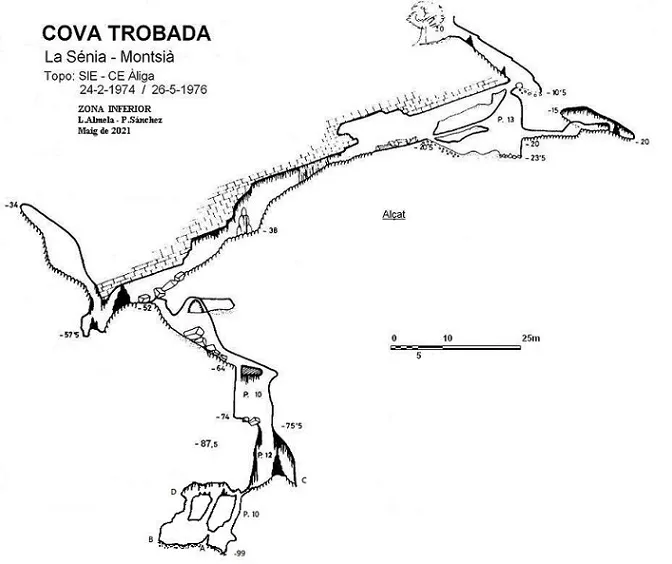
The entrance mouth, about 2 metres high by 2.5 metres wide, gives access to a steep ramp that leads us to the landing situated at elevation -10.5. A short narrow passage follows, leaving on the right the 13-metre shaft, which later communicates via a crawlway with the entrance to the chamber, which is reached after downclimbing a cornice followed by a chaos of blocks on an incline. Below the blocks, and in a horizontal direction, the base of the aforementioned shaft is reached, it being possible to access a hanging crawlway (elevation -20) that leads to a small chamber abundantly decorated with formations.
Returning to the main chamber, one must follow the descending gallery in a SE direction. This gallery, on a steep slope, descends to elevation -57.5 and some 3.5 metres above this point an ascending gallery opens that climbs up to elevation -34.
Shortly before reaching the end of the main chamber, on the left and among blocks, a small opening is found which, once passed, descends through a small room until reaching the mouth of a 10-metre shaft (elevation -64). At its bottom, another vertical opens, heavily decorated and 12 metres deep, at the lowest point of which the deepest point of the cavity was reached (elevation -87.5).
The clearance work at this point resulted in the discovery of a new vertical conduit that allows reaching 98 metres of total depth.
It is an old sinkhole of the nearby ravine, which has been deepening always following the structure of the dip of the strata and also the frequent joints of the area, which among other points are the origin of the main chamber through the crossing of two of them and also contributing a greater possibility of an erosive stagnation zone, due to the lesser inclination of the place, in proportion to the rest of the cave, once it has received a constant supply of waters pressured by the conducting slopes. The whole of the cavity can be considered to be a forced conduit, giving in short stretches different varieties of sections, causing the existence of the shafts and their work as vertical sinkholes.
Concrezioni
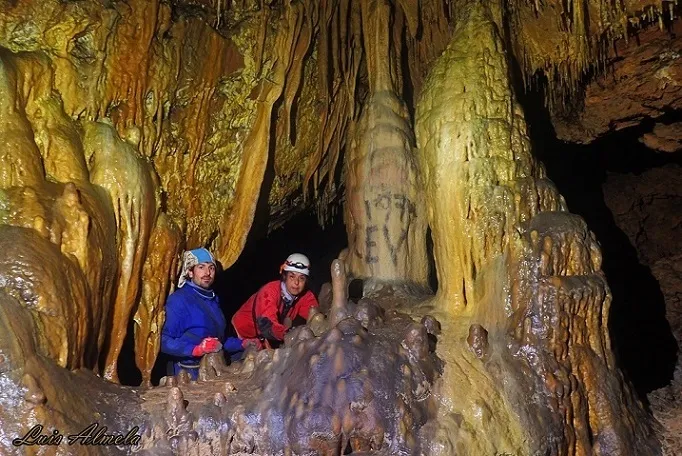
Subsequently the cave has undergone a reconstructive process of which the abundant formations, born obeying the system of continuous filtrations existing, constantly form part, offering wall and floor varieties.
Storia
Cavity known since time immemorial by the people of the region. The first speleological mention corresponds to N. Font i Sagué who in his Catàlech Espeleològich de Catalunya (1897) makes an extensive reference, the product of the information provided by the CEC delegate in Tortosa. This reference is repeated over time: Faura (1911); Ferraté (1918); Bayerri (1934) without providing any new data or reference to a specific exploration.
We know that the cavity has been explored over time, although very sporadically given its remoteness, but no accurate description is reflected until the SIE visits it in the years 1974 and 1976, resulting in a work that is made known in 1978. We also have a survey carried out during the years 1970 by members of the Grup Espeleològic d'Ulldecona that has remained unpublished until now.
In 1994, members of the Espeleo Club Tortosa, after several days of clearance work at the final elevation, managed to pass a very narrow passage that allowed them to reach 99 metres of depth.
There was no survey of this last stretch, until in May 2021 members of the Espeleo Club Castelló visited the cavity and proceeded to survey the lower stretch of the cave.
Note biospeleologiche
Coleoptera
- Paraphaenops breulianus espanoli (Ortuño and Faille)
(Data provided by Floren Fadrique, BIOSP)
Commenti degli utenti (0)
Nessun commento ancora.
Sii il primo a condividere la tua esperienza!
Esplorazioni registrate (0)
Nessuna esplorazione registrata.
Registra la tua visita a questa grotta!
Bibliografia
- EC Tortosa (1994).- “Espeleo Notícies” Cul de Sac(1): s/p. Butlletí Espeleo Club Tortosa.
- SIE (1978).- “Contribució al coneixement espeleològic dels Ports del Caro (Baix Ebre) – V” EspeleoSie (22): 47-55. SIE – CE Àliga. Barcelona.
- Coordenades i fotografies facilitades per l'Espeleo Club Tortosa.
- Actualització de dades, topografia total i altres fotografies extretes del blog: cavitats-subterranies.blogspot. Apunt del 29-10-2021. Dades: Luis Almela (EC Castelló)
Grotte vicine


Fonte: Espeleoindex (espeleoindex.com), modificato. CC BY-NC 4.0, https://creativecommons.org/licenses/by-nc/4.0/