
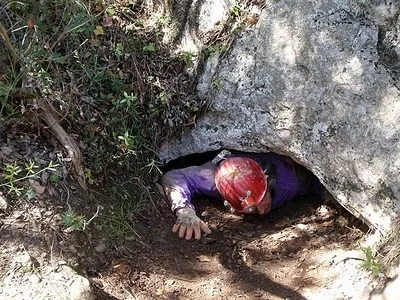
Cova del Mas de la Llana
A 105 m-long cave in Vallclara (Conca de Barberà), an ancient spring with ascending galleries, lithogenic formations and a refuge during the Civil War.
EspeleoWorld
Cova del Mas de la Llana
A 105 m-long cave in Vallclara (Conca de Barberà), an ancient spring with ascending galleries, lithogenic formations and a refuge during the Civil War.
Vallclara · Conca de Barberà
Sviluppo: 105 m · Profondità: 17 m
Scheda aggiornata
https://espeleoworld.com/it/c/cova-del-mas-de-la-llana
Le informazioni possono cambiare. Verifica sempre coordinate, accesso, meteo e condizioni della cavità prima di partire.
A 105 m-long cave in Vallclara (Conca de Barberà), an ancient spring with ascending galleries, lithogenic formations and a refuge during the Civil War.
Topografia
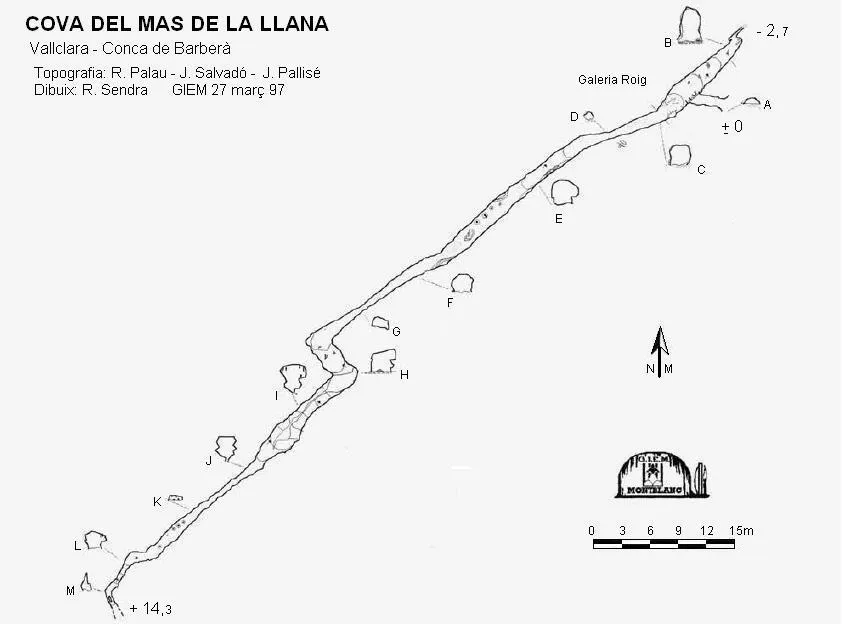

Espeleoindex · CC BY-NC 4.0, https://creativecommons.org/licenses/by-nc/4.0/ · Immagine © del suo autore.
Foto

Espeleoindex · CC BY-NC 4.0, https://creativecommons.org/licenses/by-nc/4.0/ · Immagine © del suo autore.
Descrizione
Morfologia
The entrance mouth and passage have a perfect elliptical shape, although it is so narrow that we are forced to enter by crawling a couple of metres until reaching the small chamber that was known and that apparently served as a refuge for a few days for some people during the Civil War. In the same SW direction as the surface materials, there is a narrow crawlway that, after being cleared, gives access to a straight gallery about 100 metres long that only presents a pronounced bend towards the middle, just at the point where the cavity reaches its most developed dimensions with an oval section of 2.2 x 3 metres. The whole cavity follows an ascending route until reaching the elevation + 14.3 from the entrance mouth. At some points, amid very smoothed walls, we see some pebbles of material harder than the parent conglomerate that protrude like a mushroom.
Concrezioni
In several places on the ceiling there are beautiful lithogenic formations with stalactites and stalagmites in good condition, since the cavity is little known and not very easy to visit.
Idrologia
The cavity acted as an important spring with a remarkable water circulation, with very rounded sections and some places with a ceiling very smoothed by water circulation, although it presents the peculiarity that the main passage was filled in by sediments and by layers of concretion, and was re-excavated several times, to the point of having a stretch with two levels connected by a narrow channel. Finally, the cavity was abandoned by water circulation, probably due to the formation of the exterior torrents.
Progressione
The entrance mouth and passage are so narrow that it is necessary to enter by crawling a couple of metres until reaching the small chamber. A narrow crawlway, after being cleared, gives access to the straight gallery.
Altri dettagli
Perhaps one of the most interesting geological aspects to observe is outside, since if we continue the track towards Vallclara and position ourselves upstream of the first torrent, we will find two small cavities (Cova del Mas de la Llana 2 and 3) with the same morphology, direction and slope as the main cavity, on both sides of the ravine, which indicates an origin of the cavity prior to the formation and excavation of the ravine that sectioned the galleries, and something similar happens in the next ravine (cave 3). An interesting aspect consists in elucidating the origin and the catchment area of the waters that circulated through the cavity.
Storia
A resident of Vallclara, Joan Ramon Roig, mentioned to members of GIEM – CE Montblanc the existence of this cavity that had served as a hiding place during the Civil War. On 1 February 1997 the first visit was carried out and seven days later the sediment plug of the first crawlway was cleared. In the following weeks the whole cavity was finished being explored and surveyed.
Commenti degli utenti (0)
Nessun commento ancora.
Sii il primo a condividere la tua esperienza!
Esplorazioni registrate (0)
Nessuna esplorazione registrata.
Registra la tua visita a questa grotta!
Bibliografia
- Palau, Ramon i Pallisé, Joan (2006).- “Ressenya de quatre fenòmens càrstics a la zona limítrofa del PNIN de Poblet”. Actes de les Segones Jornades sobre el Bosc de Poblet i les Muntanyes de Prades. Departament de Medi Ambient. Generalitat de Catalunya.
· Informació facilitada per Ramon Sendra i Joan Pallisé (GIEM – CE Montblanc)
· Fotografies extretes del blog Espeleobloc ( post del 6 d'abril de 2008).
Grotte vicine
Cova del Sastre
0.8 km · NO
Vallclara (Conca de Barberà)
1 topo.3 foto
Abric del Barranc de Biern
1.4 km · SO
Vilanova de Prades (Conca de Barberà)
1 topo.2 foto
Cova de les Hortes
2.3 km · N
Vallclara (Conca de Barberà)
1 topo.3 foto
Avenc del Julivert
2.3 km · E
Vimbodí i Poblet (Conca de Barberà)
2 topo.6 foto
Fonte: Espeleoindex (espeleoindex.com), modificato. CC BY-NC 4.0, https://creativecommons.org/licenses/by-nc/4.0/