
Cova del Goleró
Interesting 330 m long cave in Susqueda (la Selva), also known as Cova del Goleró, Cova d'en Salvi, Carnús and Cova de l'Om.
EspeleoWorld
Cova del Goleró
Interesting 330 m long cave in Susqueda (la Selva), also known as Cova del Goleró, Cova d'en Salvi, Carnús and Cova de l'Om.
Susqueda · Selva
Sviluppo: 330 m · Profondità: 20 m
Scheda aggiornata
https://espeleoworld.com/it/c/cova-del-golero
Le informazioni possono cambiare. Verifica sempre coordinate, accesso, meteo e condizioni della cavità prima di partire.
Interesting 330 m long cave in Susqueda (la Selva), also known as Cova del Goleró, Cova d'en Salvi, Carnús and Cova de l'Om.
Topografia
Espeleoindex · CC BY-NC 4.0, https://creativecommons.org/licenses/by-nc/4.0/ · Immagine © del suo autore.
Foto
Espeleoindex · CC BY-NC 4.0, https://creativecommons.org/licenses/by-nc/4.0/ · Immagine © del suo autore.
Descrizione
Morfologia
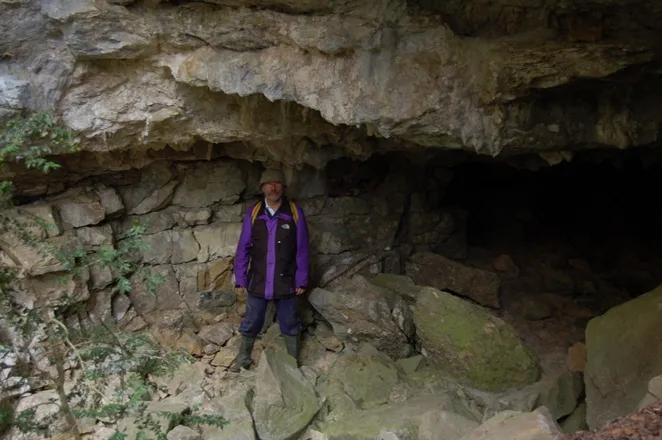
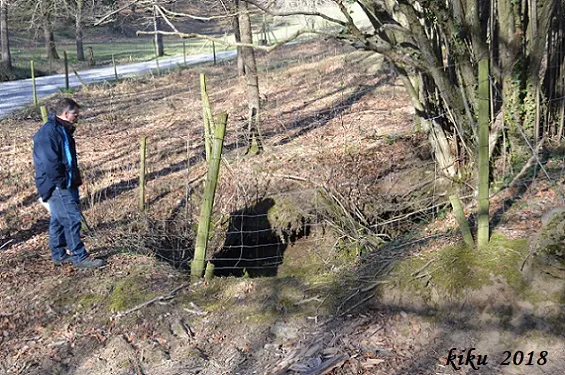
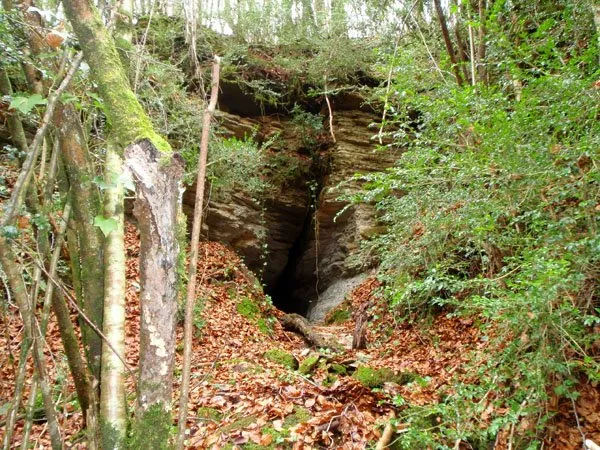
The entrance to the cavity is through a wide, almost rectangular mouth full of blocks that gives way to a gallery running E, which after a few metres turns to the left and takes the direction N, among large blocks fallen from the ceiling and with some highly fossilised lithogenic forms. Here there are different alcoves between the blocks.
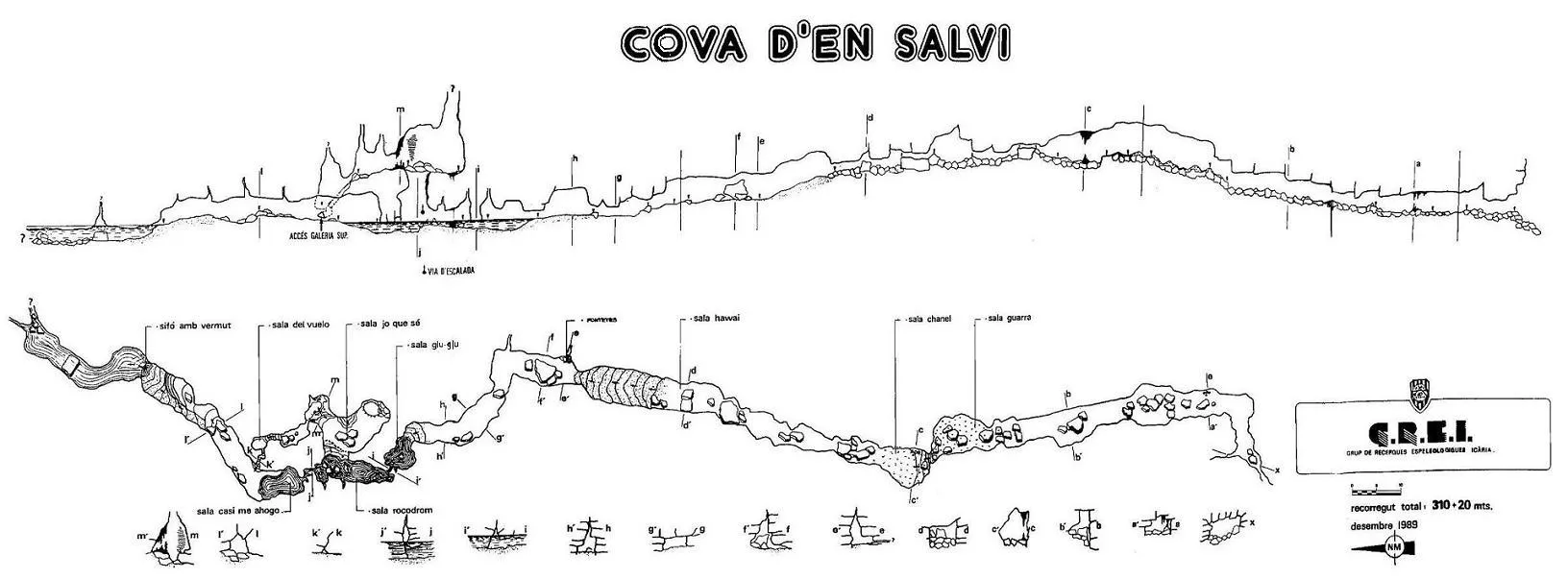
After the first 60 metres of gallery, in a slightly ascending direction, we find the so-called Sala Guarra (named thus for the large amount of bat guano found there). The chamber has many concretions and notable dimensions: 27 metres long by 7 wide and 7 high.
Next is the so-called Sala Channel (due to the aroma breathed there because of the droppings of the bats that occupy it temporarily). This chamber is 14 metres long by 7.5 wide and 6 high, taking a direction towards the NE.
After a narrow passage you continue between damp and muddy blocks until reaching the Galeria Hawai (given the amount of fine sand that accumulates) and immediately afterwards you reach a point called la Fonteta, where there is a water input that descends along a side flow, giving rise to a beautiful set of gours and microgours.
Immediately afterwards and taking direction NW you descend until finding the first stretch of flooded gallery, which is 208 metres from the entrance mouth and practically at its same level. At the other end of the “lake” there is a 2 metre long passage that at some times can almost sump and that communicates with another flooded zone (el Rocòdrom), of NE direction and a length of 14 metres by 4 wide and 2 deep, which leaves beside a wall in which a chimney continues that leads to the upper gallery. But on the more NW side a portal with formations on the ceiling can be seen, which becomes the “second sump”. A large stone that obstructs the passage 50 centimetres below the water forces a one metre long dive. Past this narrowness there is a third “lake”, of N orientation and 8.5 metres long by 5.6 wide and 6 high (called “Casi me ahogo”) and which reduces its depth until it returns to flat ground, in a totally muddy stretch that leads to a gallery of NE direction in which, on the right, there is a narrow passage that also communicates via a ramp and a strong rise with the Upper Gallery.
Following the main gallery for 34 metres with a constant width of 5 metres and a height of also 5 metres, you reach, after passing between blocks and fine sand, the sump, for now terminal (Sifó amb Vermouth). This flooded gallery has a maximum width of 6 metres and a height of 2.60 metres.
Upper gallery: Located in the “Casi me ahogo” chamber there is an ascending crawl that leads to a small chamber of 3 x 3 metres called “Sala del Vuelo”. On its right a strong rise of mud and debris 8 metres high begins which, once climbed, gives access to the Jo que sé chamber, which has dimensions of 30 metres long by 6.60 wide and 7.20 high, having travelled 330 metres from the entrance and having ahead a chimney to continue of no less than 15 metres high.
Speleometry: The oldest survey (GREI) seems, with stricter criteria, to give a length of 330 metres. The other (GE Badalona), perhaps more generous, attributes 466 metres to it, although the entire final stretch is taken from the GREI survey. The drop is 20 metres (-5 /+15).
Concrezioni
The speleothems are quite localised. In the Sala Guarra there are many concretions. At la Fonteta there is a beautiful set of gours and microgours.
Idrologia
The first stretch of flooded gallery is 208 metres from the entrance mouth and practically at its same level. At the other end of the “lake” there is a 2 metre long passage that at some times can almost sump and that communicates with another flooded zone (el Rocòdrom), of NE direction and a length of 14 metres by 4 wide and 2 deep. On the more NW side a portal with formations on the ceiling can be seen, which becomes the “second sump”. A large stone that obstructs the passage 50 centimetres below the water forces a one metre long dive. Past this narrowness there is a third “lake”, of N orientation and 8.5 metres long by 5.6 wide and 6 high (called “Casi me ahogo”) and which reduces its depth until it returns to flat ground, in a totally muddy stretch. The terminal sump (Sifó amb Vermouth) has a flooded gallery with a maximum width of 6 metres and a height of 2.60 metres. On two visits made by the ERE - CEC (13/01/2013 and 3/03/2013) the first stretch of the flooded zone was practically dry. There was only a layer of water about two or three fingers deep. But, whereas on the January visit there were no water inputs, on this last one, on the right side of the cavity a notable flow of water entered that seeped towards the second sump.
Progressione
Inside, after the first 60 metres of gallery, in a slightly ascending direction, we find the so-called Sala Guarra. Next is the so-called Sala Channel. After a narrow passage you continue between damp and muddy blocks until reaching the Galeria Hawai and immediately afterwards you reach a point called la Fonteta. Immediately afterwards and taking direction NW you descend until finding the first stretch of flooded gallery. At the other end of the “lake” there is a 2 metre long passage that at some times can almost sump and that communicates with another flooded zone (el Rocòdrom). A large stone that obstructs the passage 50 centimetres below the water forces a one metre long dive. Past this narrowness there is a third “lake” (called “Casi me ahogo”). Following the main gallery for 34 metres with a constant width of 5 metres and a height of also 5 metres, you reach, after passing between blocks and fine sand, the sump, for now terminal (Sifó amb Vermouth). At this point, using autonomous bottles, the members of the GREI were able to follow another 26 metres under the water, finding there only an air bubble at 15 metres of the route. At the end they were able to observe a Y-shaped bifurcation, which can be followed on the right side, but given the accumulation of blocks in the new narrow passage, a possible clearing does not seem very viable.
Upper gallery: Located in the “Casi me ahogo” chamber there is an ascending crawl that leads to a small chamber of 3 x 3 metres called “Sala del Vuelo”. On its right a strong rise of mud and debris 8 metres high begins which, once climbed, gives access to the Jo que sé chamber, which has dimensions of 30 metres long by 6.60 wide and 7.20 high, having travelled 330 metres from the entrance and having ahead a chimney to continue of no less than 15 metres high.
Altri dettagli
From a geomorphological point of view it is a quite interesting cavity. Clastic phenomena are very important throughout its development, as are the current marks that can be seen in many places of the gallery, both on the walls and on the ceiling.
Toponymy: This cavity is known by different names, but we have reconsidered (at the request of Francesc J. Gomes Mur, rural agent and coordinator of the Grup de Suport de Muntanya Oriental) leaving as “main” that of Cova del Goleró, since, as the colleagues of the GE Badalona also defend, it is the oldest denomination and as it is known by most of the people of the territory and despite the fact that Cova d'en Salvi is the first in which it was made known and is also how it is referenced on the ICGC map. We do not know where the toponym Carnús comes from with which the cavity is also named and we could add that we have also heard it called Cova de l'Om (after the nearby farmhouse). Given the great ‘offer’ of names, let each one call it whatever seems best.
Storia
At the end of 1974 Jordi Mor began systematic work of cataloguing cavities of the Collsacabra (or Cabrerès) and among other people he contacted Salvi Aulet, who at that time lived at the Santuari del Far. He provided him with information on numerous cavities of the Far area, but there was one that Salvi considered his little Sanctuary, which is why he only mentioned it in passing, downplaying his “little cave” and even misleading about its location. When he was first cited at the CEDC (1980) the few references that Jordi Mor had were practically nil.
At the end of 1988, Salvi was able to verify that someone had entered “his” cave and the secret had been revealed. He notified Jordi Mor and showed him the place where the cave is located; he got in contact with members of the GREI – Agrupació Excursionista Icària (Barcelona) and all together they set to the task of exploration and study of the Cova d'en Salvi. The work was carried out over five outings throughout 1989. The final work was presented at the 3rd edition of the Premi N. Font i Sagué (Federació Catalana d'Espeleologia, 1990) without obtaining any recognition.
In the mid-1990s, it received a visit from members of the SIE, during which an attempt was made to dive the terminal sump, but the sand laminator that is at -3 m. depth in the sump was totally filled.
Despite everything, the cavity had very little dissemination among the Catalan speleological world and, when it was located in 2003 by members of the GE Badalona (following information about a so-called Cova del Portuguès, since there was the legend that a person of that nationality had drowned trying to pass a sump), at first they came to think that it was an unpublished cavity. During their visits they were able to confirm that the final stretch presented water contamination by slurry and they filed a complaint with the Agència Catalana de l'Aigua (see Cavernes no. 27, 2008).
Commenti degli utenti (0)
Nessun commento ancora.
Sii il primo a condividere la tua esperienza!
Esplorazioni registrate (0)
Nessuna esplorazione registrata.
Registra la tua visita a questa grotta!
Bibliografia
- Borràs, J.; Miñarro, JM.; Talavera, F. (1980).- Catàleg Espeleològic de Catalunya (vol. 6): el Baix Empordà, el Gironès, la Selva, l’Osona, el Vallès Oriental i el Maresme: 290 pp. Ed. Políglota. Barcelona.
- GREI (1990).- “La cova d'en Salvi” Butlletí Agrupació Excursionista Icària (1): 25-30. Agrup. Excurs. Icària. Barcelona
- GE Badalona (2008).- “Una actuació de l'Agència Catalana de l'Aigua a la Cova del Goleró (la Selva)”. Cavernes (27): 74-85. Grup d'Espeleologia de Badalona.
- Coordenades, fotografies i altres dades facilitades per Alfred Montserrat (ERE – CEC)
Grotte vicine


Fonte: Espeleoindex (espeleoindex.com), modificato. CC BY-NC 4.0, https://creativecommons.org/licenses/by-nc/4.0/