
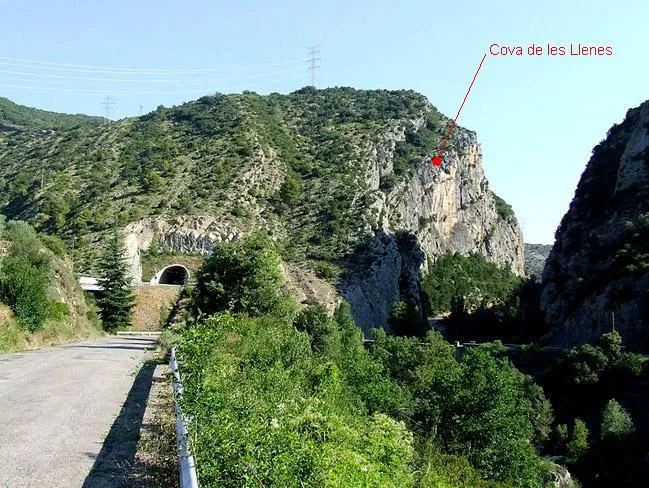
Cova de les Llenes
Cova de les Llenes, in the Serra de Lleràs: 253 metres of passage and 9 metres of vertical range (-6+3), with a 174-metre entrance-to-end gallery.
EspeleoWorld
Cova de les Llenes
Cova de les Llenes, in the Serra de Lleràs: 253 metres of passage and 9 metres of vertical range (-6+3), with a 174-metre entrance-to-end gallery.
Conca de Dalt · Pallars Jussà
Sviluppo: 253 m · Profondità: 9 m
Scheda aggiornata
https://espeleoworld.com/it/c/cova-de-les-llenes
Le informazioni possono cambiare. Verifica sempre coordinate, accesso, meteo e condizioni della cavità prima di partire.
Cova de les Llenes, in the Serra de Lleràs: 253 metres of passage and 9 metres of vertical range (-6+3), with a 174-metre entrance-to-end gallery.
Topografia
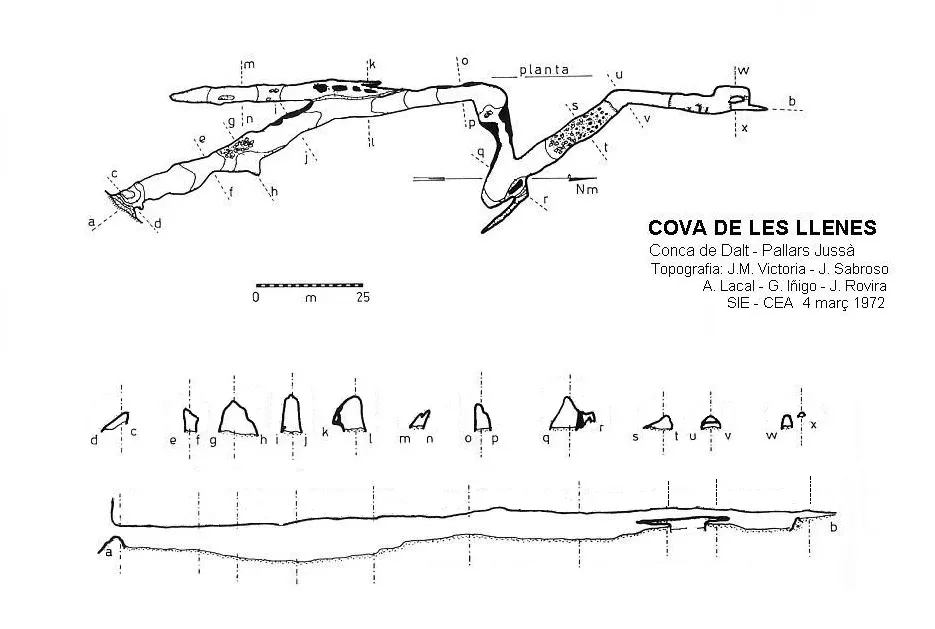
Espeleoindex · CC BY-NC 4.0, https://creativecommons.org/licenses/by-nc/4.0/ · Immagine © del suo autore.
Foto
Espeleoindex · CC BY-NC 4.0, https://creativecommons.org/licenses/by-nc/4.0/ · Immagine © del suo autore.
Descrizione
Morfologia
This interesting cavity is made up practically of a single gallery of irregular layout and 174 metres in entrance-to-end length. Once past the entrance, one reaches a slightly descending gallery, which gradually gains height until reaching a wider chamber, the product of the union of the main gallery with a secondary one that exits at the SW end; from this point the gallery begins to rise, turns about 90º to the right and narrows for a few metres due to the presence of two parietal flows, widening again and forming a chamber of regular dimensions. On the E side, there is a small gallery of short length, hanging behind an important lithogenic accumulation. The main gallery changes direction again and the gallery sections become smaller and triangular in shape; a few metres on there is an important sediment deposit that covers the lower half of the floor; once this stretch is passed, one reaches the final part, where two ascending conduits that join a few metres on lead to a small gallery that soon becomes impenetrable.
Concrezioni
The gallery narrows for a few metres due to the presence of two parietal flows. On the E side, there is a small gallery of short length, hanging behind an important lithogenic accumulation.
Progressione
The route is 253 metres and the vertical range is 9 metres (-6+3).
Storia
The first report about the Cova de les Llenes is given by N. Font i Sagué in the appendix of his Catàlech (1897), although he only mentions it and says that it is in the congost d’Erinyà. M. Faura i Sans mentions it again in his Recull (1909) and two years later he also refers to it in the excursion carried out in August 1910 (accompanied by Jeannel and Racovitza), although everything seems to indicate that they did not manage to visit it.
The first data we know about the exploration of this cavity are those carried out by Lluís Marià Vidal in the early years of the 20th century; he collected various archaeological material that became part of his private collection, studied later by Josep de C. Serra Ràfols, who in 1921 published a note on the matter in the publications of the prehistory seminar of the University of Barcelona and also in the bulletin of the Centre Excursionista de Catalunya. It seems that in 1920 the cavity was visited by Serra Ràfols himself and J. Colomina.
In June 1950 the Instituto de Estudios Pirenaicos organised an archaeological campaign at the cavity, directed by Joan Maluquer de Motes. Among other results, the finding of remains of Ursus spelaeus stands out. During these days a first topographic sketch of the cave was also produced.
Later we have news of different visits by speleological groups, although very sporadic, but it is not until March 1972 that members of the SIE – CEA make a complete and detailed survey of the cavity, which remained unpublished until its publication in the Catàleg Espeleològic de Catalunya, vol. 3 (1979).
In 2013, within the framework of a research project of the Institut Català de Paleoecologia Humana i Evolució Social (IPHES), the cave was closed with an iron grille by the Cos d’Agents Rurals in order to protect the site.
Note biospeleologiche
Coleoptera: Speonomus crypticola (very frequent in all the reliefs of the Serra de Lleràs).
Commenti degli utenti (0)
Nessun commento ancora.
Sii il primo a condividere la tua esperienza!
Esplorazioni registrate (0)
Nessuna esplorazione registrata.
Registra la tua visita a questa grotta!
Bibliografia
- Borràs, J; Miñarro, J.M.; Talavera, F.(1979).-Catàleg Espeleològic de Catalunya (Vol.3). Ed. Políglota. Barcelona.
- Faura i Sans, Mn.(1911).-”Excursiones espeleológicas realizadas durante el año 1910 en la región catalana”. Bol. Soc. Esp. de Historia Natural (6):355-377.
- GEB.(1966).-Memoria I Campamento Regional de Espeleólogos (Serradell). CRES – FCM.
- Maluquer de Motes, Juan.(1951).-”Investigaciones Arqueológicas en el Pallars III. La cueva de les Llenes de Eriñá”. Monografias del Instituto de Estudios Pirenaicos. Consejo Superior de Investigaciones Científicas. Zaragoza.
- Serra Ráfols, Josep de C.(1921).-”La col·lecció Lluís Marian Vidal”. Butlletí Centre Exc. Catalunya (317):155-157. CEC. Barcelona.
- Vega, Josep de la. (1981).-”Aplec de documents arqueològics de les coves del Montsec i llur projecció a les comarques i serres properes”. Mediterrània (12): 1-359.
- Valles, Jordi de. (2008).-”Alta Ribagorça, Pallars Jussà, Pallars Sobirà, Val d'Aran”. Catàleg Espeleològic de Catalunya (vol-1):1-319. EC Gràcia/FCE.
- Coordenades, fotos i situació extretes del blog 'Espeleobloc', posts dels dies 2 i 3-10-2012.
Grotte vicine
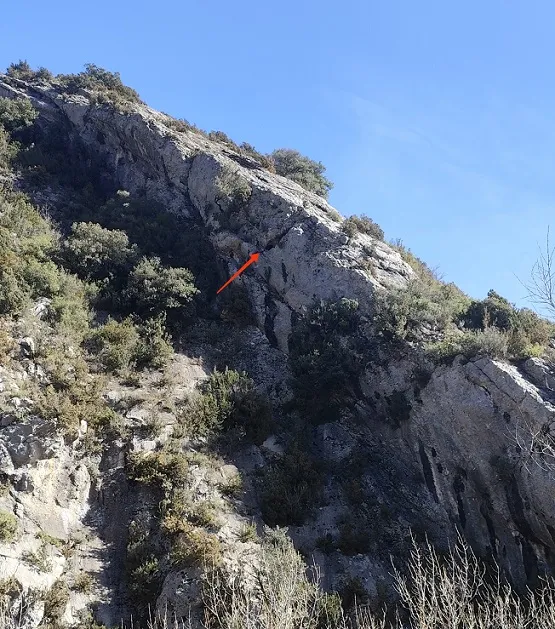
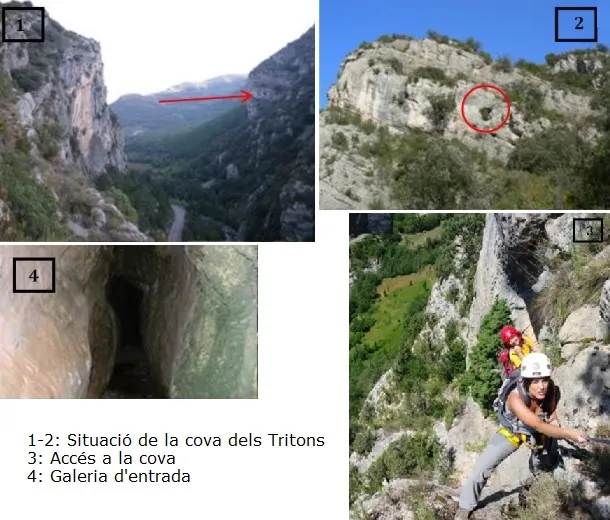


Fonte: Espeleoindex (espeleoindex.com), modificato. CC BY-NC 4.0, https://creativecommons.org/licenses/by-nc/4.0/