
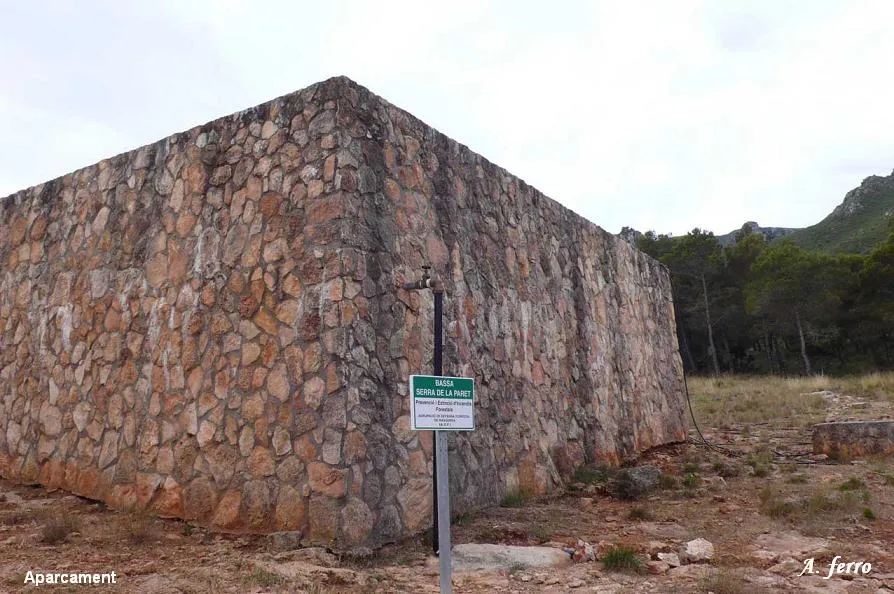
Cova de la Rabosa
A 265 m long cavity at El Perelló, with two entrances, a large inclined chamber and stalagmite masses; discovered in 1954 and surveyed by the SIE in 1980.
EspeleoWorld
Cova de la Rabosa
A 265 m long cavity at El Perelló, with two entrances, a large inclined chamber and stalagmite masses; discovered in 1954 and surveyed by the SIE in 1980.
Perelló, El · Baix Ebre
Sviluppo: 265 m · Profondità: 63 m
Scheda aggiornata
https://espeleoworld.com/it/c/cova-de-la-rabosa
Le informazioni possono cambiare. Verifica sempre coordinate, accesso, meteo e condizioni della cavità prima di partire.
A 265 m long cavity at El Perelló, with two entrances, a large inclined chamber and stalagmite masses; discovered in 1954 and surveyed by the SIE in 1980.
Topografia
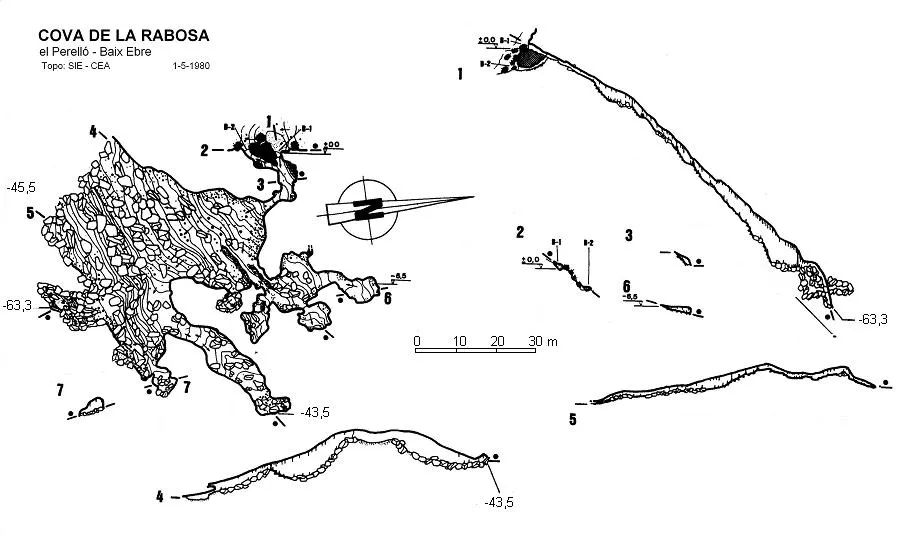

Espeleoindex · CC BY-NC 4.0, https://creativecommons.org/licenses/by-nc/4.0/ · Immagine © del suo autore.
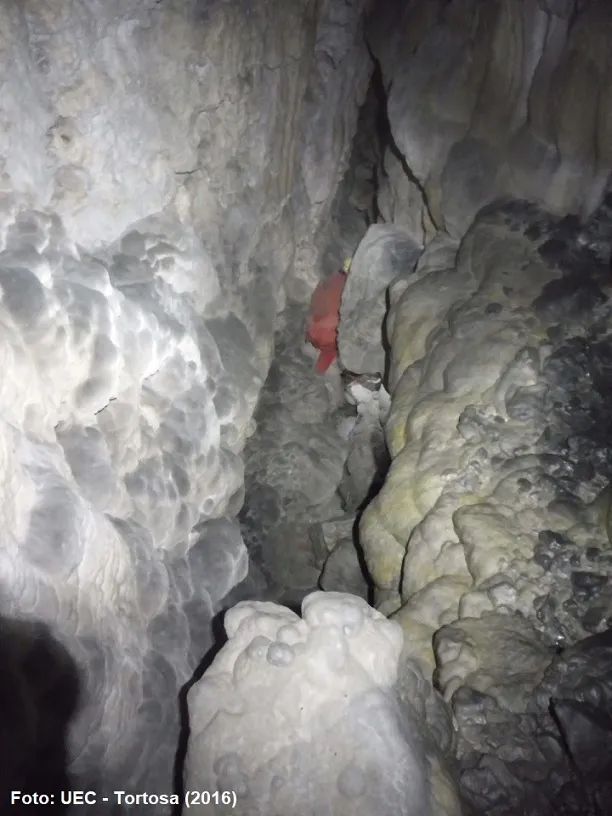
Foto

Espeleoindex · CC BY-NC 4.0, https://creativecommons.org/licenses/by-nc/4.0/ · Immagine © del suo autore.
Descrizione
Morfologia
Two small entrances situated at different levels allow access to a slightly descending passage that quickly leads into a single chamber, so to speak, of very variable width and with a floor made up of a ramp that maintains an almost uniform inclination of about 45º and is divided by a large number of blocks and stalagmite masses that give rise to a multitude of chambers of different capacities.
In the deepest sector, the presence of a much more evolved clastic process gives rise to a more chaotic stretch made up of small pits and interstices between blocks.
Establishing a route in a cavity of these characteristics is always very relative. The SIE survey (1980) determines a route of 265 metres, which is the result of adding the entrance-to-bottom traverse, the average width of the main chamber and the traverses of the side galleries. The maximum calculated drop is 63.3 metres.
Concrezioni
Great profusion of speleothems and stalagmite masses that divide the main chamber.
Storia
Discovered by some hikers in the spring of 1954. Various residents of El Perelló, supported by the mayor, made various incursions into the cavity and, faced with the great profusion of speleothems, believed in the possibility of tourist exploitation. The “Gobierno Civil” of Tarragona contacted the GES of the CMB and subsidised them in order to carry out a full exploration and a feasibility study for a tourist project. The expedition took place from 5 to 7 June 1954 and they produced a negative report regarding the possibilities of tourist exploitation.
Commenti degli utenti (0)
Nessun commento ancora.
Sii il primo a condividere la tua esperienza!
Esplorazioni registrate (0)
Nessuna esplorazione registrata.
Registra la tua visita a questa grotta!
Bibliografia
- Montoriol, J. y Andrés, O. (1955).- Estudio geoespeleológico de varias cavidades del borde oriental de la Sierra del Boix (Tarragona)” Speleon VI (4): 257-277. Universidad de Oviedo.
- SIE (1984).- “Resultat de les exploracions realitzades a la zona del Perelló (Baix Ebre)” EspeleoSie (27): 76-97. SIE – CE Àliga. Barcelona.
- Fotografies de Julio Serrano i Montse Roca, extretes del blog: espeleobloc (post del 13-1-2014)
Grotte vicine
Avenc del Cim de l'obaga del Pollo
0.8 km · SO
Tivenys (Baix Ebre)
4 topo.13 foto
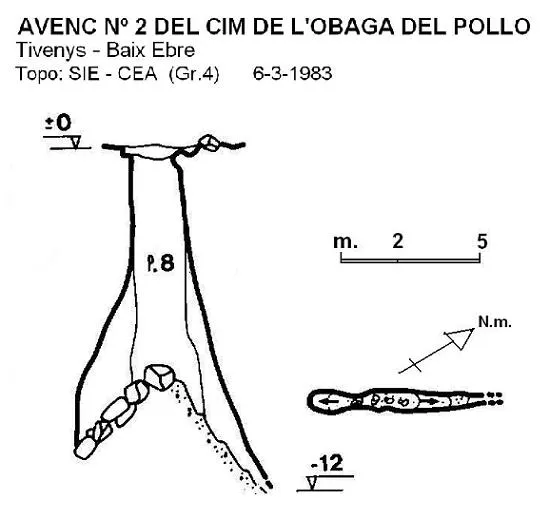
Avenc Nº2 del Cim de l'obaga del Pollo
0.8 km · SO
Tivenys (Baix Ebre)
1 topo.

Avenc del Camí de Xàquera
0.8 km · SO
Tivenys (Baix Ebre)
4 topo.11 foto

Cova-avenc del Cim de l'obaga del Pollo
0.8 km · SO
Tivenys (Baix Ebre)
4 topo.7 foto
Fonte: Espeleoindex (espeleoindex.com), modificato. CC BY-NC 4.0, https://creativecommons.org/licenses/by-nc/4.0/