
Cova de Can Sadurní
Small cave in the N of Begues, of great archaeological value, with remains from the Epipaleolithic to Roman times.
EspeleoWorld
Cova de Can Sadurní
Small cave in the N of Begues, of great archaeological value, with remains from the Epipaleolithic to Roman times.
Begues · Baix Llobregat
Sviluppo: 35 m · Profondità: 5 m
Scheda aggiornata
https://espeleoworld.com/it/c/cova-de-can-sadurni
Le informazioni possono cambiare. Verifica sempre coordinate, accesso, meteo e condizioni della cavità prima di partire.
Small cave in the N of Begues, of great archaeological value, with remains from the Epipaleolithic to Roman times.
Topografia

Espeleoindex · CC BY-NC 4.0, https://creativecommons.org/licenses/by-nc/4.0/ · Immagine © del suo autore.
Foto

Espeleoindex · CC BY-NC 4.0, https://creativecommons.org/licenses/by-nc/4.0/ · Immagine © del suo autore.
Descrizione
Morfologia
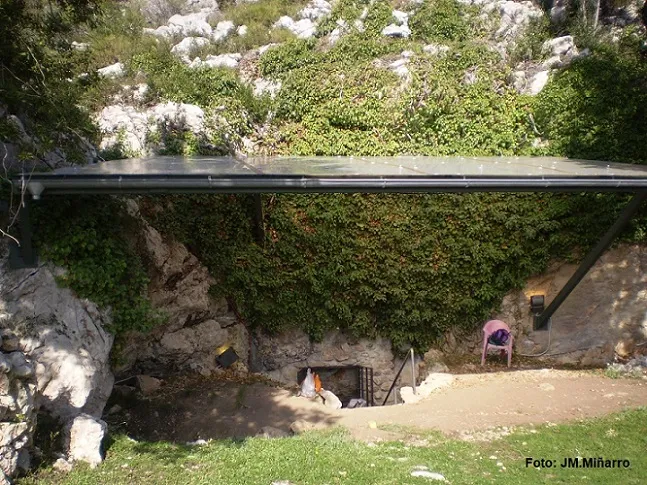
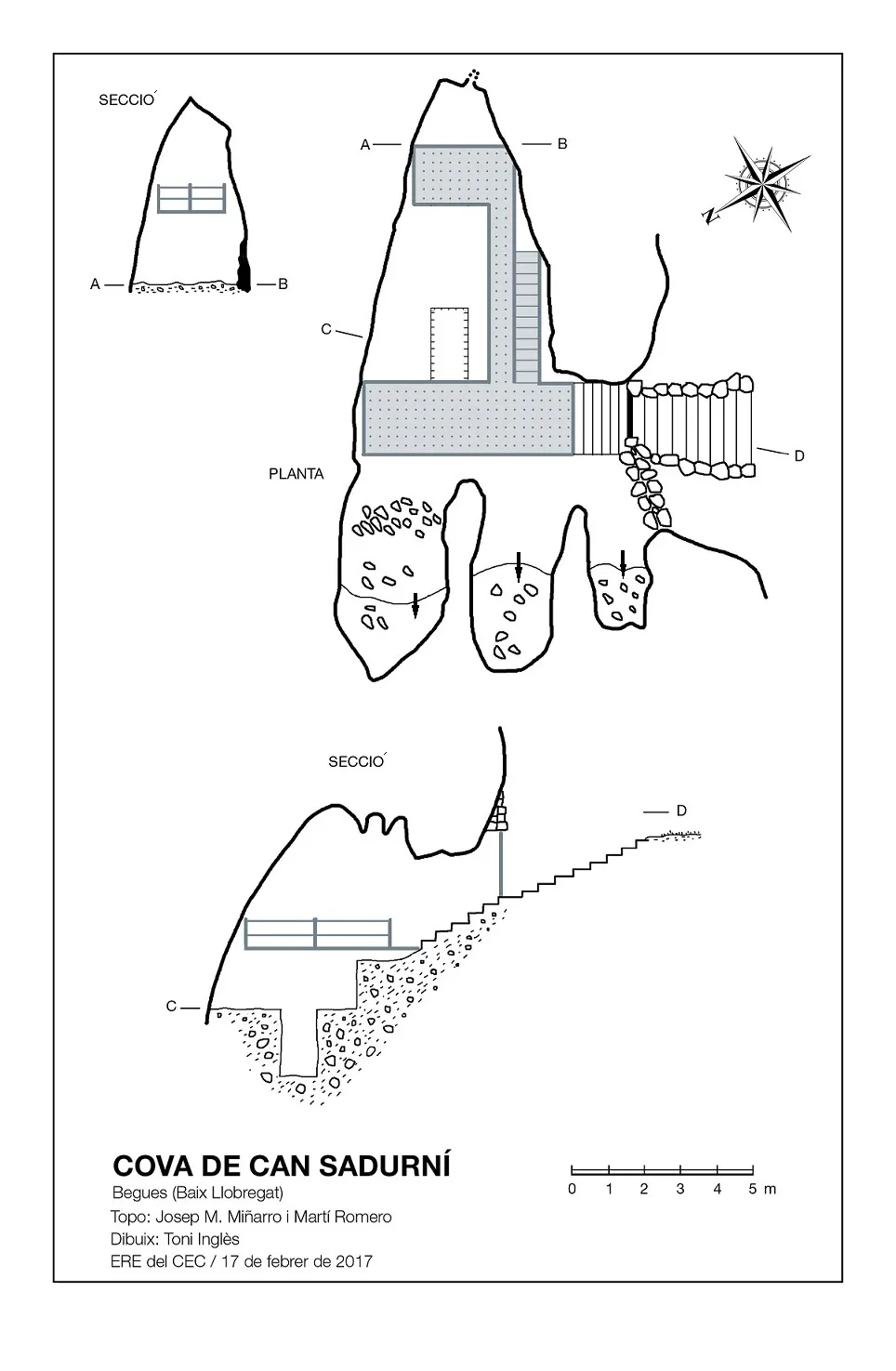
By some cement steps one reaches the main hall of the cave, elongated in shape and about 12 metres long by 6 metres at the widest part, as well as about 4 metres high from the original level. A good part of this chamber is occupied by a metal walkway situated at the original level and serves as a viewing point over the whole central section where the excavation work has been done. On the S wall there is a metal ladder that, with a few steps, allows one to reach the bottom of the excavated level.
On the west side of the hall three short galleries develop, with a low ceiling and clayey floor with some small clastic products. For the moment no excavation has been carried out in these passages.
Storia
Known since time immemorial as has been confirmed by the archaeological interventions where remains have been found from the Epipaleolithic to Roman times.
During the Middle Ages it was known as l'Espluga. It seems that following the decree of the day 2 of November of 1841 issued by the “Junta Suprema de vigilancia y seguridad pública de la provincia de Barcelona”, the cave was sealed by the carabiniers. At this time it was possibly already known as Cova de les Teixoneres, a place name that still appears today on the ICGC map.
We do not hear of it again until N. Font i Sagué, on the afternoon of 24 of June of 1897, visits it on a preliminary excursion at the start of his speleological campaigns. At that moment he already mentions it as Cova de Can Sadurní and makes no reference to it being sealed.
Around 1945, Sadurní Vendrell, owner of the estate, while doing levelling work inside the cave with the aim of dedicating it to mushroom cultivation, found various ceramic remains, flint pieces, a Roman lamp, a bronze spearhead, ... All these materials were deposited at that time in the Museum of Vilafranca del Penedès. The walls of the main hall of the cave were painted with lime and today the whiteness can still be observed on the walls. It seems that the mushroom business was not very successful.
In July 1963, members of the GES – CMB visit the cave and make a first survey and a brief description (Speleon – XV).
From here the cave begins to receive regular visits from hikers and speleologists. Around the 1970's some clandestine interventions are detected and it is in 1978 when a first research project begins.
Among the most notable finds one should mention four skeletons buried inside and a curious ceramic figurine (l'Encantat de Begues) about 6500 years old. Also much resonance was caused by the finding of a fragment of a ceramic vessel with remains of beer components, apparently the oldest in Europe.
The direction of the archaeological excavations, for 35 years, is in the charge of Manuel Edo, Ferran Antolín and Pablo Martínez. The entity that organises the excavations is the CIPAG, a multidisciplinary scientific team, made up of more than 60 specialists, scientific figures and laboratories from various Catalan universities and research seminars (Seminari d’Estudis i Recerques Prehistòriques de la Universitat de Barcelona, Laboratoris d’Arqueozoologia, Arqueobotànica i d’Antropologia de la Universitat Autònoma de Barcelona, Universitat de Lleida, UPC, CSIC...). On the part of the University of Barcelona the researcher who coordinates different aspects of geoarchaeology is Dr. Marià Mercè Bergadà.
Commenti degli utenti (0)
Nessun commento ancora.
Sii il primo a condividere la tua esperienza!
Esplorazioni registrate (0)
Nessuna esplorazione registrata.
Registra la tua visita a questa grotta!
Bibliografia
- Blasco, A.; Edo, M.; Villalba, Mª J. (2011).- La Cova de Can Sadurní i la prehistòria de Garraf. Recull de 30 anys d'investigació. EDAR
- Bergadà, MªM.; Cervelló, J.M. (2011).- «Estratigrafia, micromorfologia i paleoambient de la Cova de Can Sadurní (Begues, Baix Llobregat) des dels c. 11.000 fins als 5.000 anys BP». La cova de Can Sadurní i la Prehistòria de Garraf. Recull de 30 anys d’investigació.
- Font i Sagué, N. (1897).- “Sota Terra. Preliminars per una excursió espeleològica”. Butlletí del CEC (28): 153-158. Centre Excursionista de Catalunya. Barcelona.
- Montoriol, J. (1964).- “Estudio de las formas cársticas hipogeas desarrolladas en los bordes del polje de Begues (Macizo de Garraf, Barcelona)”. Speleon (XV, 1-4): 3-38. Universidad de Oviedo
Grotte vicine
Avenc Petit de Can Sadurní
0.1 km · SO
Begues (Baix Llobregat)
1 topo.3 foto

Avenc del Torrent Fondo
0.5 km · NO
Begues (Baix Llobregat)
1 topo.4 foto
Avenc de Cal Jepet
0.6 km · N
Begues (Baix Llobregat)
1 topo.
Avenc del Torrent del Coll de la Creu
0.6 km · N
Begues (Baix Llobregat)
2 topo.7 foto
Fonte: Espeleoindex (espeleoindex.com), modificato. CC BY-NC 4.0, https://creativecommons.org/licenses/by-nc/4.0/