
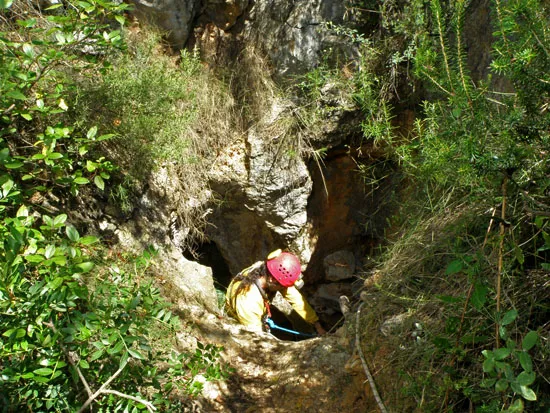
Bauma de Taleixà
An 18 m deep pit in Terrades (Alt Empordà), with a shaft of sloping walls and about 16 m of vertical drop, also known as Bauma de Taleixà.
EspeleoWorld
Bauma de Taleixà
An 18 m deep pit in Terrades (Alt Empordà), with a shaft of sloping walls and about 16 m of vertical drop, also known as Bauma de Taleixà.
Terrades · Alt Empordà
Sviluppo: 42 m · Profondità: 18 m
Scheda aggiornata
https://espeleoworld.com/it/c/bauma-de-taleixa
Le informazioni possono cambiare. Verifica sempre coordinate, accesso, meteo e condizioni della cavità prima di partire.
An 18 m deep pit in Terrades (Alt Empordà), with a shaft of sloping walls and about 16 m of vertical drop, also known as Bauma de Taleixà.
Topografia
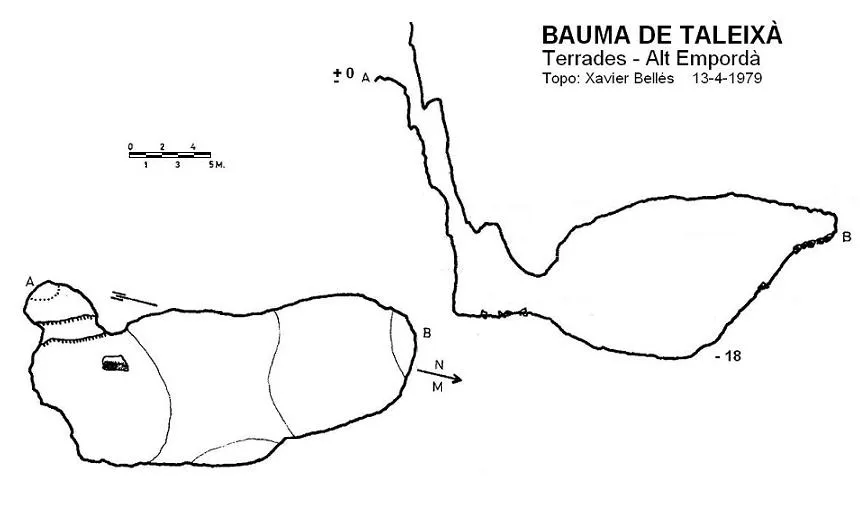
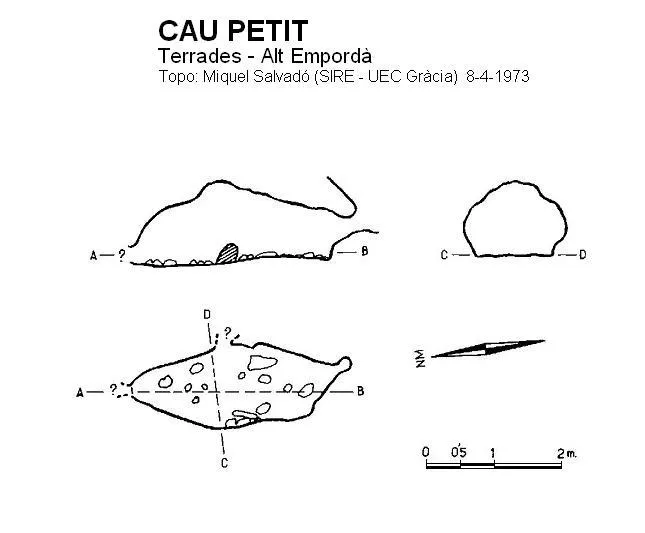
Espeleoindex · CC BY-NC 4.0, https://creativecommons.org/licenses/by-nc/4.0/ · Immagine © del suo autore.
Foto
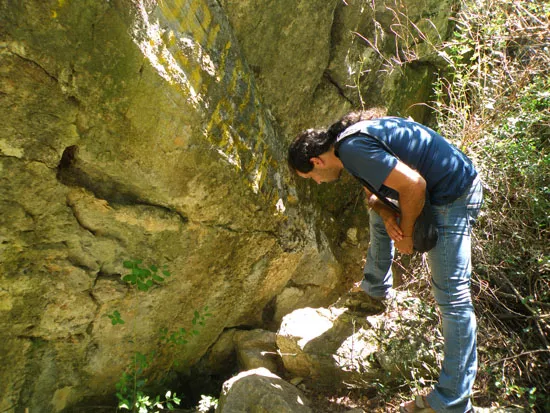
Espeleoindex · CC BY-NC 4.0, https://creativecommons.org/licenses/by-nc/4.0/ · Immagine © del suo autore.
Descrizione
Morfologia
It consists of a shaft with sloping walls and about 16 metres of vertical drop, which cuts laterally into a chamber of regular dimensions. The central part of this chamber is the point of maximum drop, and further on it continues through a cone of debris in an ascending direction, located at the opposite end from the point of entry.
Of very similar characteristics to the nearby Avenc de Can Vilà and possibly with a certain relationship between the two cavities.
Concrezioni
Lithogenesis is very localised.
Idrologia
The generating joint was affected by the action of water coming from the entrance and perhaps also from a dome located in the ceiling of the chamber; a clastic process reshaped the final chamber to its current state.
Altri dettagli
Toponymy: We retain the original toponymy of bauma, instead of balma and avenc, which have been used to name this cavity. We believe that in Old Catalonia it is the most common, just as in New Catalonia balma is the norm.
As in this case, bauma does not refer to what we normally know as a shelter; this word is very widespread throughout much of Europe with multiple variants: bame, baume, balme, barme, beaume, baumo,... especially in the area of Occitan influence, but also in others. In Switzerland it is even used to designate both caves and pits, and the variants reach as far as the Tyrol.
Those interested in the subject can consult: BIGOT, Jean-Yves (2000).- Vocabulaire français et dialectal des cavités et phénomènes karstiques”. 184 pp. Spéléo-Club de Paris.
Storia
Following his investigations in the Terrades area and trying to find another specimen of the prized Zariquieya troglodytes (only one specimen existed from the Bauma de Bruguer), Dr. Ricardo Zariquiey Álvarez was informed of the existence of a pit that the villagers know as Bauma de Taleixà. Faced with the presence of the entrance shaft, Dr. Zariquiey had a rope ladder made in Arenys de Mar and sent it to Terrades, to the house of Mr. Vilanova, who was his guide on his excursions, and since he suffered from an extraordinary vertigo that prevented him from overcoming the slightest little shaft, Vilanova descended the pit in early September 1924 and a few more times afterwards, as a result of which he managed to capture four specimens of Zariquieya. Such was the interest in this carabid that, around 1932 or 1933, M. René de la Borde went expressly to Terrades and, accompanied by Mr. Vilanova, descended the pit where he was able to capture two more specimens.
Needless to say, all generations of Catalan biospeleologists, from Dr. F. Español to the youngest, have passed through the Bauma de Taleixà and the other cavities of Terrades.
We update the record by including another survey made by the colleague Oleguer Escolà in 1975, which we have rediscovered in the ERE – CEC archive and which had remained unpublished until now. The only difference from the others is that this one gives it a couple of metres more depth.
Note biospeleologiche
Coleoptera:
Speonomus delarouzeei Farmaire
Zariquieya troglodytes Jeann.
Commenti degli utenti (0)
Nessun commento ancora.
Sii il primo a condividere la tua esperienza!
Esplorazioni registrate (0)
Nessuna esplorazione registrata.
Registra la tua visita a questa grotta!
Bibliografia
- Borràs, J.; Miñarro,JM.; Talavera,F. (1980).- Catàleg espeleològic de Catalunya. Vol. 4: el Ripollès, la Garrotxa i l'Alt Empordà. 296 pp. Ed.Políglota. Barcelona.
- Escolà, O.; Bellés, X. (1984).- “Distribució geogràfica dels Speonomus del subgènere Parvospeonomus (Col. Catopidae Bathysciinae) al vessant meridional dels Pirineus. Actes de la III Sessió conjunta d'entomologia: 19-28. ICHN – SCL. Mataró
- Español, F. (1946).-”La Zariquieya troglodytes Jeann.” Graellsia 4 (4): 89-97
- Español, F. (1956).- “Los Bathysciinae catalanes (col. Catopidae)”. Actes du II Congrés International d'Etudes Pyrénéens, T.3 (2):109-123. Luchon – Pau, 1954.
- Lagar, A.; Salvadó, M.; Sabater, J.; Torrella, J. (1973).- “Cavidades de Terrades (Alt Empordà, Girona)”. Senderos (176): 19-25. Unió Excursionista de Catalunya. Barcelona.
- Pallarès, J. (1979).- “Nota sobre la influència de la presència humana en la climàtica d'una cavitat”. Gours (6): 9-12. GEFOMA. Foment Martinenc. Barcelona.
- Coordenades i fotografies extretes del blog: espeleobloc.blogspot (apunt del 15-8-2011)
Grotte vicine


Fonte: Espeleoindex (espeleoindex.com), modificato. CC BY-NC 4.0, https://creativecommons.org/licenses/by-nc/4.0/