
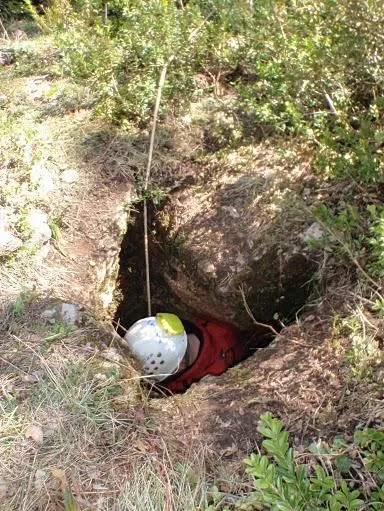
Avenc de l'Engany
A 78 m deep pit at the Mola de Catí (el Port, Tortosa), with a labyrinthine route and large vertical shafts.
EspeleoWorld
Avenc de l'Engany
A 78 m deep pit at the Mola de Catí (el Port, Tortosa), with a labyrinthine route and large vertical shafts.
Tortosa · Baix Ebre
Sviluppo: 150 m · Profondità: 78 m
Scheda aggiornata
https://espeleoworld.com/it/c/avenc-de-l-engany
Le informazioni possono cambiare. Verifica sempre coordinate, accesso, meteo e condizioni della cavità prima di partire.
A 78 m deep pit at the Mola de Catí (el Port, Tortosa), with a labyrinthine route and large vertical shafts.
Topografia
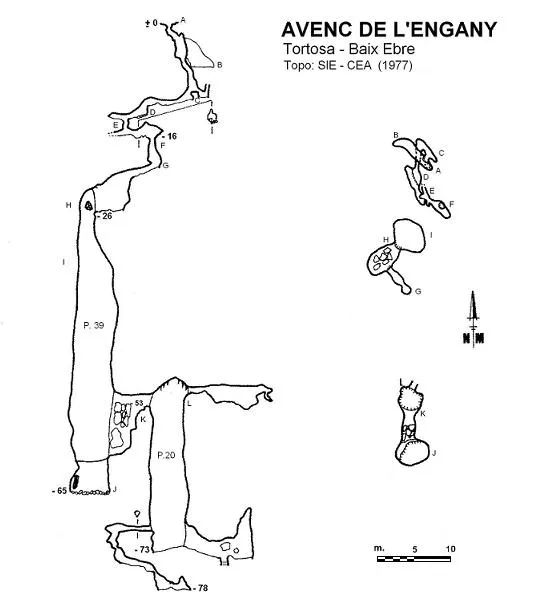
Espeleoindex · CC BY-NC 4.0, https://creativecommons.org/licenses/by-nc/4.0/ · Immagine © del suo autore.
Foto
Espeleoindex · CC BY-NC 4.0, https://creativecommons.org/licenses/by-nc/4.0/ · Immagine © del suo autore.
Descrizione
Morfologia
The entrance appears as a tiny shaft of irregular outline, with dimensions of 0.4 x 0.6 metres that increase slightly as depth is gained. At -1.5 a 3 metre drop is descended by opposition, leading out into a small side chamber. The continuation is found just in front of the last vertical (NE), being a crawl with a steep slope that gives onto a 3 metre drop which we will also descend by opposition, following a further 1.5 metre drop that leads to the -10 level. From this point until reaching 15 metres depth it is a chaotic and labyrinthine stretch. From -10 we follow towards the NW for 3 metres, then turn sharply to the S. 4 metres further on, crawling, a further 1.2 metre drop is descended, the fissure turns towards the SE 4 metres more and shortly before ending, on the floor and behind a block, a 2.2 metre shaft opens; at its bottom there are two possible continuations. We take the more southerly one and after a low crawl with a bend, one reaches the small chamber at the -16 level. From here, a 3.8 metre shaft leads us to a well-defined conduit, 4 metres long, 25º inclination and 1 metre in diameter, leading out, by means of an overhanging 4.6 metre shaft, into a chamber of 5 x 3 x 5 metres, with the floor covered in blocks. From this chamber (-26.5 level) a morphological change becomes evident and the signs of dissolution-corrosion are clear, exposing the rhythmic stratification characteristic of the great cavities of the massif. By means of a window one reaches the broad 39 metre shaft that constitutes the major axis of the pit; at its bottom, -65 level, there is no appreciable continuation, but 5 metres above the base, there is a ledge on the SE wall with a cornice that curves diagonally around the shaft and allows us to overcome, between blocks, 7 metres until reaching the -53 level, where a gallery leads us rapidly to another broad 20 metre shaft. Before beginning the descent, by means of a delicate and airy traverse between flowstone on the eastern part of the shaft, one can reach 5 metres further on and just in front of the gallery joining the two “great” shafts, a stretch of gallery about 12 metres long. At the bottom of the shaft (-73 level), there is a short gallery towards the SW. With a terminal chimney and a small flooded shaft. However, progression can be continued by climbing 2.4 metres up the base of the shaft. At this point, and through a crawl in keyhole form, one reaches a descending 4 metre drop and at its bottom, after a very selective narrow section, the conduit becomes vertical again for 3 metres to continue at its bottom again with difficulties and lead out within a few metres into a terminal small chamber 1.5 metres in diameter, where the point of maximum depth is reached.
Idrologia
At the bottom of the shaft (-73 level), there is a small flooded shaft.
Progressione
Progression can be continued by climbing 2.4 metres up the base of the shaft. At this point, and through a crawl in keyhole form, one reaches a descending 4 metre drop and at its bottom, after a very selective narrow section, the conduit becomes vertical again for 3 metres to continue at its bottom again with difficulties and lead out within a few metres into a terminal small chamber 1.5 metres in diameter, where the point of maximum depth is reached.
Storia
Discovered and explored down to -30m during Holy Week (April 1970) by D. Schibi and F. Monsonís (ERE – CEC). During these same days the Avenc de la Casualitat (-7m) was explored, of which no data are preserved and which could be some other cavity in the area later known under another name.
A week later (25 and 26-4-1970) a team from the ERE-CEC (D. Schibi, O. Escolá, M. Ubach and P. Cantons) return to the cavity and carry out the complete exploration down to -80m, according to the sketch made at that time. (Information provided by Pere Cantons).
It is not until 1977 that it is rediscovered by members of the SIE-CEA and they make it known the following year.
Commenti degli utenti (0)
Nessun commento ancora.
Sii il primo a condividere la tua esperienza!
Esplorazioni registrate (0)
Nessuna esplorazione registrata.
Registra la tua visita a questa grotta!
Bibliografia
SIE (1978).- “Contribució al coneixement espeleològic dels Ports del Caro (Baix Ebre) (IV): La Mola de Catí i el Mont Caro”. EspeleoSie (21): 27-70. SIE-CE Àliga. Barcelona.
Fotografies i Coordenades aportades per: Elena Mateu, Oscar Barquero i Joan Sabater.
Grotte vicine
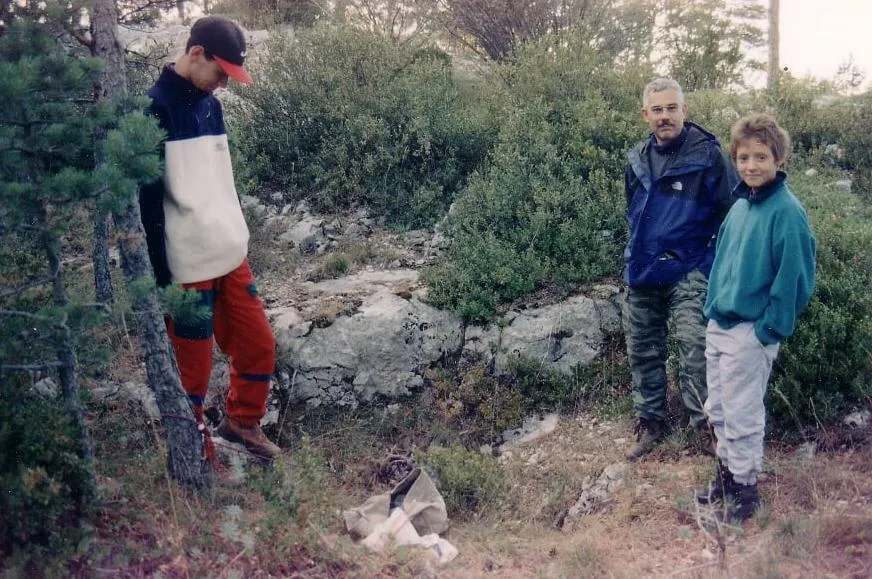
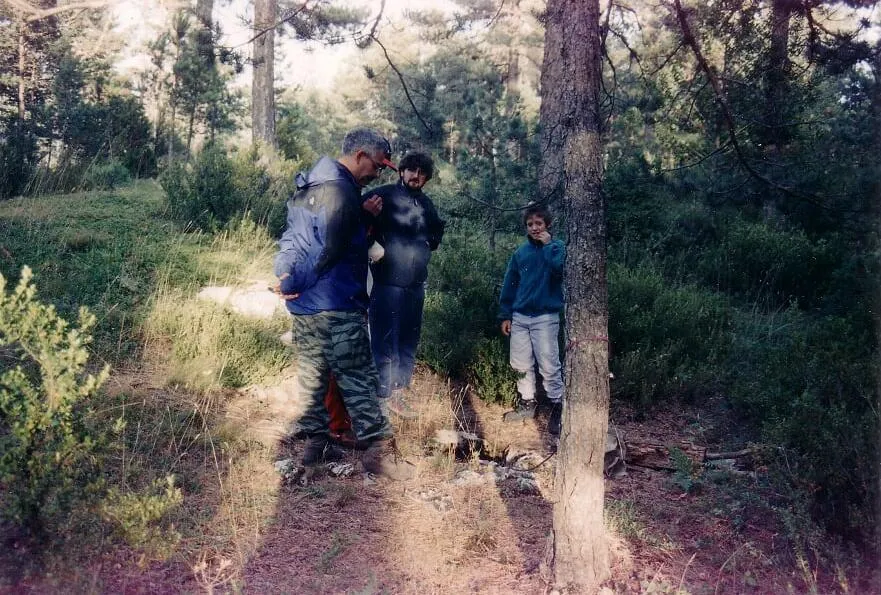


Fonte: Espeleoindex (espeleoindex.com), modificato. CC BY-NC 4.0, https://creativecommons.org/licenses/by-nc/4.0/