
Horat d'Escunhau
A 101 m deep pit in the Bargadèra area, Vall d'Aran, discovered and explored in 1997 by the Col·lectiu Escunhau (GIEG de Granollers and GREC de Barcelona).
EspeleoWorld
Horat d'Escunhau
A 101 m deep pit in the Bargadèra area, Vall d'Aran, discovered and explored in 1997 by the Col·lectiu Escunhau (GIEG de Granollers and GREC de Barcelona).
Vielha e Mijaran · Val d'Aran
Length: 117 m · Depth: 101 m
Updated record
https://espeleoworld.com/en/c/horat-d-escunhau
Information can change. Always verify coordinates, access, weather, and cave conditions before setting out.
A 101 m deep pit in the Bargadèra area, Vall d'Aran, discovered and explored in 1997 by the Col·lectiu Escunhau (GIEG de Granollers and GREC de Barcelona).
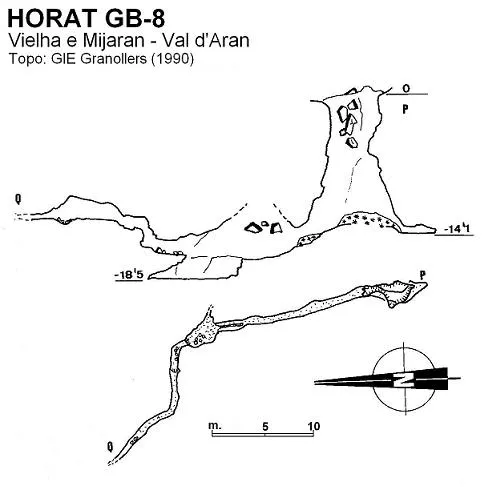
Topographic
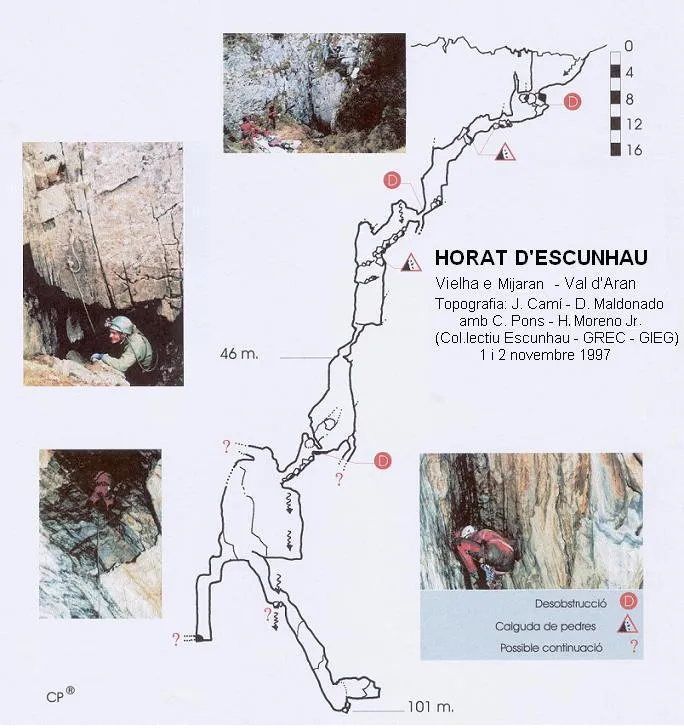
Espeleoindex · CC BY-NC 4.0, https://creativecommons.org/licenses/by-nc/4.0/ · Image © its author.
Description
Morphology
The pit is located at the bottom of a doline-like depression with fairly vertical walls. The cavity begins with a horizontal narrow passage where it was cleared, leading into a short shaft. At this point the plug of sediments that forms the base of the doline is clearly visible. Next, a steep slope of unstable stones gives way to a new shaft about 5 metres deep excavated in marble, the material that accompanies the rest of the cavity. At the base of the shaft there is sandy material. Then it continues through a fissure 3 metres long by 50 centimetres wide where a clearance also had to be made. Next there are two possible continuations: on the left begins an inclined slope of stones and on the right there is a blind shaft about 2 metres deep. The continuation is possible via the slope, which is followed by a shaft about 10 metres deep full of ledges. At its base there is a fairly narrow vertical passage of about 3 metres that leads into a small niche, which is the head of a cylindrical shaft about 14 metres deep. At the highest part of its base there is a pressure tube of possible continuation and on the opposite side, about 3 metres above the floor, there is a window with clear forms of being a water conduit. At the lowest part of the shaft there is a narrow passage where a new clearance was needed and, once this narrow passage is passed, a steep slope begins that leads into the shaft of greatest volume in the cavity, about 12 metres of drop. At the base of this shaft there are two possible continuations: in one of them a fossil tube starts which is crossed by the active water course and ends in a cul-de-sac, the point where the maximum depth level is reached (-101), where shortly before arriving a small room without apparent continuation is located. The other continuation follows a cylindrical shaft where it ends in a horizontal tube whose base is filled with sandy sediments and the target of future explorations.
Hydrology
On the right side of the doline-like depression an active water course flows, where before reaching the entrance it disappears among an accumulation of blocks. Through the ceiling of the blind shaft about 2 metres deep appears the water course that had been lost in the entrance doline. At the shaft of greatest volume in the cavity the water course is found again. A fossil tube is crossed by the active water course.
Progression
The exploration to the point of maximum known depth was prolonged in different attempts until November, due to the different clearances that had to be carried out to advance.
History
Discovered and explored during the summer campaign of 1997 at the barranc de la Bargadèra carried out by members of the Col·lectiu Escunhau (GIEG de Granollers and GREC de Barcelona).
User Comments (0)
No comments yet.
Be the first to share your experience!
Registered Explorations (0)
No explorations registered yet.
Register your visit to this cave!
Bibliography
- AA (1998).- “Últimas exploraciones” Subterránea (9): 4-11. Federación Española de Espeleología. Barcelona.
- Valles, Jordi de (2008).- “Catàleg espeleològic de Catalunya”. Vol. 1: 319 pp. EC de Gràcia – Federació Catalana d'Espeleologia. Barcelona.
· Dades de situació facilitades per Hilari Moreno Jr. (ERE-CEC).
Nearby caves

Source: Espeleoindex (espeleoindex.com), modified. CC BY-NC 4.0, https://creativecommons.org/licenses/by-nc/4.0/