
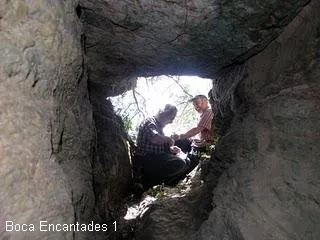
Coves de Santa Creu d'olorda
A group of five interrelated cavities on the western slope of the Serra de Collserola, at the ASLAND quarry, with 206 metres of surveyed passage and a maximum vertical range of 14 metres.
EspeleoWorld
Coves de Santa Creu d'olorda
A group of five interrelated cavities on the western slope of the Serra de Collserola, at the ASLAND quarry, with 206 metres of surveyed passage and a maximum vertical range of 14 metres.
Sant Feliu de Llobregat · Baix Llobregat
Length: 206 m · Depth: 14 m
Updated record
https://espeleoworld.com/en/c/coves-de-santa-creu-d-olorda
Information can change. Always verify coordinates, access, weather, and cave conditions before setting out.
A group of five interrelated cavities on the western slope of the Serra de Collserola, at the ASLAND quarry, with 206 metres of surveyed passage and a maximum vertical range of 14 metres.
Topographic
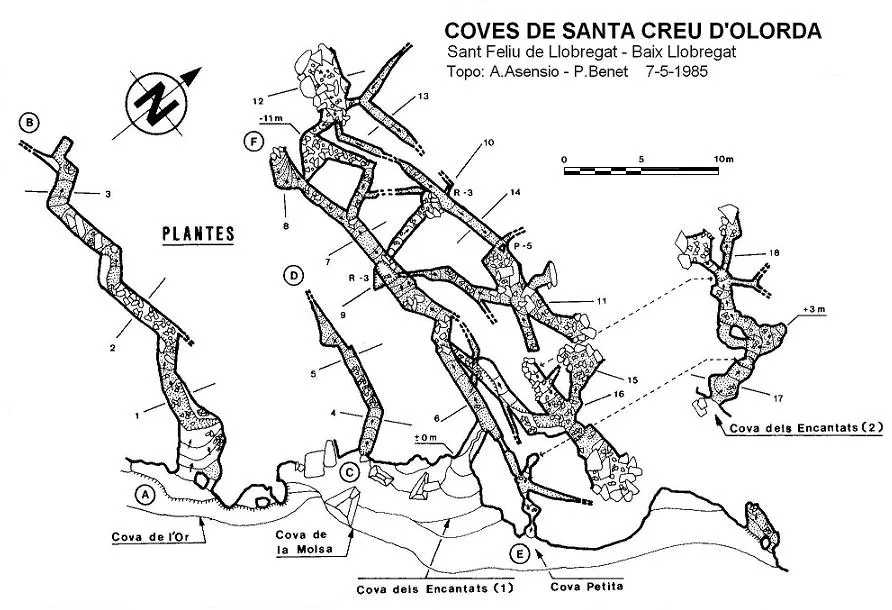
Espeleoindex · CC BY-NC 4.0, https://creativecommons.org/licenses/by-nc/4.0/ · Image © its author.
Photos
Espeleoindex · CC BY-NC 4.0, https://creativecommons.org/licenses/by-nc/4.0/ · Image © its author.
Description
Morphology
Under the name Coves de Santa Creu d'Olorda five cavities are known, a short distance from one another and clearly interrelated, from west to east, they are:
- Cova de l'Or: In the lower part of a small crag with an elongated mouth that gives way to a small vestibule of rounded section and low ceiling; at the opposite end and at floor level, there is a fissure 1.90 metres deep that is the start of a gallery 19 metres long, meandriform in shape and with the floor covered by earth and dust, ending in a narrow passage.
- Cova de la Molsa: 12 metres from the previous one, with a narrow mouth, it opens beside a large slab, half hidden by the abundant vegetation, and gives way to a single gallery of modest dimensions and descending direction along its 11 metres of passage.
- Coves dels Encantats 1 and Cova Petita: Cova dels Encants 1 opens through a short corridor that leads directly into the so-called main gallery, 25 metres long and with a section of 2 x 5 metres. In its widest area several branches emerge. The first is found just upon entering on the right, being the continuation of the main gallery, it is reached through a vertical crawl and immediately places us in a small chamber from which three continuations emerge: The first comes out to the exterior through the so-called Cova Petita, although its access is impenetrable; the second gives way to a narrow gallery of 4 metres and after passing another crawl and climbing a short step, leaves us at Cova dels Encantats 2, a few metres from its entrance. Descending along the main gallery, we will find on the right side a step, which gives access to a gallery of 4 metres, ending in an ascending step that is no more than its continuation at a higher level. A few metres further on it opens into a chamber of considerable dimensions, the largest in the cavity, from which three new continuations emerge, two of them of short length and ending in small exits caused by the accumulation of large blocks. The third continuation is the most evident, after climbing a gallery wide at the start and narrow at the end, and it also communicates with the Cova dels Encantats 2. Back in the main gallery and leaving behind the first step mentioned before, we will find another step (R-3) that abruptly cuts the gallery. This small pit, easily down-climbed on the right, gives access to two continuations, connected to each other by an upper gallery, which is reached through an R-3 on one side and a P-5 on the other, the base of this latter pit is formed by a chamber of very irregular section and with the floor totally covered by blocks. In the final stretch of the main gallery is the last branch, on the right side a short and descending gallery opens, joined to another of similar characteristics, but with a horizontal floor, linked to a triangular chamber; at its left end and at ceiling level, there is a crawl that links again with the final part of the main gallery. Back in the triangular chamber, on the right, a small room opens divided in two by accumulations of blocks and from this, two galleries at right angles of about 5 metres of passage each.
- Cova dels Encantats 2: It is found some 4 metres above Encantats 1, behind a small tree and with a mouth in the form of a crawl giving access to a flat-out passage cut a few metres on by a step that links with the lower cavity. Some 3 metres from this obstacle the flat-out passage widens and forms a small room with a low ceiling, joined at one end with a gallery of short length, divided in two by a curious rock bridge, this gallery in descending direction communicates again with the lower cave by means of a small step.
Speleometry: The sum of the passage of all the cavities is 206 metres. It should be noted that the authors of the survey specify that this is the surveyed passage, therefore the real passage would be somewhat greater. The maximum vertical range reached is 14 metres (- 11; +3) in the Encantats 1 cave.
History
Known since time immemorial by the people of the region and with a multitude of legends about treasures and bandits. Joan Amades collected in 1921 from Timoteu Colomines the story that at Santa Creu d'Olorda there exists a cave called cova de la Moneda, where there is an enchanted treasure in the form of small round stones and that anyone who has enough daring to go there at the point of twelve o'clock at night on Christmas Eve and take a quantity of stones, afterwards they will be turned into gold. It is said that various landowners of Sarrià made their fortune in this way.
Surely this cova de la Moneda is the one also known as coves de l'Or and coves dels Encantats, names that do not refer to any specific cavity but to the group of them, although recently a name has been given to each of the five mouths.
Despite these antecedents, they were not mentioned in any of the old speleological catalogues, and it is not until 1951 that members of the GES – CMB begin the work of exploration and survey. From here, they result in some cavities, which due to their proximity to Barcelona in times of economic hardship, become very popular and visited by the speleologists of the 1950s and until the early 60s, when the advance of the quarry makes their disappearance feared.
It is not until 1985 that A. Asensio and P. Benet relocate them, survey them and publish them, assigning a name to each of the five mouths.
Currently (2014), the mouth is closed with a grille with a padlock.
User Comments (0)
No comments yet.
Be the first to share your experience!
Registered Explorations (0)
No explorations registered yet.
Register your visit to this cave!
Bibliography
- Andrés, O. (1952).- “Exploración de las cuevas de Sant Creu d'Olorde” Speleon.T.III (1-2): 71-76. Universidad de Oviedo.
- Asensio, A.; Benet, P. (1991).- “ Les Coves de Santa Creu d'Olorda (Baix Llobregat)”. Cavernes (23): 31-34. GE Badalona.
- GES – CMB (1961).- Catálogo espeleológico de la provincia de Barcelona. Tomo 1; 95 pp. Club Montañés Barcelones – 1963
- Fotografies, coordenades i altres dades extretes del blog: Espeleobloc (post del 24 maig de 2007)
- Fotografia reixa boca i dades facilitades per Agustí Pérez (SIE-CEA)
Nearby caves
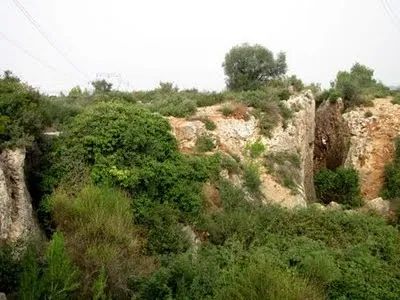
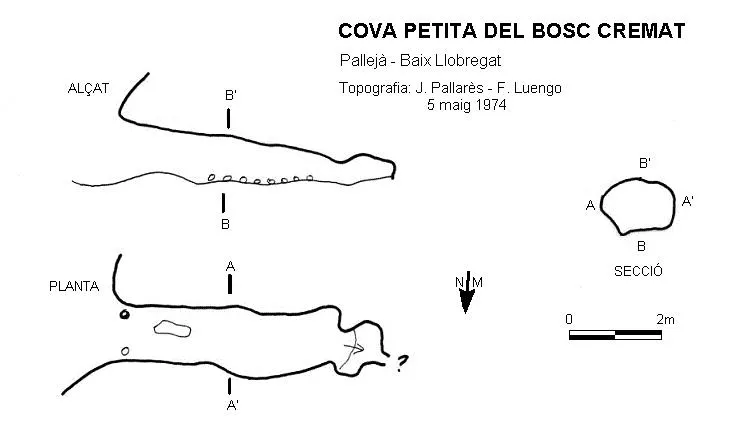


Source: Espeleoindex (espeleoindex.com), modified. CC BY-NC 4.0, https://creativecommons.org/licenses/by-nc/4.0/