
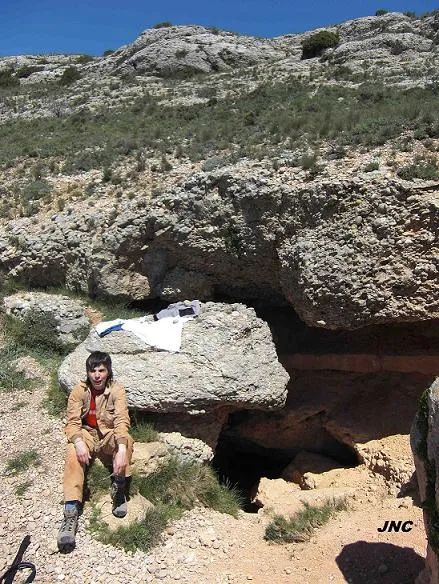
Cova Santa
La cova més coneguda del Montsant, de 200 m. de recorregut a la Morera de Montsant.
EspeleoWorld
Cova Santa
La cova més coneguda del Montsant, de 200 m. de recorregut a la Morera de Montsant.
Morera de Montsant, La · Priorat
Length: 200 m · Depth: 15 m
Updated record
https://espeleoworld.com/en/c/cova-santa
Information can change. Always verify coordinates, access, weather, and cave conditions before setting out.
The best-known cave of Montsant, with a 200 m route at la Morera de Montsant, known since time immemorial and in a precarious state of conservation due to the flood of visitors.
Topographic
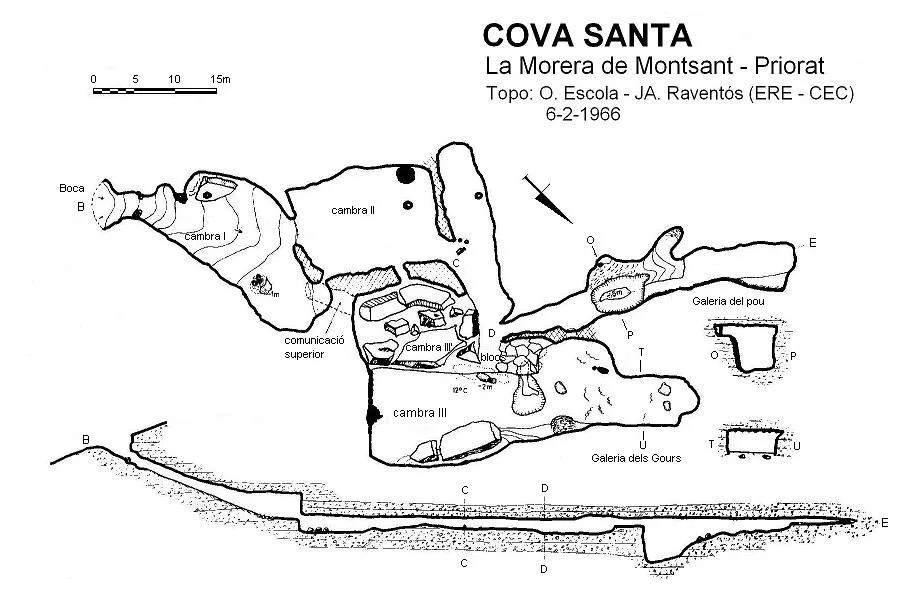

Espeleoindex · CC BY-NC 4.0, https://creativecommons.org/licenses/by-nc/4.0/ · Image © its author.
Photos

Espeleoindex · CC BY-NC 4.0, https://creativecommons.org/licenses/by-nc/4.0/ · Image © its author.
Description
Morphology
A collapse entrance located at the bottom of a sinkhole about 5 x 3 metres which, after a narrow passage, leads to chamber I (28 x 12 metres maximum dimensions), with a sloping floor occupied by a cone of exterior debris. Below this first chamber there is a small room of small dimensions.
At the bottom of chamber I there are two openings, one main and the other of very reduced dimensions, which give access to chamber II (17 x 12 metres) with a ceiling formed by a bedding plane. At its N end, a portico leads out into the middle of a gallery 22 metres long which, at its NE end, leads out into chamber III'. This, about 15 x 10 metres, is occupied by large blocks of graviclastic origin and communicates with chamber II through a crawlway and a passage between the blocks, and with chamber I through an upper gallery 6 metres long. A step formed by fairly concretioned blocks delimits this chamber from chamber III, which occupies a lower position.
This chamber III, 39 metres long and 6 to 11 metres wide (considering it together with the Galeria dels Gours), has a slight slope towards its midpoint.
At the crossing between chambers III, III' and the CD gallery, an accumulation of blocks cemented by concretion laterally limits the entrance to the Galeria del pou, 36 metres long and 2 to 7 metres wide.
Speleothems
The walls are covered by a considerable lithogenic process and some large stalagmites, especially one located towards the back of the hall (known of old as la Campana).
Hydrology
Chamber III has a slight slope towards its midpoint, where a small depression collects water during the rainy period, which comes from the S end and from the N, through a series of fossilised gours.
Progression
At 3 metres from the central absorption point, a small erosion pothole of 2 metres leads to a short lower gallery of 6 metres.
At 13 metres from the start of the Galeria del pou, a highly concretioned pothole of 5 metres cuts it and it continues afterwards until ending in a laminador. The bottom of the aforementioned pothole is the point of maximum drop in the cavity.
History
Known since time immemorial by the people of the region and mentioned in all the oldest works compiling cavities (Madoz, Puig y Larraz, Font, Faura, etc.).
It is said that in the early times of the Reconquest it was inhabited by hermits and perhaps this is where its name comes from.
Visited by I. Martí i Turró on 14 July 1883 during a botanical excursion. Font i Sagué also visited it on 24 July 1899 and ratifies the brief description he gives in his Catàleg with information from previous visitors. Years later J. Ferraté also visits it and is the first to publish a simple sketch in his work on the Tarragona comarques.
It is not until February 1966 that a small group from the ERE – CEC explore it and carry out the most accurate survey known to date, as well as a meticulous study of the cavity.
The flood of visits it has had over the centuries means that its state of conservation is quite precarious.
User Comments (0)
No comments yet.
Be the first to share your experience!
Registered Explorations (0)
No explorations registered yet.
Register your visit to this cave!
Bibliography
- Borràs, J.; Miñarro, JM.; Talavera, F. (1984).-Catàleg espeleològic de Catalunya. Vol. 7 (el Baix Camp, el Priorat i la Ribera d'Ebre. Políglota: 283 pp. Barcelona
- Escolà, O. (1967).- “La Cova Santa del Montsant” Montaña (108-109): 317-324. Centre Excursionista de Catalunya. Barcelona.
-Coordenades i fotos facilitades per Jordi Navarro, CE Castellar del Vallès.
Nearby caves
Cova del Moloner
0.4 km · NE
Morera de Montsant, La (Priorat)
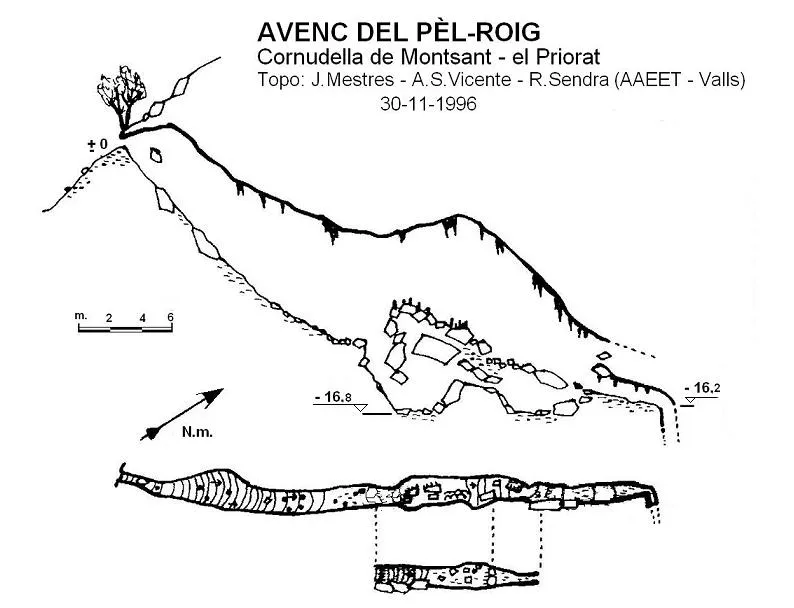
Avenc del Pèl-roig
0.4 km · SE
Cornudella de Montsant (Priorat)
1 topo.
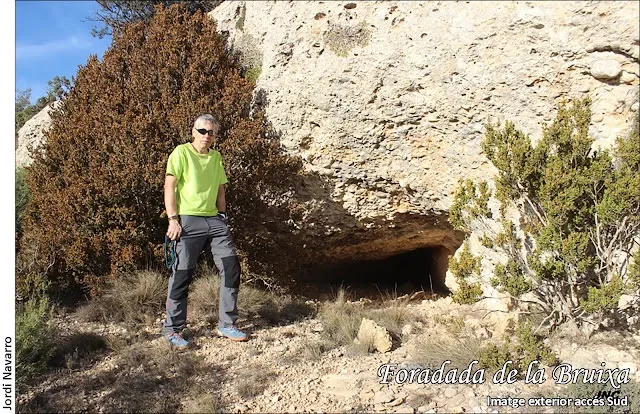
Foradada de la Bruixa
0.4 km · N
Morera de Montsant, La (Priorat)
1 topo.3 photos
Avenc de la Falca
0.5 km · SE
Cornudella de Montsant (Priorat)
1 topo.1 photos
Source: Espeleoindex (espeleoindex.com), modified. CC BY-NC 4.0, https://creativecommons.org/licenses/by-nc/4.0/