
Cova d'en Rubí
Coneguda i llegendària cova d'uns 200 m. de recorregut a Bítem (Tortosa)
EspeleoWorld
Cova d'en Rubí
Coneguda i llegendària cova d'uns 200 m. de recorregut a Bítem (Tortosa)
Tortosa · Baix Ebre
Length: 207 m · Depth: 18 m
Updated record
https://espeleoworld.com/en/c/cova-d-en-rubi
Information can change. Always verify coordinates, access, weather, and cave conditions before setting out.
A legendary cave of about 200 m in Bítem (Tortosa), known since time immemorial and documented in 1890, with galleries, shafts and a rich history and legend.
Topographic
Espeleoindex · CC BY-NC 4.0, https://creativecommons.org/licenses/by-nc/4.0/ · Image © its author.
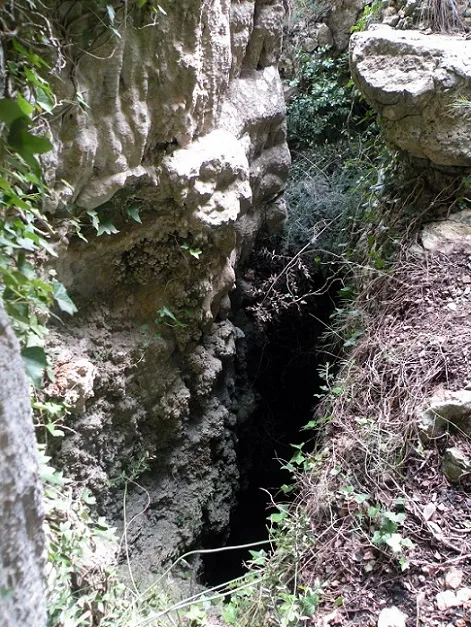
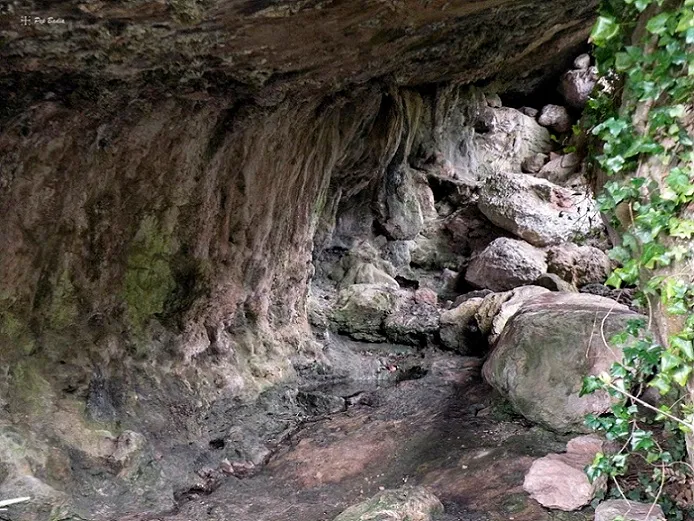
Photos
Espeleoindex · CC BY-NC 4.0, https://creativecommons.org/licenses/by-nc/4.0/ · Image © its author.
Description
Morphology
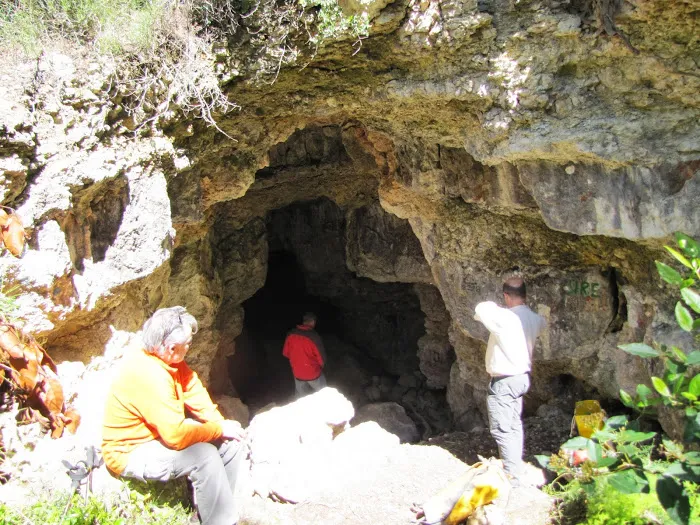
We reach the entrance through a kind of trench, the product of the significant fracture in the ground. The entrance is of good dimensions (4×3 m); we observe remains of a dry-stone wall, which is evidence that this part of the cave has served as a fold.
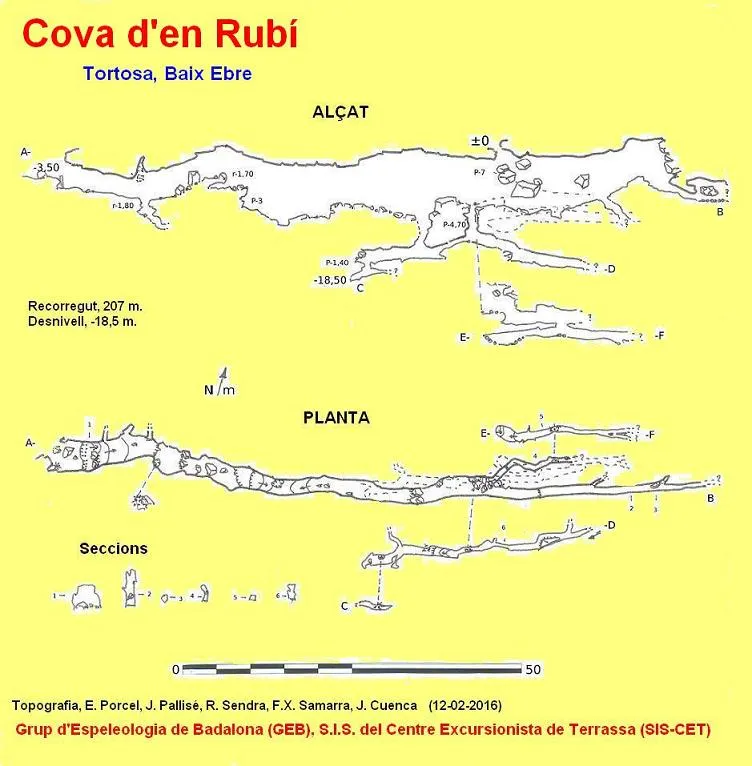
At 10 metres we find on the left the entrance of a small hanging gallery, which we suppose connects with the cova Petita d'en Rubí. On the right we find an entrance of 0.6×0.5 metres that leads to a shaft of -1.8 metres that takes us to a small room of 1×1.4 metres with another small shaft of -0.9 metres with no apparent continuation.
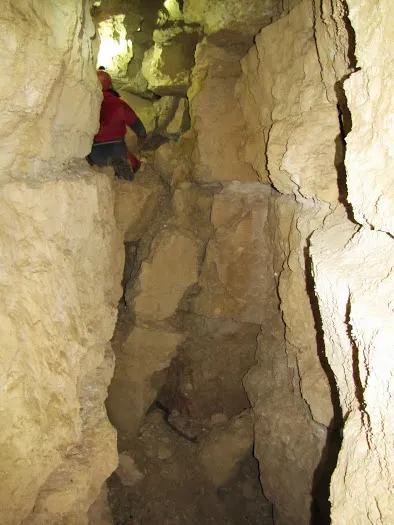
We return to the main gallery and 4 metres further on we find some fallen blocks that we will climb over on the right; here the height of the gallery is 4 metres. We advance 7 metres more and find an r-1.7 followed by an r-3, which is descended on the left with the help of a fixed rope hanging from 2 Parabolts.
The gallery descends, and on the left there is a blind shaft of -1.5 metres. The ceiling height here is 8 metres, the width is about 2 metres. We will climb 8 metres until we find another chaos of blocks, continue 11 metres more and climb over an r+1.2 m; 4 metres further on there is a P-2.6, which through an inaccessible passage leads to the lower gallery that we will describe later. 7 metres more and we find ourselves beneath the ceiling where the bats usually form a colony. Further on we see the light of the upper entrance at 7 metres of height.
On the left side, between the wall and the blocks, a shaft of 4.7 metres communicates with the lower gallery. The main gallery bifurcates, separated by large blocks; if we go right, at 8 metres there is a small blind shaft of 1.2 metres. The width is 1 metre and the height 7.
Eight metres more and we find a small deviation on the left; it is a descending fissure of about 5 metres, not accessible because of its narrowness. We advance 10 metres more and the gallery becomes a crawlway (0.50×0.50 m); we will crawl for about 7 metres, and although the continuation is quite evident, we could not get past the narrowness.
We go back about 3 metres and observe that by climbing an E-2.2 m there seems to be an upper access, but it also becomes very narrow. At this point there are some graffiti: “M. GAS, M. BEGUER 1950, J. MONTAGUT, TORRAS, F.GAS, VIÑAS”.
Having exhausted the right branch, we go back to the start of the bifurcation and will go to the left gallery; we will climb a ramp of about 4 metres and enter a gallery 0.40 metres wide and 2 high. At 2 metres we find an r-1.9 metres, we continue 4 metres and a hole in the ceiling at +0.70 metres takes us to a small upper gallery through which we will not be able to advance because of its narrowness. Continuing below, at 2.50 metres we find a small shaft of -1.5 m; ahead, at 3 metres, the gallery narrows. If we descend the aforementioned small shaft, in direction E the gallery ends at 7 metres; if we go in direction O it ends at 9 metres in a small room.
Progression
We reach the entrance through a kind of trench, the product of the significant fracture in the ground. The entrance is of good dimensions (4×3 m); we observe remains of a dry-stone wall, which is evidence that this part of the cave has served as a fold.
At 10 metres we find on the left the entrance of a small hanging gallery, which we suppose connects with the cova Petita d'en Rubí. On the right we find an entrance of 0.6×0.5 metres that leads to a shaft of -1.8 metres that takes us to a small room of 1×1.4 metres with another small shaft of -0.9 metres with no apparent continuation.
We return to the main gallery and 4 metres further on we find some fallen blocks that we will climb over on the right; here the height of the gallery is 4 metres. We advance 7 metres more and find an r-1.7 followed by an r-3, which is descended on the left with the help of a fixed rope hanging from 2 Parabolts.
The gallery descends, and on the left there is a blind shaft of -1.5 metres. The ceiling height here is 8 metres, the width is about 2 metres. We will climb 8 metres until we find another chaos of blocks, continue 11 metres more and climb over an r+1.2 m; 4 metres further on there is a P-2.6, which through an inaccessible passage leads to the lower gallery that we will describe later. 7 metres more and we find ourselves beneath the ceiling where the bats usually form a colony. Further on we see the light of the upper entrance at 7 metres of height.
On the left side, between the wall and the blocks, a shaft of 4.7 metres communicates with the lower gallery. The main gallery bifurcates, separated by large blocks; if we go right, at 8 metres there is a small blind shaft of 1.2 metres. The width is 1 metre and the height 7.
Eight metres more and we find a small deviation on the left; it is a descending fissure of about 5 metres, not accessible because of its narrowness. We advance 10 metres more and the gallery becomes a crawlway (0.50×0.50 m); we will crawl for about 7 metres, and although the continuation is quite evident, we could not get past the narrowness.
We go back about 3 metres and observe that by climbing an E-2.2 m there seems to be an upper access, but it also becomes very narrow. At this point there are some graffiti: “M. GAS, M. BEGUER 1950, J. MONTAGUT, TORRAS, F.GAS, VIÑAS”.
Having exhausted the right branch, we go back to the start of the bifurcation and will go to the left gallery; we will climb a ramp of about 4 metres and enter a gallery 0.40 metres wide and 2 high. At 2 metres we find an r-1.9 metres, we continue 4 metres and a hole in the ceiling at +0.70 metres takes us to a small upper gallery through which we will not be able to advance because of its narrowness. Continuing below, at 2.50 metres we find a small shaft of -1.5 m; ahead, at 3 metres, the gallery narrows. If we descend the aforementioned small shaft, in direction E the gallery ends at 7 metres; if we go in direction O it ends at 9 metres in a small room.
Other details
According to what the friends of the Espeleo Club Tortosa told us, the state of the cavity is quite deplorable due to the massive visits by all kinds of people. It seems that hunts have even been organised against the bat colony with air rifles and also with stone throws.
History
Known since time immemorial. The first mention that refers to it is by Lucas Mallada in an article about the province of Tarragona published in the Boletín de la Comisión del mapa geológico de España. Vol. XVI (1890), in which a more or less detailed description of the cave is made. This note was later reproduced by Puig y Larraz in his “Cavernas y simas de España” (1896) and also by Font i Sagué in his “Catàlech” (1897).
About the cova d'en Rubí there is a very famous legend in Tortosa which explains that many, many years ago, a tall young man named Rufolet, who had come from distant lands, arrived in Tortosa asking about the princess Rubí, who was held captive by a beast called the Cucafera. With the directions he received he went to find the beast's lair. On the way he saved a goblin named Xaco, who was drowning in a pool. In gratitude, the goblin and his companions accompanied Rufolet to the cave and freed the princess Rubí and imprisoned the Cucafera. On the way back to Tortosa they met some gaiters, who played their bagpipes at the triumphal entry of the whole retinue. One version of the legend says that the goblins left with Rufolet for his distant country, and another says that the goblins stayed to live in the cave, which from then on they called d'en Rubí, in honour of the princess.
Every year, at the Corpus festival in Tortosa, a figure with the body of a turtle and the head of a crocodile resembling a gargoyle (the Cucafera) precedes, accompanied by two smaller figures representing the daughters, the Corpus procession in Tortosa.
Enrique Bayerri, in his work “Història de Tortosa y su comarca” (1934), also speaks of the cave. He attributes the name of the cave to C. Despuig, who in 1557 already spoke of it as a mine of rubies.
It is not until 12 February 2016 that members of the GE Badalona and of the SIS – CE Terrassa make a complete visit and prepare a documented record and survey, which is the only one we know of.
User Comments (0)
No comments yet.
Be the first to share your experience!
Registered Explorations (0)
No explorations registered yet.
Register your visit to this cave!
Bibliography
- Les fotografies i altres dades que acompanyen la primera versió de la fitxa (juny 2015) van ser facilitades per l'Espeleo Club Tortosa.
- Actualització de dades, revisió de coordenades i topografia, extretes del web: geb.cat (apunt del 16-5-2016). Autor fitxa: E. Porcel, GE Badalona. Malgrat ser una cavitat molt coneguda, aquest va ser el primer treball específic sobre la cova.
Nearby caves


Source: Espeleoindex (espeleoindex.com), modified. CC BY-NC 4.0, https://creativecommons.org/licenses/by-nc/4.0/