
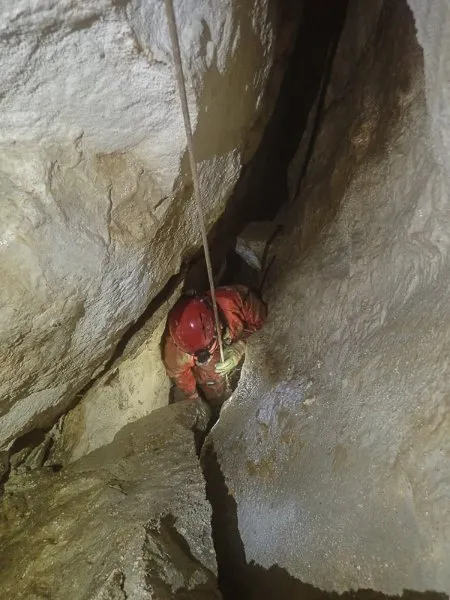
Trou d'Iko
An interstitial cavity formed by stress-relief fissures parallel to the slope, developed on two levels of passages bounded by debris cones, whose terminal fissure is no longer passable.
EspeleoWorld
Trou d'Iko
An interstitial cavity formed by stress-relief fissures parallel to the slope, developed on two levels of passages bounded by debris cones, whose terminal fissure is no longer passable.
Asson
Länge: 85 m · Tiefe: 24 m
Aktueller Datensatz
https://espeleoworld.com/de/c/trou-d-iko-asson
Informationen können sich ändern. Koordinaten, Zugang, Wetter und Höhlenbedingungen vor dem Aufbruch immer prüfen.
Ungefähre Lage: Für diese Höhle werden weder Karte noch Koordinaten gedruckt. Die Quelle kennzeichnet diese Eingangsposition als nicht verifiziert.
An interstitial cavity formed by stress-relief fissures parallel to the slope, developed on two levels of passages bounded by debris cones, whose terminal fissure is no longer passable.
Fotos
© Degouve (GSHP) · CC BY-NC-SA (version not stated by the source), https://www.karsteau.org/karsteau/index.php · Karsteau: Fracture MO42 · https://www.karsteau.org/karsteau/recherche/entree/recherche_entree.php?entree=20163
Beschreibung
Morphologie
Morphologically, it is an interstitial cavity formed by stress-relief fissures parallel to the slope. The entrance shaft (7 m) pierces the roof of a fairly spacious gallery (2 m x 2 m). This first level continues north for about fifteen metres to a debris cone. To the south, a small 3 m step followed by a 5 m shaft allows descent into the fissure and reaches a second level of passages (-13 m), also bounded to the north by debris cones. To the south, after a widening followed by a low passage, a 4 m shaft allows further descent into the fissure; this continues downward for another 7 m, becoming increasingly narrow. It is still possible to progress south at the bottom of the P.4, but there too the fissure eventually becomes impassable. Its end lies less than 10 m from the small MO-43 pit, also dug along a fissure but impassable at -3 m.
Befahrung
The entrance of the cavity was discovered by the GSHP (J.L. Lacrampe) on 13 January 2018. It was enlarged the same day and a first reconnaissance down to -12 m was made (S. Degouve). Exploration and surveying were continued on 28 January following (P. and S. Degouve).
Weitere Einzelheiten
The air current (temp. 9.8°C) observed in both cavities is explained by the presence of these multiple entrances, which must mark out the fissure stretching near the surface.
Benutzerkommentare (0)
Noch keine Kommentare.
Seien Sie der Erste, der seine Erfahrung teilt!
Registrierte Erkundungen (0)
Noch keine Erkundungen registriert.
Registrieren Sie Ihren Besuch in dieser Höhle!
Höhlen in der Nähe

Quelle: Karsteau (Fédération Française de Spéléologie et Canyon) (www.karsteau.org), verändert. CC BY-NC-SA (version not stated by the source), https://www.karsteau.org/karsteau/index.php Karsteau (Fédération Française de Spéléologie et Canyon) · Text von Karsteau (FFS) contributors · bearbeitet von Espeleoworld (normalisiert, übersetzt); die Bearbeitung steht unter der Lizenz CC BY-NC-SA (version not stated by the source), https://www.karsteau.org/karsteau/index.php · https://www.karsteau.org/karsteau/recherche/entree/recherche_entree.php?entree=20163 · Datenstand 2026