
Exsurgence de Mortefemme
Temporary emergence completely flooded in high water, beginning with an inclined 65° shaft whose bottom is today once again obstructed.
EspeleoWorld
Exsurgence de Mortefemme
Temporary emergence completely flooded in high water, beginning with an inclined 65° shaft whose bottom is today once again obstructed.
Saint-Germain-des-Bois
Länge: 14 m · Tiefe: 6 m
Aktueller Datensatz
https://espeleoworld.com/de/c/exsurgence-de-mortefemme-saint-germain-des-bois-nievre
Informationen können sich ändern. Koordinaten, Zugang, Wetter und Höhlenbedingungen vor dem Aufbruch immer prüfen.
Ungefähre Lage: Für diese Höhle werden weder Karte noch Koordinaten gedruckt. Die Quelle kennzeichnet diese Eingangsposition als nicht verifiziert.
Temporary emergence completely flooded in high water, beginning with an inclined 65° shaft whose bottom is today once again obstructed.
Topografie
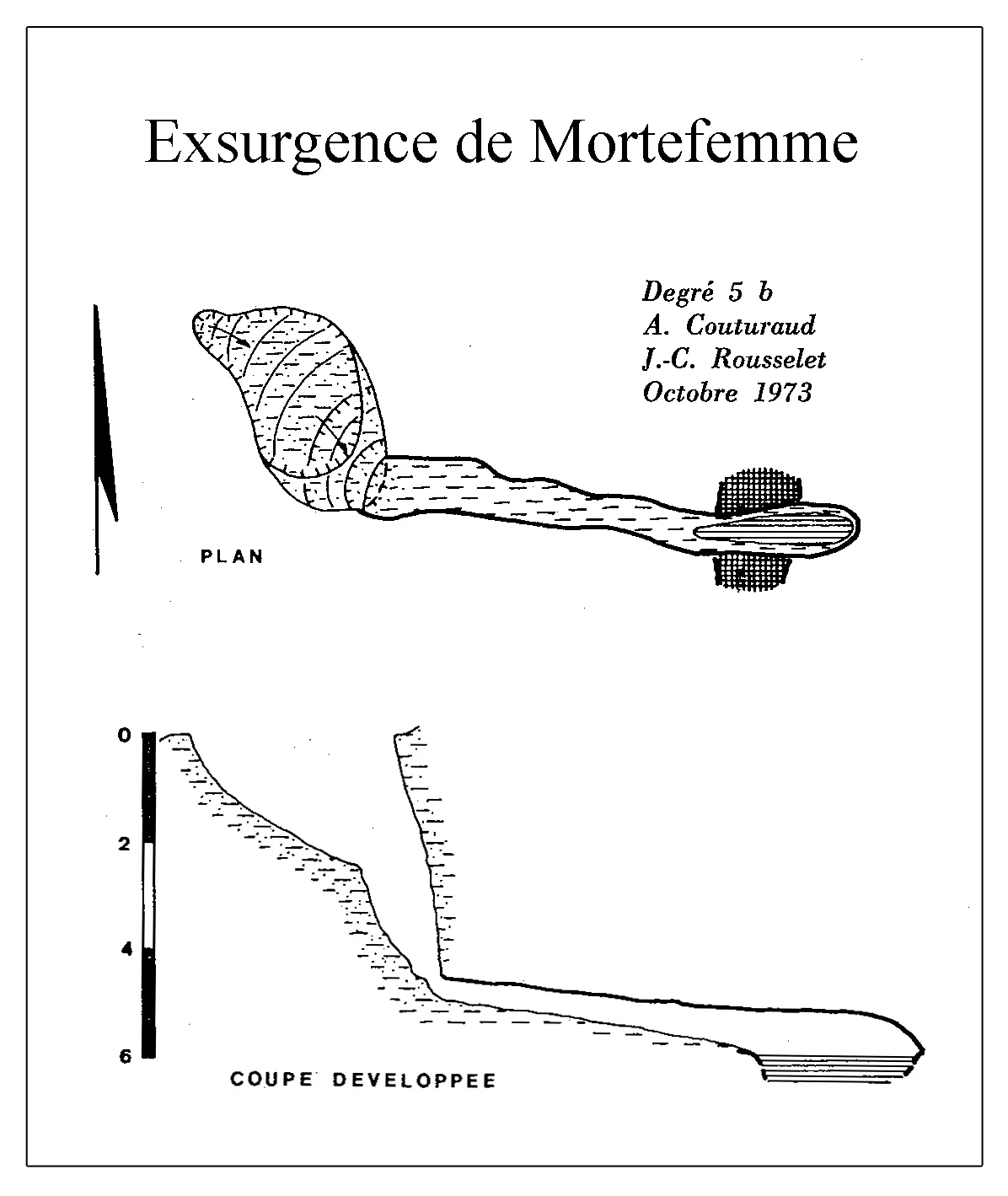
© Couturaud, Rousselet · CC BY-NC-SA (version not stated by the source), https://www.karsteau.org/karsteau/index.php · Karsteau: Topographie Exsurgence de Mortefemme · https://www.karsteau.org/karsteau/recherche/entree/recherche_entree.php?entree=24297
Beschreibung
Morphologie
The emergence springs from the bottom of a hole 4 to 5 m deep. The cavity begins with an inclined 65° shaft that is easily descended. The bottom of the entrance shaft is a mixture of clay and pebbles; it is today once again obstructed.
Hydrologie
It is a temporary emergence that can discharge around 200 l/s in flood. The cavity is completely flooded during high-water periods. The gallery discovered at Easter 1961 ended 6 m further on at a sump whose water comes from a perpendicular gallery, inaccessible because of its narrowness.
Befahrung
The hole had been covered by a grate fixed on four stone slabs. During a flood, the remaining opening being insufficient, the water managed to break through the floor over an area of 4 to 5 m2; the slabs came loose. In 1960, Jean-Claude Rousselet and the Spéléo-Club de Lutèce took an interest in the emergence; their first work, named “Opération Morte-femme”, consisted of removing the unstable slabs and the grate: installing a 500 kg pulley block and a makeshift hoist was necessary to remove the slabs from the hole. The bottom was dug out for about a year (1960-1961) by the Spéléo-Club de Lutèce, which, at Easter 1961, discovered a gallery.
Weitere Einzelheiten
Geology: Lower Bathonian.
Geschichte
In 1960, Jean-Claude Rousselet and the Spéléo-Club de Lutèce took an interest in the emergence; their first work, named “Opération Morte-femme”, consisted of removing the unstable slabs and the grate. The bottom was dug out for about a year (1960-1961) by the Spéléo-Club de Lutèce, which, at Easter 1961, had the pleasure of discovering a gallery.
Benutzerkommentare (0)
Noch keine Kommentare.
Seien Sie der Erste, der seine Erfahrung teilt!
Registrierte Erkundungen (0)
Noch keine Erkundungen registriert.
Registrieren Sie Ihren Besuch in dieser Höhle!
Höhlen in der Nähe

Quelle: Karsteau (Fédération Française de Spéléologie et Canyon) (www.karsteau.org), verändert. CC BY-NC-SA (version not stated by the source), https://www.karsteau.org/karsteau/index.php Karsteau (Fédération Française de Spéléologie et Canyon) · Text von Karsteau (FFS) contributors, Karsteau (FFS) contributors (Géologie) · bearbeitet von Espeleoworld (normalisiert, übersetzt); die Bearbeitung steht unter der Lizenz CC BY-NC-SA (version not stated by the source), https://www.karsteau.org/karsteau/index.php · https://www.karsteau.org/karsteau/recherche/entree/recherche_entree.php?entree=24297 · Datenstand 2026