
Cueva del Carcabón
Large Cantabrian cave with about 13 km of development according to the 2024 federation list, with wide galleries containing gypsum crystallizations and a regime conditioned by floods.
EspeleoWorld
Cueva del Carcabón
Large Cantabrian cave with about 13 km of development according to the 2024 federation list, with wide galleries containing gypsum crystallizations and a regime conditioned by floods.
Ruesga
Länge: 12798 m · Tiefe: 23 m
Aktueller Datensatz
https://espeleoworld.com/de/c/cueva-del-carcabon-ruesga
Informationen können sich ändern. Koordinaten, Zugang, Wetter und Höhlenbedingungen vor dem Aufbruch immer prüfen.
Ungefähre Lage: Für diese Höhle werden weder Karte noch Koordinaten gedruckt. Die Quelle kennzeichnet diese Eingangsposition als nicht verifiziert.
Large Cantabrian cave with about 13 km of development according to the 2024 federation list, with wide galleries containing gypsum crystallizations and a regime conditioned by floods.
Fotos
© Degouve (SCD-GSHP) · CC BY-NC-SA (version not stated by the source), https://www.karsteau.org/karsteau/index.php · Karsteau: L'entrée de Carcabon en crue · https://www.karsteau.org/karsteau/recherche/entree/recherche_entree.php?entree=22483
Beschreibung
Morphologie
Exploration reports describe a set of galleries of notable proportions, with stretches about 20 m wide on average, others that are divided into several levels, and wide meanders that link some sectors with others. There is also a large fossil level and parts filled with sediment that reduce the height of the passages. The published elevation differences are measured upward from the entrance (more than 200 m at the highest known points), which explains why the 23 m vertical extent figure that appears in some records should be treated with caution.
Speläotheme
There are brightly colored helictites in a stretch with sediments. In several areas gypsum crystals appear, some with spiral forms. Some passages have many formations.
Hydrologie
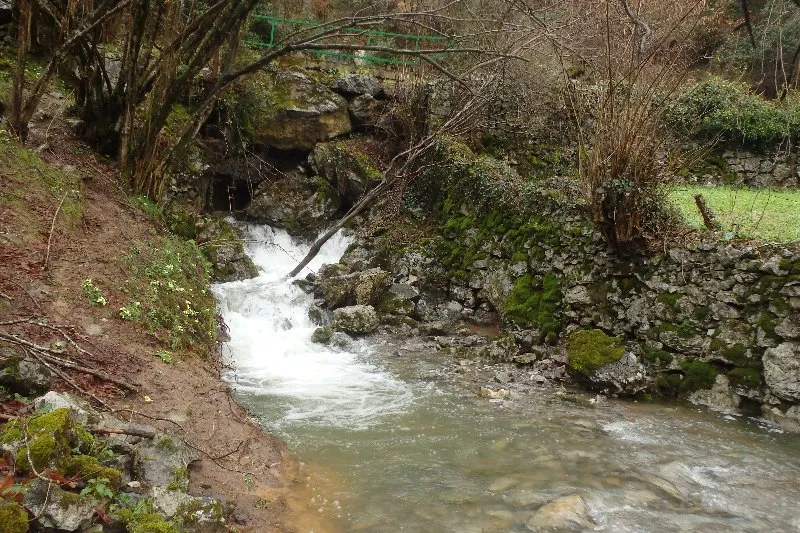
In 2017 contamination was detected in one of the water intakes inside the cave, probably of agricultural origin. The entrance area carries water and functions as a collector. There are several lakes and sumps, whose state depends on the water level. Floods are rapid, so visits depend on the water level and are only possible in some periods. A published photograph shows the flooded entrance.
Befahrung
The Spanish list of large cavities of 2024 (October 2024, based on the AER 2023 report) gives 12992 m. In 2017, 8600 m were known, after adding about 1600 m in a single expedition. In 2015, 2016 and 2017 there were new explorations with the AER club. In 2013 a Franco-Spanish team from clubs in Dijon and Tarbes opened a narrow passage, and thus the network was accessed.
For safety, no details of the route or equipment are given.
Weitere Einzelheiten
Other records give 12,798 m of development, slightly below the 2024 federation figure (12,992 m). No source has been found that explicitly includes it in a larger cave system, so it is treated as an independent cavity. Plan topographies published in the 2013, 2016 and 2017 expedition reports exist, and they remain in the private archive because of the sensitivity of the cave.
Geschichte
The first reference consulted is the report of the 2013 campaign by the Spéléo-Club de Dijon and GSHP de Tarbes, with a topography of the initial part. Since then these teams, together with the AER club, have expanded the network, and the 2024 national list places the cavity among those exceeding 12 km of development in Spain.
Bio
No published data on the fauna of this cave have been found.
Benutzerkommentare (0)
Noch keine Kommentare.
Seien Sie der Erste, der seine Erfahrung teilt!
Registrierte Erkundungen (0)
Noch keine Erkundungen registriert.
Registrieren Sie Ihren Besuch in dieser Höhle!
Höhlen in der Nähe

Quelle: Karsteau (Fédération Française de Spéléologie et Canyon) (www.karsteau.org), verändert. CC BY-NC-SA (version not stated by the source), https://www.karsteau.org/karsteau/index.php Karsteau (Fédération Française de Spéléologie et Canyon) · https://www.karsteau.org/karsteau/recherche/entree/recherche_entree.php?entree=22483 · Datenstand 2026 · Text von Espeleoworld aus öffentlichen Quellen verfasst. Bitte frag uns, bevor du ihn weiterverwendest. · Text von José Luis Membrado Julián (Grandes Cavidades Españolas 2024), Spéléo-Club de Dijon / GSHP Tarbes / FFS (Spéléo-Club de Dijon - GSHP 2013 (compte rendu)), Spéléo-Club de Dijon / GSHP Tarbes / FFS (Spéléo-Club de Dijon - GSHP 2016 (compte rendu)), Spéléo-Club de Dijon / GSHP Tarbes / FFS (Spéléo-Club de Dijon - GSHP Tarbes 2017 (compte rendu)) · bearbeitet von Espeleoworld (normalisiert, übersetzt); die Bearbeitung steht unter der Lizenz Our own text, written from public sources. Please ask us before reusing it.