
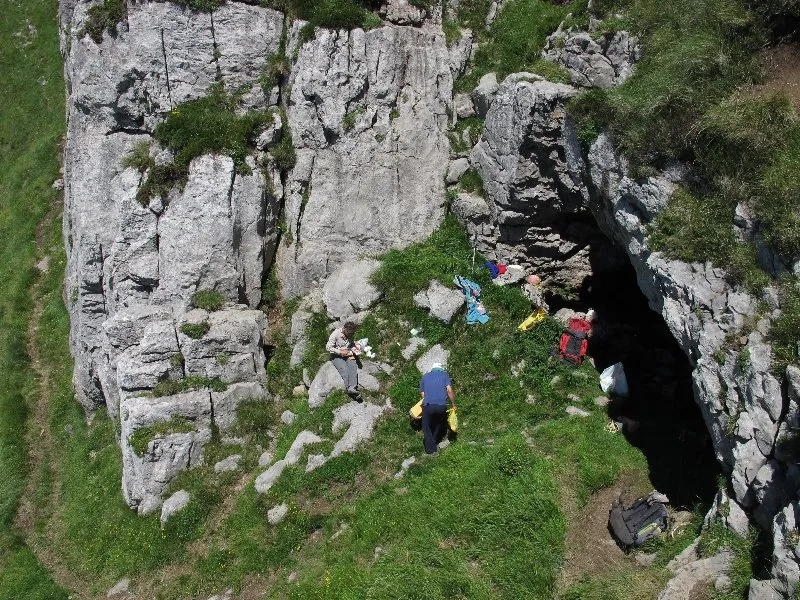
Cueva de San Antonio
A cave remarkable from the entrance for a large forced conduit cut into a limestone bed, whose gallery widens then closes abruptly 130 m from the entrance.
EspeleoWorld
Cueva de San Antonio
A cave remarkable from the entrance for a large forced conduit cut into a limestone bed, whose gallery widens then closes abruptly 130 m from the entrance.
Espinosa de los Monteros
Länge: 145 m · Tiefe: 19 m
Aktueller Datensatz
https://espeleoworld.com/de/c/cueva-de-san-antonio-espinosa-de-los-monteros
Informationen können sich ändern. Koordinaten, Zugang, Wetter und Höhlenbedingungen vor dem Aufbruch immer prüfen.
Ungefähre Lage: Für diese Höhle werden weder Karte noch Koordinaten gedruckt. Die Quelle kennzeichnet diese Eingangsposition als nicht verifiziert.
A cave remarkable from the entrance for a large forced conduit cut into a limestone bed, whose gallery widens then closes abruptly 130 m from the entrance.
Topografie
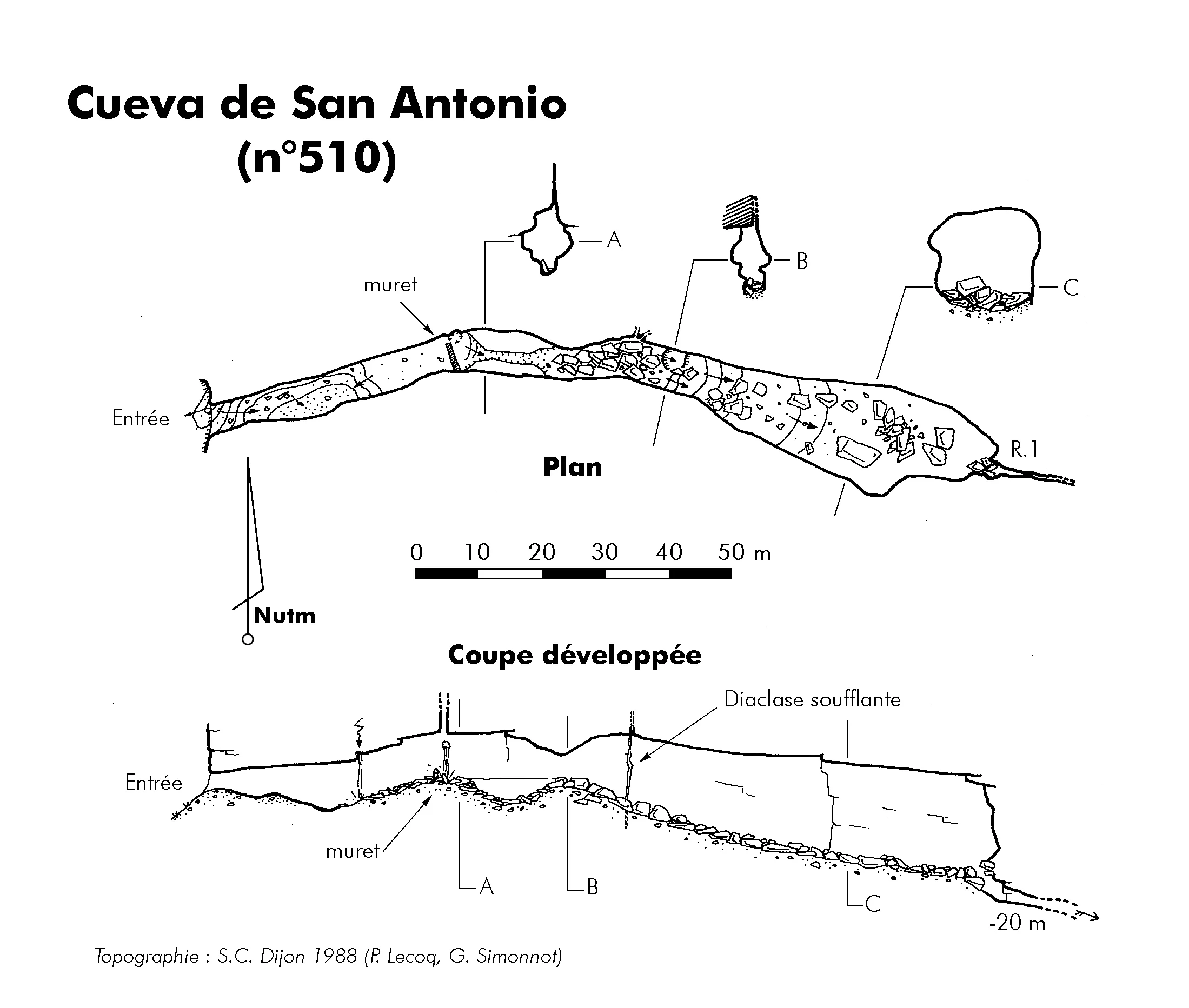
© S.C.Dijon 1988 (-19,+8) · CC BY-NC-SA (version not stated by the source), https://www.karsteau.org/karsteau/index.php · Karsteau: Topographie de la cavité n°510 (numérotation SCD) · https://www.karsteau.org/karsteau/recherche/entree/recherche_entree.php?entree=21277
Fotos
© Degouve (SCD-GSHP) · CC BY-NC-SA (version not stated by the source), https://www.karsteau.org/karsteau/index.php · Karsteau: Entrée de la cueva 510 · https://www.karsteau.org/karsteau/recherche/entree/recherche_entree.php?entree=21277
Beschreibung
Morphologie
The cave is remarkable from the entrance: a large forced conduit (6 x 4 m) is cut into a limestone bed inserted between 2 sandstone strata. After two boulder chokes, the gallery widens further (17 x 15 m at maximum) before closing abruptly 130 m from the entrance. Only a joint traversed by a very weak draught of aspirating air continues the cavity into the lower sandstone bed. At 70 m from the entrance, the entire left wall of the cave is fissured by a narrow slot that draws a violent roaring draught of air (28/10/1988, summer period). The erosion waves on the walls appear to testify to a very ancient flow from South to North, giving this cave a certain originality.
The cavity develops along a fault clearly visible in the first half of the cave.
Hydrologie
Spring: Gandara.
Befahrung
In July 1974, A.R.E.S. Dijon cleared a passage at the back of the large gallery and progressed about fifteen metres. In 1988, S.C.Dijon revisited the cavity and drew up a new survey (P. Lecoq and G. Simonnot).
Weitere Einzelheiten
The cavity must have served as a shelter for animals (low walls).
Geology: level 13, limestones of the Picon del Fraile (Albian).
Geschichte
The spacious entrance gallery has probably been frequented since time immemorial.
Benutzerkommentare (0)
Noch keine Kommentare.
Seien Sie der Erste, der seine Erfahrung teilt!
Registrierte Erkundungen (0)
Noch keine Erkundungen registriert.
Registrieren Sie Ihren Besuch in dieser Höhle!
Höhlen in der Nähe


Quelle: Karsteau (Fédération Française de Spéléologie et Canyon) (www.karsteau.org), verändert. CC BY-NC-SA (version not stated by the source), https://www.karsteau.org/karsteau/index.php Karsteau (Fédération Française de Spéléologie et Canyon) · Text von Karsteau (FFS) contributors · bearbeitet von Espeleoworld (normalisiert, übersetzt); die Bearbeitung steht unter der Lizenz CC BY-NC-SA (version not stated by the source), https://www.karsteau.org/karsteau/index.php · https://www.karsteau.org/karsteau/recherche/entree/recherche_entree.php?entree=21277 · Datenstand 2026