
Cueva de los Huesos
Dry cave with a strong draught of indrawn air, developed along a bedding joint overdeepened by a meander, ending in a choke of sandstone blocks.
EspeleoWorld
Cueva de los Huesos
Dry cave with a strong draught of indrawn air, developed along a bedding joint overdeepened by a meander, ending in a choke of sandstone blocks.
Arredondo
长度: 180 m
最新资料
https://espeleoworld.com/zh/c/cueva-de-los-huesos-arredondo
信息可能会变化。出发前请务必核对坐标、通行情况、天气和洞穴状况。
大致位置:此洞穴不打印地图或坐标。 数据来源将该洞口位置标记为未经核实。
Dry cave with a strong draught of indrawn air, developed along a bedding joint overdeepened by a meander, ending in a choke of sandstone blocks.
地形图
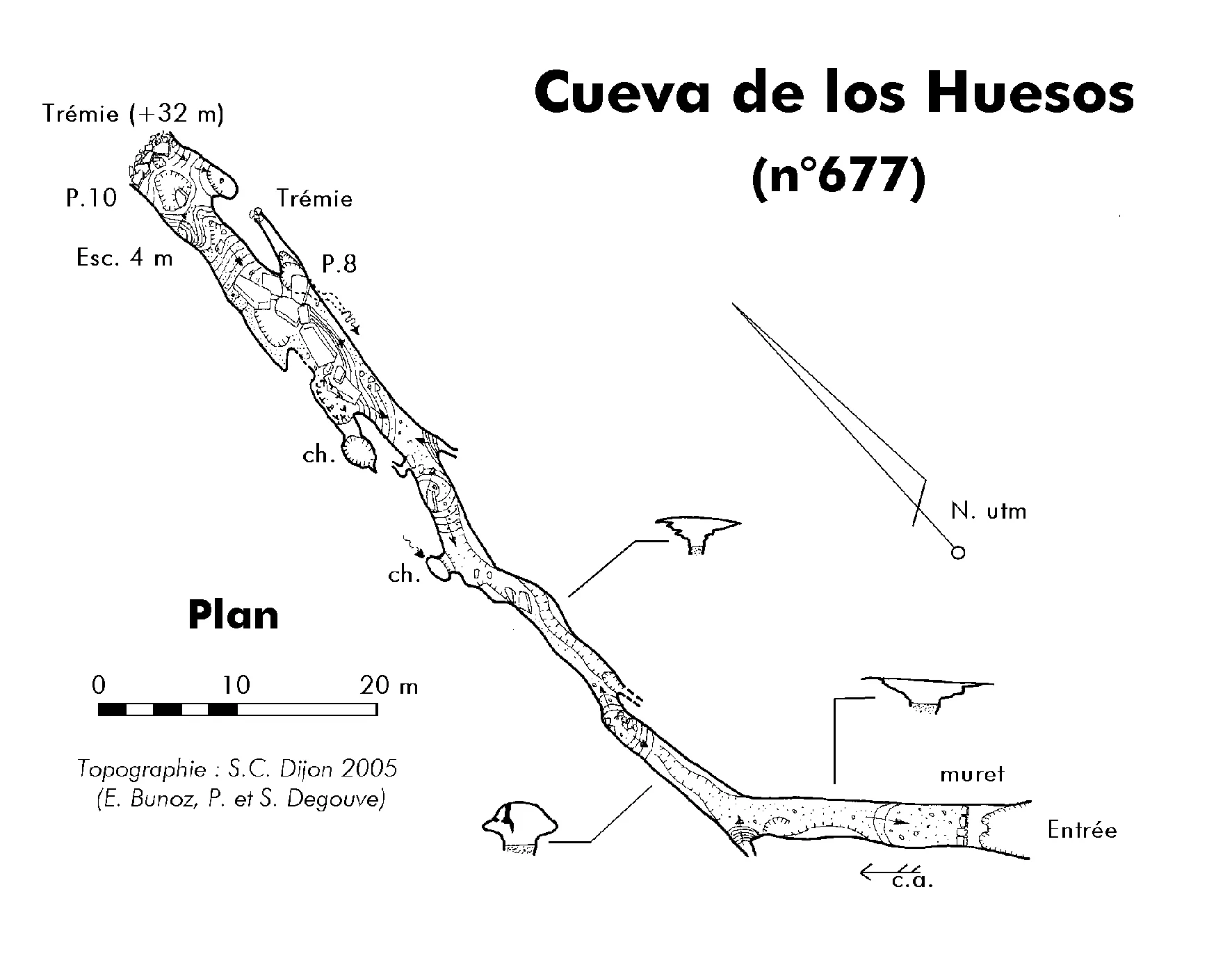
© S.C.Dijon août 2005 · CC BY-NC-SA (version not stated by the source), https://www.karsteau.org/karsteau/index.php · Karsteau: Topographie de la cavité n°677 (numérotation SCD) · https://www.karsteau.org/karsteau/recherche/entree/recherche_entree.php?entree=21399
描述
形态
The cave begins with a low porch (1 m x 2 m) barred by a small wall and opening onto a dry gallery traversed by a strong draught of indrawn air. The passage develops along a bedding joint overdeepened by a meander partly filled by the fill. After a low passage, the cave gains in size (2 m x 3 m). Several shafts line the route; the highest, 120 m from the entrance, measures about ten metres in height. A little further on, after large collapsed blocks, one reaches a widening. To the right, an 8 m pit reaches a short meander that becomes impenetrable. To the left, after climbing a clayey slope, a 4-metre step requires a climb to reach the top of the gallery (+ 32 m), entirely barred by a choke of sandstone blocks; just before it, a pit of about ten metres continues via impenetrable fissures.
Geology: Level 7: Sandstone and marls of the Porra (Aptian).
洞穴次生沉积物
An old concretion and the remains of a suspended stalagmitic floor attest that the latter must have been more extensive at one time (see section on the survey).
水文
Spring: ?
其他详情
Numerous animal bones scattered all along the gallery and doubtless brought there by a predator.
历史
The cueva was known to the shepherds who built a small wall at the entrance. It was located and partly explored by the S.C. Dijon on 17 July 1993 (P. and S. Degouve, C. Lecas). The exploration and the survey were carried out in August 2005 (E. Bunoz, P. and S. Degouve).
用户评论 (0)
暂无评论。
成为第一个分享体验的人!
已记录的探索 (0)
暂无探索记录。
记录您对这个洞穴的访问!
附近洞穴

来源:Karsteau (Fédération Française de Spéléologie et Canyon)(www.karsteau.org),已修改。 CC BY-NC-SA (version not stated by the source), https://www.karsteau.org/karsteau/index.php Karsteau (Fédération Française de Spéléologie et Canyon) · 文本作者:Karsteau (FFS) contributors · 由 Espeleoworld 改编(规范化、翻译);改编内容依据 CC BY-NC-SA (version not stated by the source), https://www.karsteau.org/karsteau/index.php 许可 · https://www.karsteau.org/karsteau/recherche/entree/recherche_entree.php?entree=21399 · 2026年数据