
Cenobio de Valerón
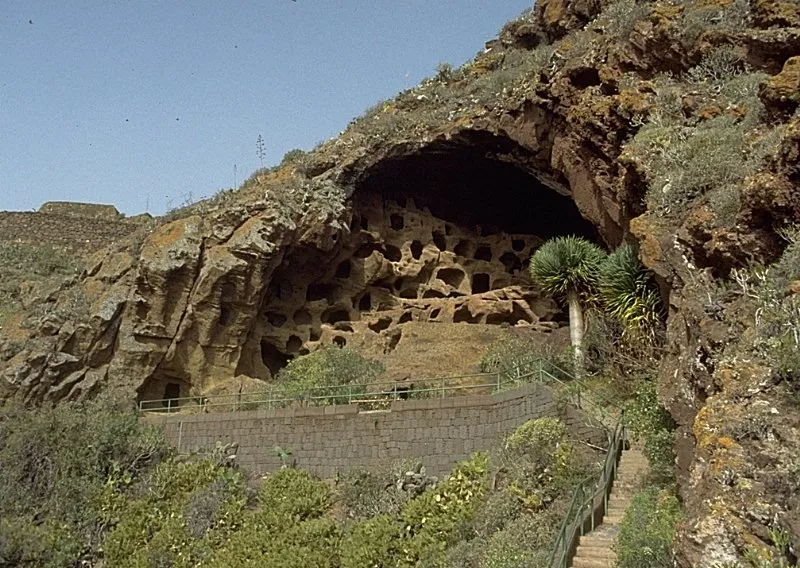
Cenobio de Valerón is a large basaltic arch over soft volcanic tuff, into which the Guanche excavated about 300 small caves, cavities and cubicles as a collective-fortified granary.
EspeleoWorld
Cenobio de Valerón
Cenobio de Valerón is a large basaltic arch over soft volcanic tuff, into which the Guanche excavated about 300 small caves, cavities and cubicles as a collective-fortified granary.
Santa María de Guía de Gran Canaria
最新资料
https://espeleoworld.com/zh/c/cenobio-de-valeron-santa-maria-de-guia-de-gran-canaria
信息可能会变化。出发前请务必核对坐标、通行情况、天气和洞穴状况。
Cenobio de Valerón is a large basaltic arch over soft volcanic tuff, into which the Guanche excavated about 300 small caves, cavities and cubicles as a collective-fortified granary.
照片

Jochen Duckeck · CC0 1.0, https://creativecommons.org/publicdomain/zero/1.0/ · Show Caves of the World (showcaves.com) · https://www.showcaves.com/english/es/caves/Cenobio.html
描述
形态
Cenobio de Valerón is a large basaltic arch, covering volcanic tuff. The arch is formed by a compact and hard layer of basalt, which resists weathering rather well. It covers a massive deposit of tufa or tuff, a volcanic pyroclastic sediment which is very porous and thus soft and eroded quite easily. As a result the natural form is a huge portal, a cave opening with a wall of soft tufa at the rear end. Into this rather soft material, the Guanche excavated about 300 small caves, cavities and cubicles. The artificial cellars were dug into the soft tuff in horizontal rows. While their location is quite regular, their form is not; the shapes are completely different, except for a few basic rules. The site is classified as a natural cave with artificial structures which may be best described as cellars, underground storage for food.
水文
The tufa with its pores keeps the temperature and humidity inside constant, at a level which is actually ideal to store grains for a long time. They are neither drying out, nor start to mold. One of the reasons is the cave portal, which keeps rainfall from hitting the tufa directly, so it stays dry even through storms.
行进路线
The path goes uphill and crosses the whole site right below the cave. It is very fortunate to see the whole site. Most of the small caves are not open to visitors, but it is possible to have a look into two of them. The wheat holes in the ground, which were closed by a wooden lid, are easy to find. The guard tells you something about protection of the site and helps with some archaeological background info. There is no fee, and you are free to visit the whole site, as long as you stay on the paved paths. A few years ago the trails were renovated and the car park was enlarged. As a result the free entrance is also gone. Nevertheless, the fee is still very low and the site is well worth the money. It is also possible to book guided visits for groups of 10 people or more.
其他详情
This place is an agadir (a collective-fortified granary) similar to the agadirs in North Africa. The ancient people stored their agricultural surplus here. The faican, a religious, political and economic chief, distributed it then between the community. The cavities were used as silos, closed with a wooden plank and marked with a seal called pintadera which indicated the owner. The spaces were tightly closed with the wooden planks, so it was not possible for rodents to go inside and eat the stored food. It is possible to dig holes quite easily, with a wooden stick or Stone Age tools. The place is well developed and the guardian uses the spare time to plant local succulents. But the equatorial sun is very hot, and so a hat, sunglasses and sunblocker are recommended for a visit. Probably the most beautiful cave-related sight on Gran Canaria and much recommended by our reviewer!
历史
The name Cenobio de Valerón or Convent of Valerón is wrong. The traditional consideration was that this was a monastery or a place where the harimaguadas (priestesses) were confined. But there is no archaeological evidence for this legend.
用户评论 (0)
暂无评论。
成为第一个分享体验的人!
已记录的探索 (0)
暂无探索记录。
记录您对这个洞穴的访问!
附近洞穴
来源:Show Caves of the World (Jochen Duckeck)(www.showcaves.com),已修改。 CC0 1.0, https://www.showcaves.com/english/TermsOfUse.html Show Caves of the World (showcaves.com), Jochen Duckeck · 文本作者:Jochen Duckeck (Cenobio de Valerón) · 由 Espeleoworld 改编(规范化、翻译);改编内容依据 CC0 1.0, https://www.showcaves.com/english/TermsOfUse.html 许可 · 2026年数据