
Cueva de la Orilla
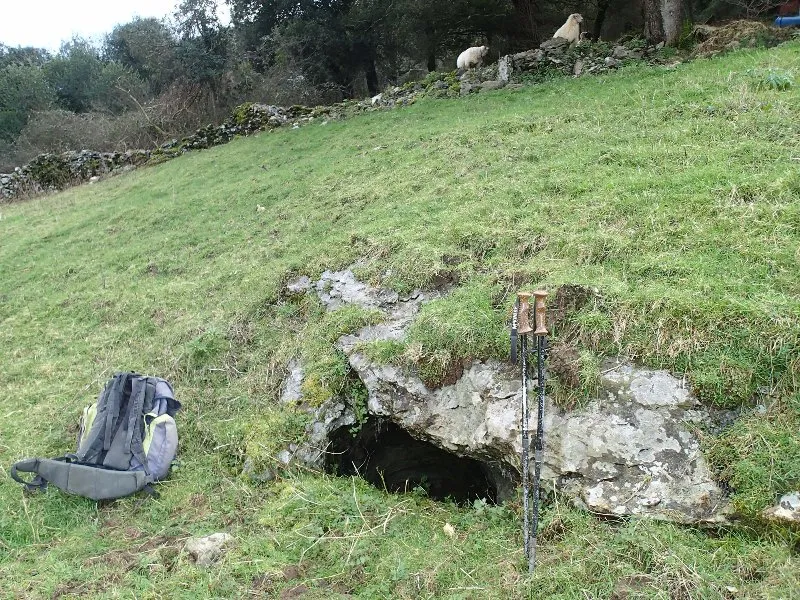
Cueva de la Orilla, a modest entrance of 1.1 x 0.5 m, extends for 46 m with a vertical drop of 7 m to a clay fill that occupies practically the entire passage.
EspeleoWorld
Cueva de la Orilla
Cueva de la Orilla, a modest entrance of 1.1 x 0.5 m, extends for 46 m with a vertical drop of 7 m to a clay fill that occupies practically the entire passage.
Ruesga
Длина: 46 m
Актуальная запись
https://espeleoworld.com/ru/c/cueva-de-la-orilla-ruesga
Информация может меняться. Перед выходом всегда проверяйте координаты, доступ, погоду и состояние пещеры.
Приблизительное местоположение: для этой пещеры карта и координаты не печатаются. Источник помечает положение этого входа как непроверенное.
Cueva de la Orilla, a modest entrance of 1.1 x 0.5 m, extends for 46 m with a vertical drop of 7 m to a clay fill that occupies practically the entire passage.
Топография
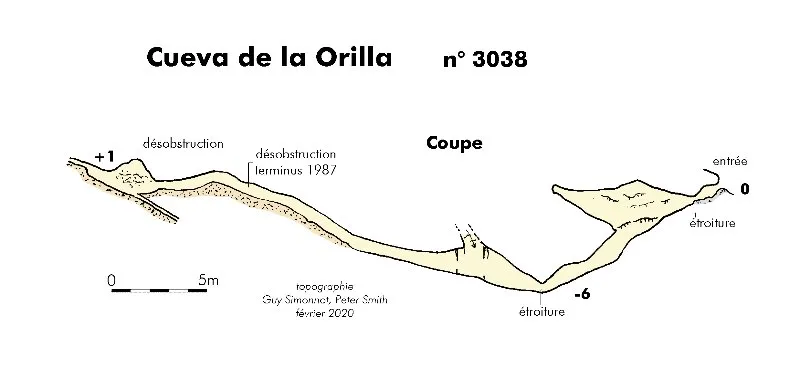
© Simonnot · CC BY-NC-SA (version not stated by the source), https://www.karsteau.org/karsteau/index.php · Karsteau: Topographie de la cueva 3038 - Coupe · https://www.karsteau.org/karsteau/recherche/entree/recherche_entree.php?entree=27333
Фотографии
© G. Simonnot · CC BY-NC-SA (version not stated by the source), https://www.karsteau.org/karsteau/index.php · Karsteau: Cueva de la Orilla. Entrée · https://www.karsteau.org/karsteau/recherche/entree/recherche_entree.php?entree=27333
Описание
Морфология
The entrance, modest (1.1 x 0.5 m), is at the foot of a very small limestone step running across the meadow. Just after the initial descending opening, a dug-out squeeze (1987) leads to a large inclined fissure forming a step and leading quickly to a low passage and the lowest point of the cave (-6). The passage then rises, first gently and then abruptly (chute), occupied by a substantial deposit of fine varved clay. After the 1987 terminus opened in the terrigenous plug comes a more or less subhorizontal section at about the altitude of the entrance. At the end, the fill occupies practically the entire passage and the absence of airflow does not encourage continuing tedious work.
Development: 46 m; vertical drop: 7 m.
Спелеотемы
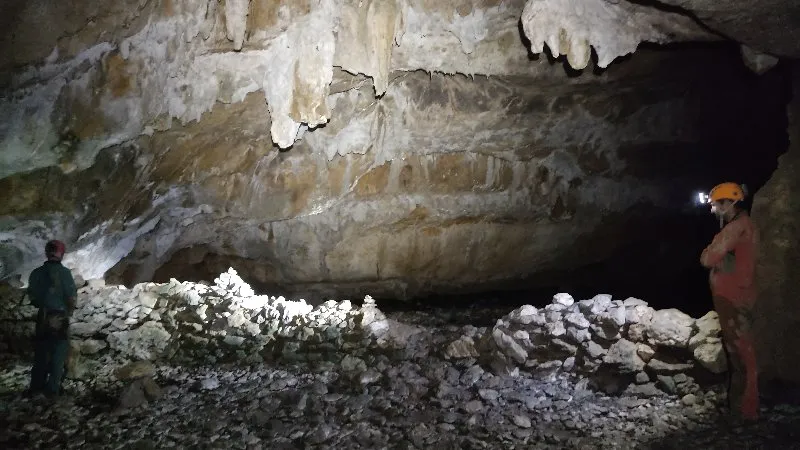
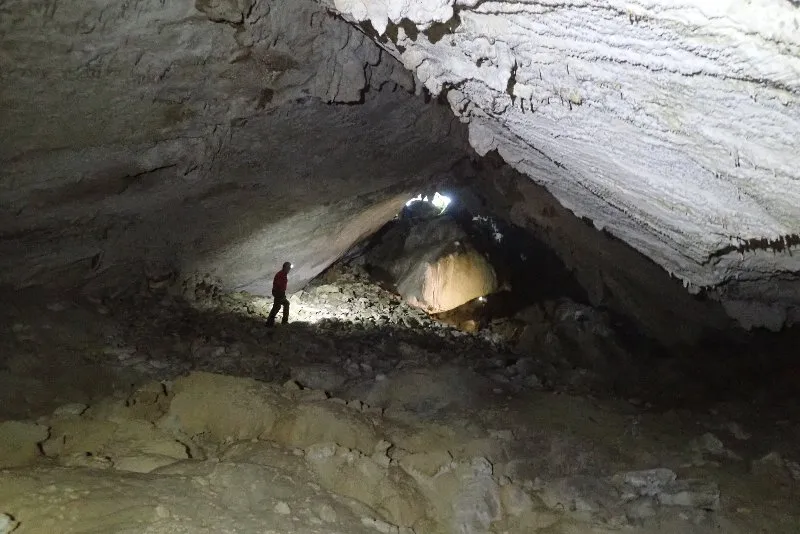
The beautiful vaults with erosion forms and the classic fine clay deposits are the evidence of an ancient flooded zone.
Прохождение
Exploration history: 8 September 1964: Claude Mugnier spotted the entrance opening and noted the existence of a "shaft" beyond. 28 August 1987: the cave was explored for 34 m up to the clay chute by Guy and Maxime Simonnot (4 years old!) and then fell into oblivion. 15 February 2018: after several unsuccessful searches, the cave was found again and revisited more than 30 years later (Guy Simonnot). 3 June 2019: a dig in the substantial clay fill allowed progress of 7 m to a passage requiring a little rock to be broken. The survey was made (Guy Simonnot and Peter Smith). Sunday 16 February 2020: the narrow passage was opened and gives access over 5 m to the terminal "chamber" (Guy Simonnot and Peter Smith).
Другие сведения
The level of excavation (Z = 160 m) is probably more recent than that of the cuevas de la Sierra and de la Cañuela, which are higher and nearby.
Survey: Spéléo-Club de Dijon 2019-2020.
Presumed spring: ?
Комментарии пользователей (0)
Комментариев пока нет.
Станьте первым, кто поделится своим опытом!
Зарегистрированные исследования (0)
Зарегистрированных исследований пока нет.
Зарегистрируйте свое посещение этой пещеры!
Ближайшие пещеры


Источник: Karsteau (Fédération Française de Spéléologie et Canyon) (www.karsteau.org), с изменениями. CC BY-NC-SA (version not stated by the source), https://www.karsteau.org/karsteau/index.php Karsteau (Fédération Française de Spéléologie et Canyon) · Текст: Karsteau (FFS) contributors · адаптировано Espeleoworld (нормализовано, переведено); адаптация распространяется по лицензии CC BY-NC-SA (version not stated by the source), https://www.karsteau.org/karsteau/index.php · https://www.karsteau.org/karsteau/recherche/entree/recherche_entree.php?entree=27333 · данные на 2026 г.