
Forat Micó
An interesting cave in the Cardona salt deposit, with three entrances, high galleries and a route that varies due to collapses.
EspeleoWorld
Forat Micó
An interesting cave in the Cardona salt deposit, with three entrances, high galleries and a route that varies due to collapses.
Cardona · Bages
Sviluppo: 640 m · Profondità: 25 m
Scheda aggiornata
https://espeleoworld.com/it/c/forat-mico
Le informazioni possono cambiare. Verifica sempre coordinate, accesso, meteo e condizioni della cavità prima di partire.
An interesting cave in the Cardona salt deposit, with three entrances, high galleries and a route that varies due to collapses.
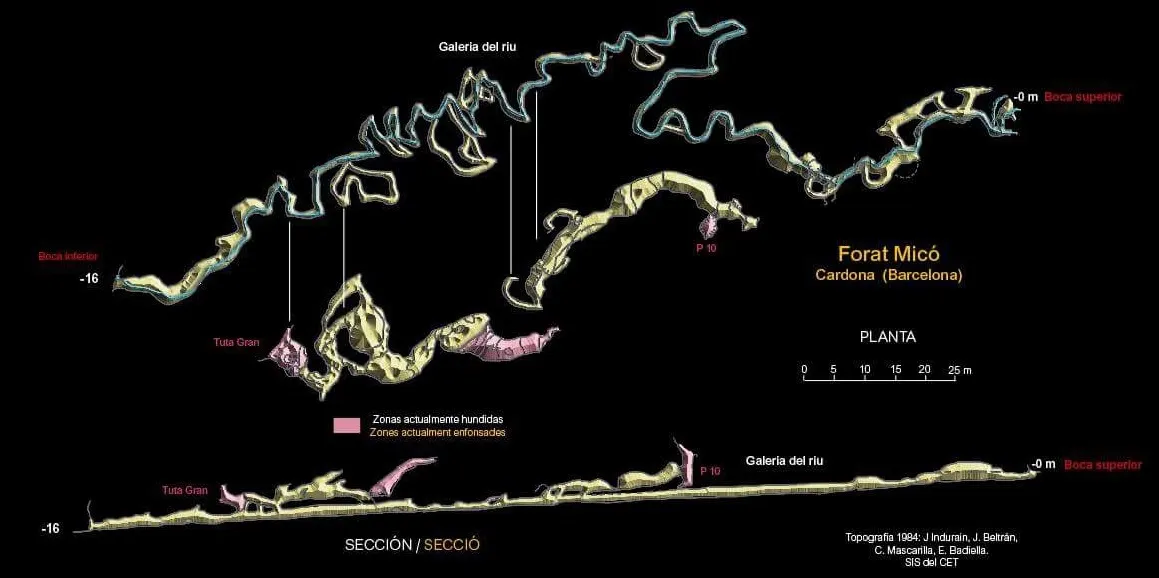
Topografia
Espeleoindex · CC BY-NC 4.0, https://creativecommons.org/licenses/by-nc/4.0/ · Immagine © del suo autore.
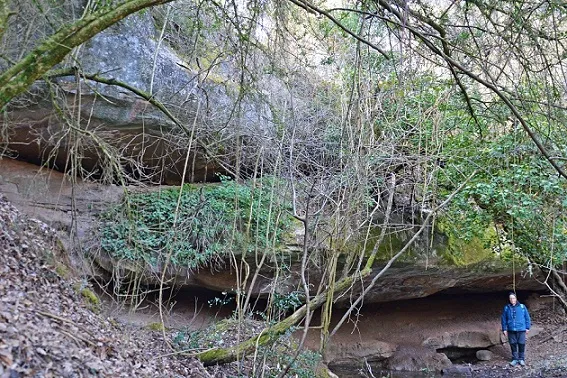
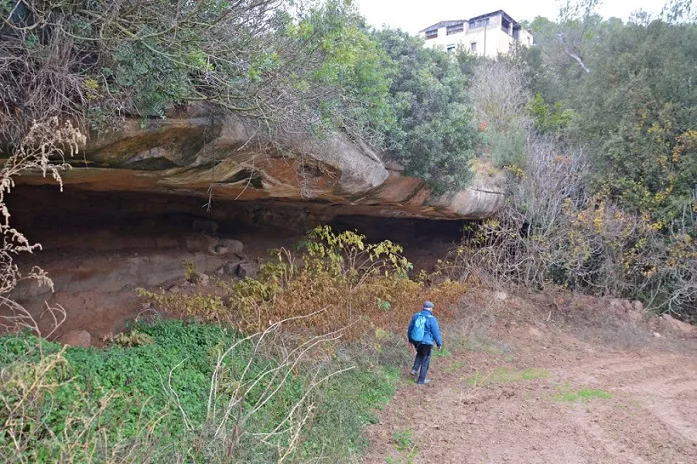
Foto
Espeleoindex · CC BY-NC 4.0, https://creativecommons.org/licenses/by-nc/4.0/ · Immagine © del suo autore.
Descrizione
Morfologia
Currently (June 2017), the cavity has three entrances. Two upper mouths at the bottom of the Bòfia Gran, where water seeps in through one of them. Through the one that opens in the form of a pit and leads to a meander, it is possible to enter and make the traverse, always depending on the collapses that make the exploration variable.
The entrance of the resurgence is the one we will normally use to go to the cave. It is not advisable to go in rainy weather because of the danger of collapses.
Currently the height difference between the upper mouth and the resurgence is 11 metres.
The current straight-line distance between mouths is 154 metres.
Concrezioni
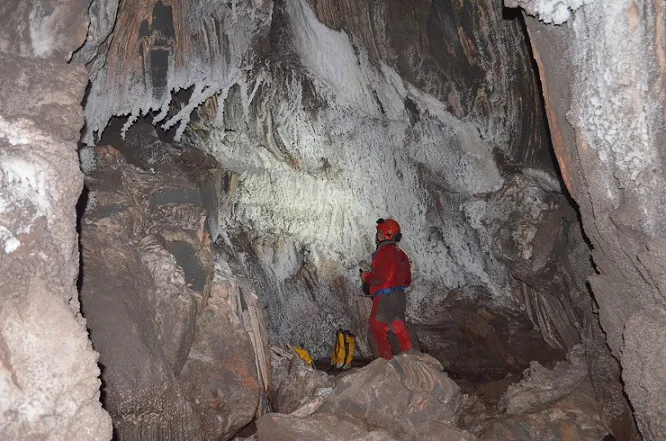
A first gallery leads to a chamber with a great profusion of stalactites. At this point begins the route that leads to the Galeries Altes de la Tuta Gran.
High galleries of the Tuta Gran: Once back at the short climbing passage, once at the top, we must leave a meander on the right and cross to the left above the pit until we find a narrow ascending passage. Once past it, we continue climbing up a short vertical conduit until we reach a chamber with beautiful stalactites. On the left-hand side we reach another chamber that is finally closed off by collapses and that must have been the place through which people entered in the past. We must return to the previous chamber and look for a narrow passage with a fallen block. Once past it, we reach a large gallery with some small branch in the form of a white gallery.
Idrologia
Resurgence: Through the lower mouth of the cave, of medium dimensions, we enter a white vestibule through which the stream flows. Falling stones make it dangerous to stand beneath the entrance mouth, so we must pass quickly into the cave.
If, on the other hand, we continue along the meander, we reach a chamber followed by another chamber, and after a narrow passage, we reach the hardest part of the cave, where a flooded flat-out passage makes the exploration arduous. Once past the flat-out passage the meander continues with small side galleries and upper levels where the key is always to follow the river current upstream.
Further on we have a hanging chamber of good dimensions, and following the meander we reach the outside through one of the two mouths at the bottom of the Bòfia Gran.
Progressione
Afterwards we must crawl along the stream to enter a meander that leads to a somewhat wider chamber, which leads to another chamber with a high ceiling. Here we must climb up by means of a short climbing passage.
Storia
We have long been aware of the existence of cavities in these salt materials. It seems that other cavities existed before, now collapsed, as is the case at hand at the forat Micó.
Pascual Madoz, in his Diccionario Geográfico written between 1845-1850, already mentions these cavities.
In 1860, Cayetano Cornet i Mas gives a very interesting description of the Forat Micó, of the Bòfia Gran and other cavities that are unknown today, possibly disappeared due to collapses; from his assertions, it can be deduced that in the 18th century the extent of the salt outcrop was considerably smaller than today.
Maureta i Thos in 1881 mention the singularities of the salt mountain and, especially, its morphology which causes the almost immediate absorption of rainwater and its consequent underground circulation.
En Font i Sagué in 1987 makes brief mention of the Forat Micó and the Bòfia Gran.
E.A Martel visits it on 23 April 1901, publishing the results of this visit in 1902 in the journal Nature. Martel refutes the length of 1,500 metres that was attributed to the Forat Micó, saying that it is certainly exaggerated and is not a serious piece of data. In 1908 in his work Evolution souterraine he tells us about the magnificent example of the salt caves of Spain.
Faura i Sans, in 1911, gives for the first time concrete data on the existence of a cavity that crosses the hill of Sant Onofre, according to him over a length of 400 metres, reappearing at the place known as la Tanca.
In 1914, Lluís Marià Vidal Bol. Real Soc. Hist. Nat. XIV, tries to explain the genesis of its special morphology. He presents a sketch showing the cavern of the hill of Sant Onofre, which should be more important than the Forat Micó as regards its dimensions.
Since then and for many decades, the cavities of this mountain go unnoticed by speleologists, becoming almost forgotten.
Well into the 1960s, the SIE del CEA finally takes an interest in this salt karst. The results of the explorations and the topography of the Forat Micó, to which they assign 650 metres of passage, are published in 1969 in EspeleoSie 4. This same topography appears published in 1970 in the excursion guide of the Primer Congreso Nacional de Espeleología. Since then, the cavity has been visited with some frequency by speleologists.
In 1984, the SIS del CET carries out a new, more accurate topography, 640 metres of passage and -25 metres of height difference, which was published in the excursion guide of the 9è Congrés Internacional d'Espeleologia. This same topography has been appearing in all the articles published since then.
In 2013 the cave is almost collapsed and only some sections can be visited partially.
From 2013 onwards, the new diggings carried out by Victor Ferrer and about twenty collaborators belonging to various clubs, together with the heavy rains of 2016 and early 2017, have made it possible to reopen some passages that allow, with certain difficulties, a significant part of the cave to be visited.
Commenti degli utenti (1)

14 giugno 2026
Visita 07/06/2026. Travessa molt Bonica, en aquest cas volíem fer la travessa des de baix del Forat Micó fins a dalt de la boca superior, però va ser impossible fer la travessa, per un esfondrament a la part final dels meandres de sortida, una paret sencera va caure a sobre del meandre final, s’ha de vigilar molt, perquè la cavitat té molt de movimentt durant tot l’any, cada vegada que la visitem trobem més dificultat, d’accedir i de remuntar, es més tècnic i més perillós, aneu amb compte amb la boca d’entrada, ja que és perillós quedar-se molta estona, per posibles caigudes de roques, encara wue segueix sent un lloc màgic i especial per fer una activitat tan maca com l’espeleologia, salud , muntanya i espeleo
Esplorazioni registrate (1)
Data dell'esplorazione: 7 giugno 2026
Travessa molt Bonica, en aquest cas volíem fer la travessa desde abaix fins a dalt de la bofia pero no es fa ser possible passar per un esfondrament a la part final del meandres estret, s’ha de vigilar molt perquè la cavitat te molt de moviment durant tot l’any
Bibliografia
- Anònim (1986).-”La carstificació a Catalunya”. Guia d'excursió del 9è Congrés Internacional d'Espeleologia :pp 9-18. Barcelona.
- Cardona, Ferran (1987).-”Les cavitats catalanes al Diccionari Geogràfic de Pascual Madoz”. Exploracions (10):101-105. ECG. Badalona.
- Cardona Ferran. (1990).-”Segon volum: El sistema mediterrani i la depressió central”. Grans Cavitats de Catalunya (vol.2):426-431. ECG. Badalona.
- Cardona, Ferran (1990).-”El carst salino de Cardona”. Actas V Cong. Esp. Espeleologia :pp 401-408.
- Cardona, Ferran (1990).-”La vall salina de Cardona (Bages-Barcelona). Característiques i evolució d'un carst en sal”. Exploracions (14):7-34. ECG. Badalona.
- Cardona, Ferran. (1994).-”El Forat Micó y el karst en sal de Cardona. Barcelona” Mundo Subterráneo: pp 169-176. TIASA.
- Cardona, F.; Viver, J. (2002).-Sota la sal de Cardona :1-128 pp. EC Gràcia. Barcelona.
- Cardona, Ferran. (2003).-”Sota la sal de Cardona”. Espeleo-Cat (1):19-22. FAE. Barcelona.
- Ferrer Rico, Victor. (2017).-”Coves de sal de Cardona”. Forat Micó.1-88.
- Fierro, Carlos (2004).-”Cavidades en rocas no calizas. 2ª parte. Cavidades en sal de Gema”. Espeleo Madrid 2ª época (4):30-33. FME. Madrid.
- Font i Sagué, N. (1897).-”Catàleg Espeleològich de Catalunya”. But. Cent. Exc. Catalunya (33):266-274. CEC. Barcelona.
- Maureta, J.; Thos, S. (1881).-”Descripción física, geológica y minera de la provincia de Barcelona”. Mem. Com. Mapa Geol. España (9):487 pp. Madrid.
- Moreno, M.C.; Victoria,J.M. (1969).-”El karst salino de Cardona”. EspeleoSie (4):20-26. SIE-CEA. Barcelona.
- SIE-CEA. (1976).-”Guia de las excursiones a Moià, Cardona, i Montserrat”. I Congreso Nacional de Espeleología :1-34pp. Barcelona.
- Valles Tena, Jordi de (2016).-”Bages, Barcelonès, Maresme, Vallès Occidental, Vallès Oriental” Catàleg Espeleològic de Catalunya (vol.5):114-117. ECG/FCE
- Nota descriptiva, actualitzada a 2016 però ja desfasada, que ens la va fer arribar pocs mesos abans de la seva mort el company Jordi Lloret Prieto (EPD), el qual havia fet una darrera visita aquell mateix any i en la qual es deixava constància de la gairebé desaparició de la cova per ensorraments haguts els darrers anys.
- Coordenades, situació i fotografies facilitades per Juli Serrano i Francesc Rubinat.
- descripció actual, facilitada el 2017 per Victor Ferrer.
Grotte vicine


Fonte: Espeleoindex (espeleoindex.com), modificato. CC BY-NC 4.0, https://creativecommons.org/licenses/by-nc/4.0/