
Bòfia de la Corba
A 110 m deep pit at Rasos de Peguera, with a route that includes the first 11 m shaft, the Sala del Misteri and the Normal and SECEM routes.
EspeleoWorld
Bòfia de la Corba
A 110 m deep pit at Rasos de Peguera, with a route that includes the first 11 m shaft, the Sala del Misteri and the Normal and SECEM routes.
Castellar del Riu · Berguedà
Sviluppo: 270 m · Profondità: 110 m
Scheda aggiornata
https://espeleoworld.com/it/c/bofia-de-la-corba
Le informazioni possono cambiare. Verifica sempre coordinate, accesso, meteo e condizioni della cavità prima di partire.
A 110 m deep pit at Rasos de Peguera, with a route that includes the first 11 m shaft, the Sala del Misteri and the Normal and SECEM routes.
Topografia
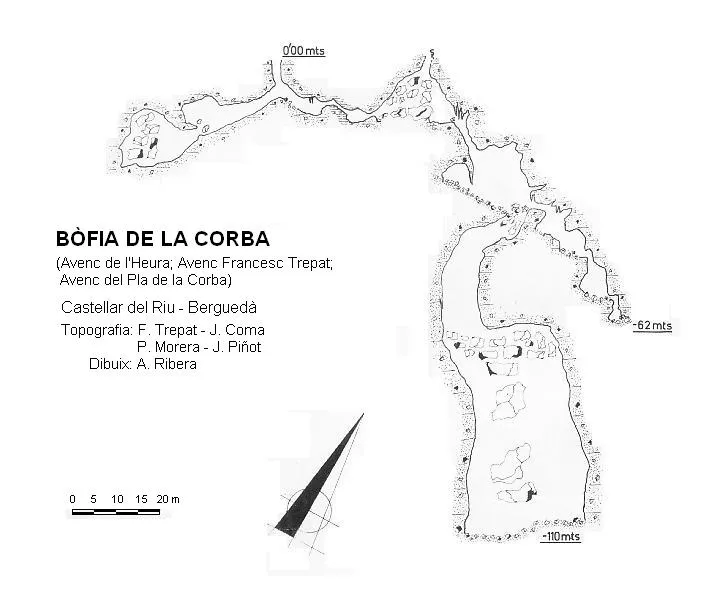
Espeleoindex · CC BY-NC 4.0, https://creativecommons.org/licenses/by-nc/4.0/ · Immagine © del suo autore.
Foto
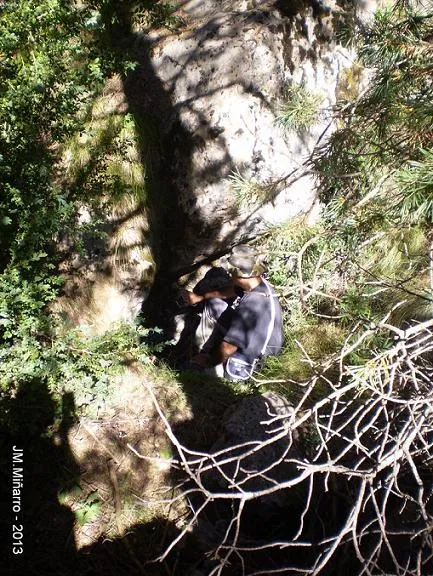
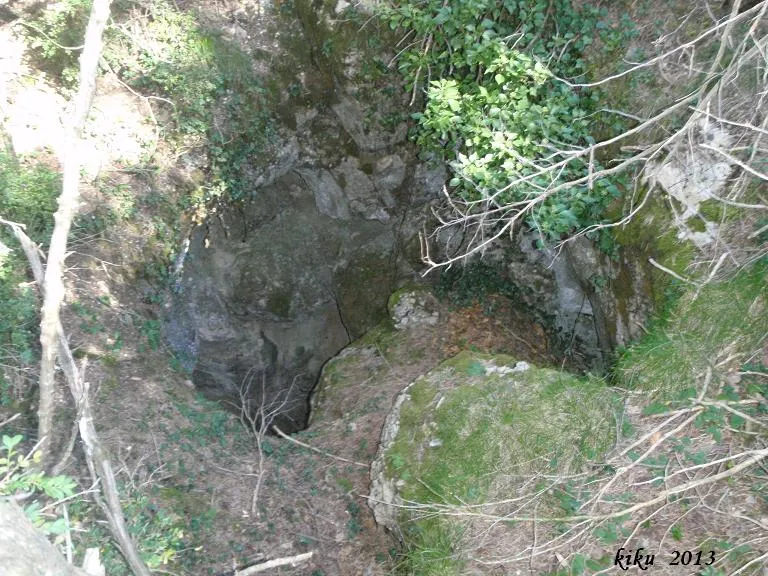
Espeleoindex · CC BY-NC 4.0, https://creativecommons.org/licenses/by-nc/4.0/ · Immagine © del suo autore.
Descrizione
Morfologia
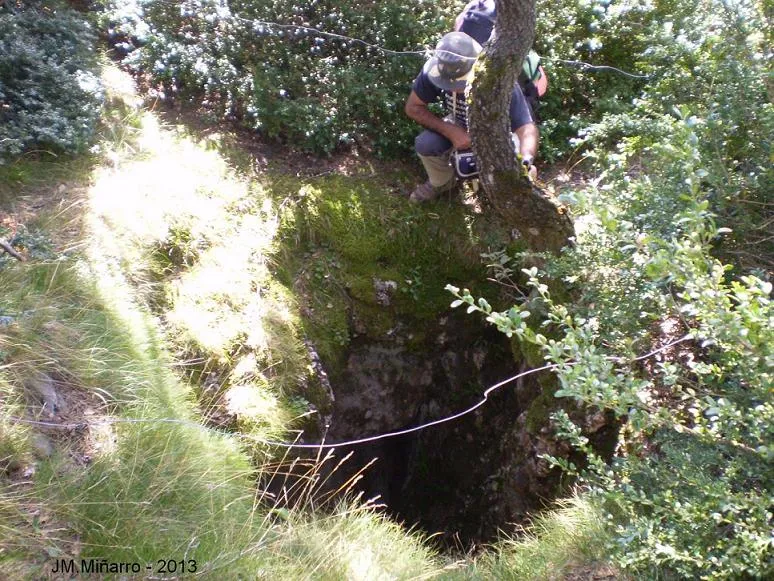
With the walls covered in moss and of an earthy appearance, the first shaft presents a vertical drop of 11 metres. At its base two galleries open, towards the SW and by means of a rubble ramp, one can penetrate for a few metres until the fissure becomes impracticable and half blocked by blocks. In the opposite direction, a short ramp leads us to a tiny ramp where, somewhat raised above the floor, a cylindrical and narrow conduit opens (El Macarró), about 4 metres long and slightly descending, allowing access to a narrow and short gallery, then the passage narrows again and passes under a block to enter next a chamber divided up by the accumulations of blocks (to cross it one must climb up a few metres and come back down them at the other end). From here, a ramp leads into a shaft of about 15 metres of drop that leads to a lower hall (Sala del Misteri), with an inclined floor and covered in rubble.
It is one of the typical detachment fissures of the Rasos de Peguera, this is the largest one and with an approximate orientation of SW-NE.
Concrezioni
The lithogenic forms are practically non-existent, but the clastic process is very important.
Progressione
Here two continuation options are presented:
Normal Route: located at the end opposite the arrival at the Sala del Misteri and, by small shafts and steps, the 62 metres of depth are reached.
SECEM Route: it starts at the lowest point of the Sala del Misteri. One must squeeze between the blocks and after passing a very narrow passage, one reaches a shaft of about 20 metres of drop, the point where the joint gains length and continues progressing downwards with new verticals very broken up by the accumulation of blocks between the walls. Its bottom, narrow and with a slight ramp, is the point of maximum depth of the cavity.
Storia
On 18 and 19 July 1959, three members of the ERE-CEC (Molist, Garcia and Pomerol) explore two cavities at Rasos de Peguera: Avenc del Pla de la Corba (- 51 m.) and the Avenc del Cingle de la Corba (- 26 m.). The first, without doubt, is a partial exploration of what we now know as Bòfia de la Corba and the other should be the one later called Avenc del Sixto (although with exaggerated depth). We think that here, however, there is a slip, since by logic of the location, the first should be the one of the Cingle de la Corba and the other the one of the Pla de la Corba. These explorations go completely unnoticed and have no kind of dissemination.
So much so, that when in 1966 the members of the SECEM of Manresa explore them again, they are convinced that they are two unpublished cavities and they name them Avenc de l'Eura (where they can force the narrow passages and reach 110 m. of depth) and the other as Avenc del Sixto. At the end of May 1967, Francesc Trepat, leader of the group and one of the explorers of the cavity, dies in a diving accident at the port of Blanes; then his companions decide to rename the pit with his name.
In 1968 the people of the SECEM accompany members of the SIRE – UEC Sants to visit the pit and give them a copy of the survey of the cavity (the only one known so far).
Between 1972 and 1976 members of the SIE – CEA visit the cavity several times and on 5 September 1976 they make a new survey that fixed the total depth at 106 metres (unfortunately this survey was never written up and was lost).
In 1977 components of the GEPEG (Penya Excursionista Guimerà) made a sketch without topographic value down to – 62 metres.
When the volume of the Catàleg Espeleològic de Catalunya (1980) corresponding to the comarca of Berguedà was made, the authors observed that M. Faura i Sans in his Recull (1909) mentioned the Bofia de la Corva (sic), certainly a piece of information that someone had referred to him and of which he only put an f (place where waters melt) and placed it at Llinàs (the nearby small village of Llinars). However, in the archive of the GES – CMB a record was located (possibly with data from N. Llopis Lladó) where only the name (Bòfia de la Corba) and a location (in the area of the Pla de la Corba) were mentioned. All this led to the decision to name the cavity with the name believed to be the oldest and most correct.
Despite everything, we still have doubts that it was the same cavity and we think that Faura's citation could refer to the large funnel-shaped depression that is a short distance from the pit. To avoid confusions we have decided to leave it with the name Bòfia de la Corba that appears in all the catalogues and later publications.
Commenti degli utenti (0)
Nessun commento ancora.
Sii il primo a condividere la tua esperienza!
Esplorazioni registrate (0)
Nessuna esplorazione registrata.
Registra la tua visita a questa grotta!
Bibliografia
- Alemany, J.I. (1980).- “Fitxa tècnica: Avenc del Pla de la Corba”. Butlletí de la Penya Excursionista Guimerà (gener-març): 23-24. Barcelona.
- Borràs,J; Miñarro,J.M; Talavera,F.(1980).-”l'Urgell, el Solsonès, la Segarra i el Berguedà”. Catàleg Espeleològic de Catalunya (vol. 5): 1-233. Ed. Políglota. Barcelona.
- Cardona i Oliván,Ferran.(1989).-”La Serralada Pirinenca”.Grans Cavitats de Catalunya (Primer Volum):102-105. E.C. Gràcia. Barcelona.
- SECEM (1968).- “Resum activitats SECEM”. Espeleòleg (7): 244-245.
- Valles, Jordi de (2009).-”Berguedà, Cerdanya, Garrotxa, Ripollès”. Catàleg Espeleològic de Catalunya (Vol.3):1-381. EC Gràcia/FCE.
- Fotografies extretes del bloc (www.espeleoblog.blogspot.com) post del dia 4-5-2015.
Grotte vicine


Fonte: Espeleoindex (espeleoindex.com), modificato. CC BY-NC 4.0, https://creativecommons.org/licenses/by-nc/4.0/