
Avenc del Daví
Historic 65 m deep pit in Sant Llorenç del Munt, with two entrances, a large chamber and an important colony of bats that hibernates inside.
EspeleoWorld
Avenc del Daví
Historic 65 m deep pit in Sant Llorenç del Munt, with two entrances, a large chamber and an important colony of bats that hibernates inside.
Sant Llorenç Savall · Vallès Occidental
Sviluppo: 250 m · Profondità: 65 m
Scheda aggiornata
https://espeleoworld.com/it/c/avenc-del-davi
Le informazioni possono cambiare. Verifica sempre coordinate, accesso, meteo e condizioni della cavità prima di partire.
Historic 65 m deep pit in Sant Llorenç del Munt, with two entrances, a large chamber and an important colony of bats that hibernates inside.
Topografia

Espeleoindex · CC BY-NC 4.0, https://creativecommons.org/licenses/by-nc/4.0/ · Immagine © del suo autore.
Foto

Espeleoindex · CC BY-NC 4.0, https://creativecommons.org/licenses/by-nc/4.0/ · Immagine © del suo autore.
Descrizione
Morfologia
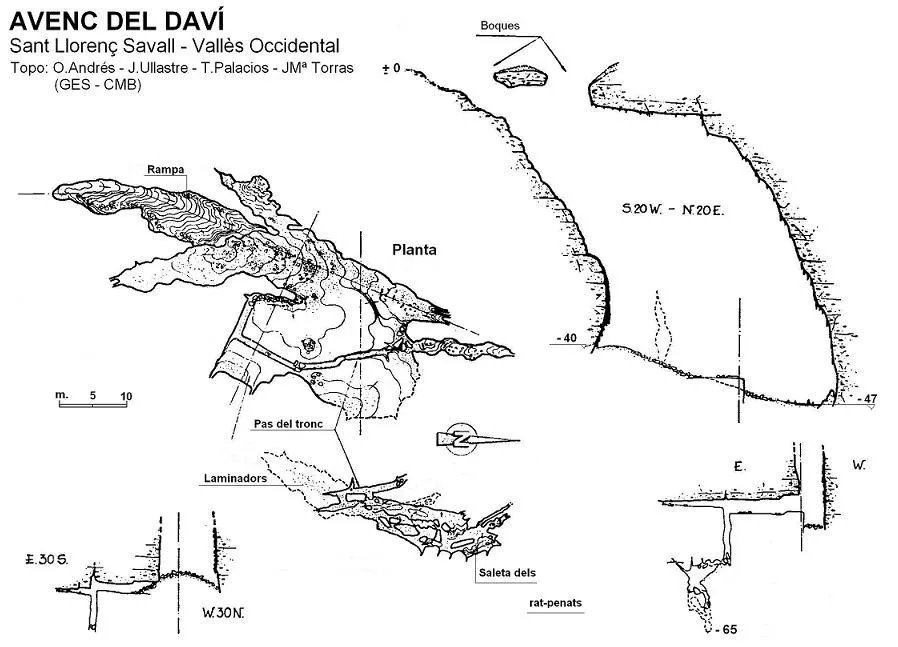
The two entrances of the pit are located at the bottom of two depressions. This chamber has a maximum length of about 50 metres, a width of 9 metres and a vault height of almost 45 metres, slightly lit by the light coming from the two entrances. The floor is a large debris cone about 8 metres high.
Concrezioni
Limestone formations are abundant, especially on the W side.
Progressione
Through the southernmost entrance you descend a steep ramp that reaches the level of – 28, here there is a ledge where a 13-metre vertical drop begins that lands in the very middle of a large chamber, a point also reached from the other entrance by means of a shaft of just over 40 vertical metres. Descending through a fissure located between two large displaced blocks, which are found at the level of – 47, on one side of the main chamber, we find a series of passages that descend until reaching the deepest point (Saleta dels rat-penats) at 65 metres depth.
Storia
This well-known cavity does not appear in the old catalogues (Puig y Larraz; Font i Sagué; Faura i Sans). The first documented news is that of the partial exploration carried out on 22 September 1912 (according to E. Aragonès it took place on 11 May 1911) by members of the Centre Excursionista de Terrassa.
The Terrassa excursionists got in contact with M. Faura i Sans who, with colleagues from the CEC, from the CE de Terrassa itself and apparently with some member of the CE del Vallès (Sabadell), carried out the complete exploration on 21 September 1913.
Since then it was a frequently visited cavity, but practically no work had been done on it. This was the reason that motivated the group of speleologists of the Club Muntanyenc Barcelonès, led by N. Llopis Lladó, to make a visit, which took place on 8 September 1934 and publishing the results the following year.
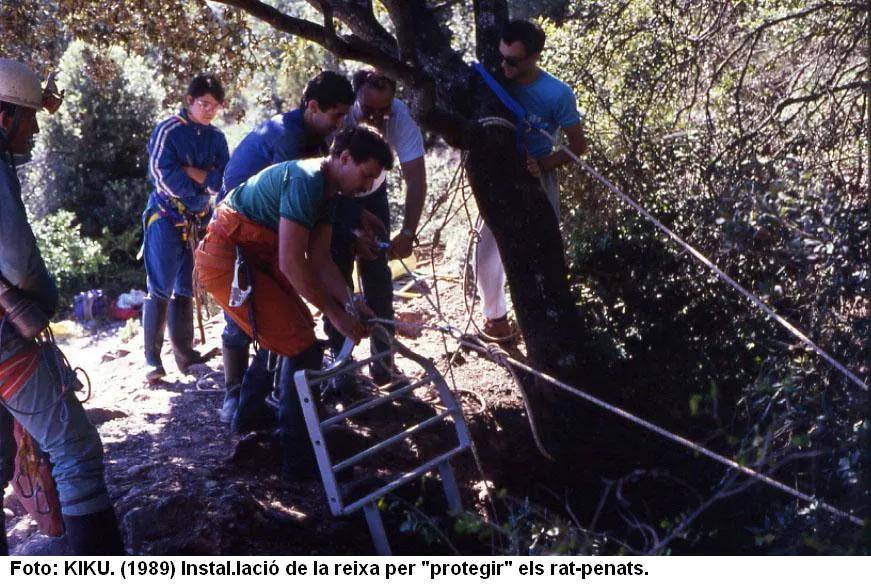
As it is one of the most visited cavities of the massif and with the aim of protecting the important colony of bats that hibernates inside, on the initiative of biospeleologists of the SIS del CE Terrassa, the support of the Federació Catalana d'Espeleologia and the sponsorship of the Servei de Parcs de la Diputació de Barcelona, on 8 October 1989 a grille was installed that closed the access to the final small room of the pit and that had to remain closed from October to April. The experience was negative and it was possible to verify that the colony of bats decreased notably during the following winters, having to remove the grille in question and regulate the regime of visits during the hibernation period.
Note biospeleologiche
Arachnida / Araneae / Amaurobiidae
- Amaurobius similis (Blackwall, 1861)
Arachnida / Araneae / Nesticidae
- Nesticus cellulanus (Clerck, 1757)
Crustacea / Isopoda / Porcellionidae
- Porcellio sp.
Diplopoda / Polydesmida / Polydesmidae
- Polydesmus sp.
Insecta / Coleoptera / Cantharidae
- Armidia unicolor (Dufour, 1851)
Insecta / Coleoptera / Leiodidae
- Troglocharinus kiesenwetteri sanllorensi (Zariquiey, 1924)
Insecta / Diplura / Campodeidae
- Paratachycampa sp.
Insecta / Diptera / Heleomyzidae
- Heteromyza sp.
Insecta / Diptera / Limoniidae
- Dicranophragma (Brachylimnophila) relictum (Mederos, 2020)
- Limonia nubeculosa (Meigen, 1804)
(Source of the data: Dept. Artròpodes del Museu de Ciències Naturals de Barcelona)
Commenti degli utenti (0)
Nessun commento ancora.
Sii il primo a condividere la tua esperienza!
Esplorazioni registrate (0)
Nessuna esplorazione registrata.
Registra la tua visita a questa grotta!
Bibliografia
- Andrés, O. (1970).- “La génesis y evolución de dos cavidades subterráneas de la cabecera del Torrent del Dalmau: El Avenc del Daví y la cueva Les Casetes del Bufí (macizo de Sant Llorenç del Munt, Barcelona)”. Comunicaciones del Primer Congreso Nacional de Espeleología: : 11-15. Ayuntamiento de Barcelona.
- Aragonès, E. (2010).- Marià Faura i Sans espeleòleg (1883-1941). 106 pp. Federació Catalana d'Espeleologia. Barcelona.
- Centre Excursionista de Terrassa (1935).- Guia monogràfica de Sant Llorenç del Munt : 280 pp. Terrassa
- GES-CMB (1974).- Catálogo espeleológico de la provincia de Barcelona. 198 pp. Club Montañés Barcelonés /Diputación Provincial de Barcelona.
- Llopis, N. (1935).- “Avenc del Daví” Sota Terra (II): 57-64. Club Muntanyenc Barcelonès.
- Fotografies “JNC” facilitades per Jordi Navarro (Centre Excursionista de Castellar del Vallès).
- Fotografies facilitades per Antonio Ferro (SIE del CE Àliga).
- Fotografies facilitades per Arcadia Cabanas i Francesc Rubinat (ERE del CEC).
Grotte vicine
les Casetes del Bofí
0.2 km · N
Sant Llorenç Savall (Vallès Occidental)
1 topo.1 foto
Cova del Cingle dels òbits
0.3 km · SO
Matadepera (Vallès Occidental)
1 topo.3 foto
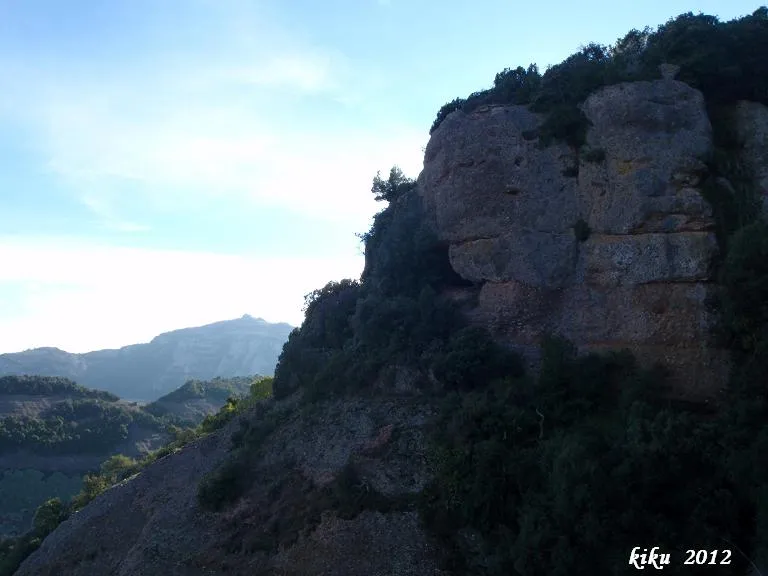
Avenc Quim Solbas
0.3 km · S
Sant Llorenç Savall (Vallès Occidental)
1 topo.12 foto
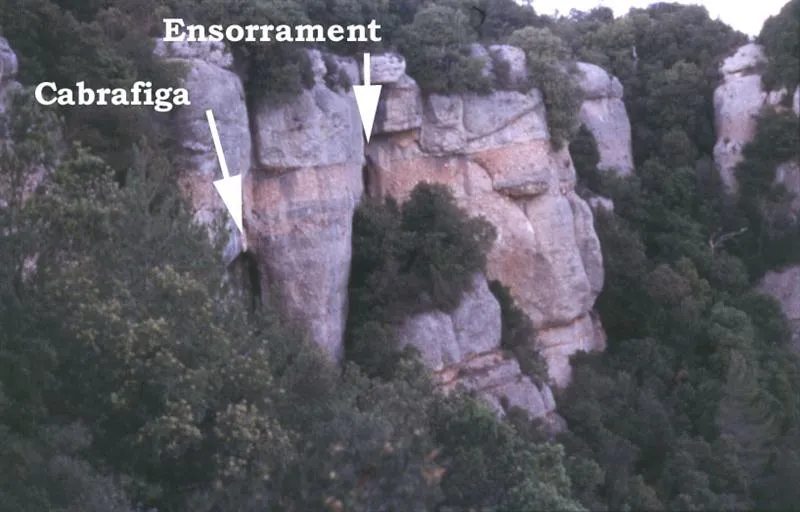
Cova de la Cabrafiga
0.4 km · N
Sant Llorenç Savall (Vallès Occidental)
1 topo.2 foto
Fonte: Espeleoindex (espeleoindex.com), modificato. CC BY-NC 4.0, https://creativecommons.org/licenses/by-nc/4.0/