
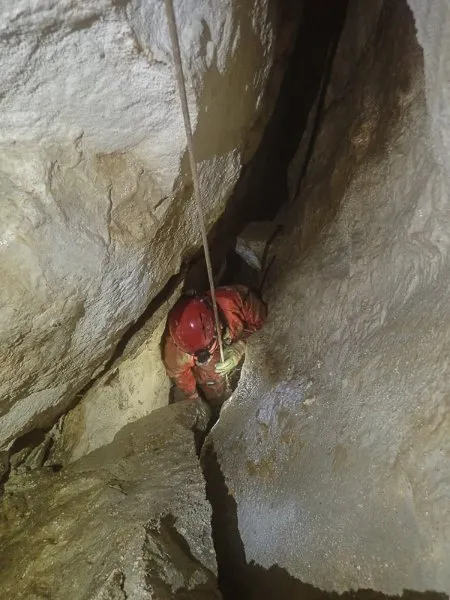
Trou d'Iko
An interstitial cavity formed by stress-relief fissures parallel to the slope, developed on two levels of passages bounded by debris cones, whose terminal fissure is no longer passable.
EspeleoWorld
Trou d'Iko
An interstitial cavity formed by stress-relief fissures parallel to the slope, developed on two levels of passages bounded by debris cones, whose terminal fissure is no longer passable.
Asson
الطول: 85 m · العمق: 24 m
السجل المحدّث
https://espeleoworld.com/ar/c/trou-d-iko-asson
قد تتغير المعلومات. تحقق دائمًا من الإحداثيات والوصول والطقس وظروف الكهف قبل الانطلاق.
موقع تقريبي: لا تُطبع خريطة ولا إحداثيات لهذا الكهف. يضع المصدر علامة على موضع هذا المدخل بوصفه غير مؤكَّد.
An interstitial cavity formed by stress-relief fissures parallel to the slope, developed on two levels of passages bounded by debris cones, whose terminal fissure is no longer passable.
الصور
© Degouve (GSHP) · CC BY-NC-SA (version not stated by the source), https://www.karsteau.org/karsteau/index.php · Karsteau: Fracture MO42 · https://www.karsteau.org/karsteau/recherche/entree/recherche_entree.php?entree=20163
الوصف
الشكل
Morphologically, it is an interstitial cavity formed by stress-relief fissures parallel to the slope. The entrance shaft (7 m) pierces the roof of a fairly spacious gallery (2 m x 2 m). This first level continues north for about fifteen metres to a debris cone. To the south, a small 3 m step followed by a 5 m shaft allows descent into the fissure and reaches a second level of passages (-13 m), also bounded to the north by debris cones. To the south, after a widening followed by a low passage, a 4 m shaft allows further descent into the fissure; this continues downward for another 7 m, becoming increasingly narrow. It is still possible to progress south at the bottom of the P.4, but there too the fissure eventually becomes impassable. Its end lies less than 10 m from the small MO-43 pit, also dug along a fissure but impassable at -3 m.
التقدم
The entrance of the cavity was discovered by the GSHP (J.L. Lacrampe) on 13 January 2018. It was enlarged the same day and a first reconnaissance down to -12 m was made (S. Degouve). Exploration and surveying were continued on 28 January following (P. and S. Degouve).
تفاصيل أخرى
The air current (temp. 9.8°C) observed in both cavities is explained by the presence of these multiple entrances, which must mark out the fissure stretching near the surface.
تعليقات المستخدمين (0)
لا توجد تعليقات بعد.
كن أول من يشارك تجربته!
الاستكشافات المسجلة (0)
لا توجد استكشافات مسجلة بعد.
سجل زيارتك لهذا الكهف!
الكهوف القريبة

المصدر: Karsteau (Fédération Française de Spéléologie et Canyon) (www.karsteau.org)، مع تعديلات. CC BY-NC-SA (version not stated by the source), https://www.karsteau.org/karsteau/index.php Karsteau (Fédération Française de Spéléologie et Canyon) · النص بقلم Karsteau (FFS) contributors · عدّلته Espeleoworld (توحيد الصيغة، ترجمة)؛ التعديل مرخّص بموجب CC BY-NC-SA (version not stated by the source), https://www.karsteau.org/karsteau/index.php · https://www.karsteau.org/karsteau/recherche/entree/recherche_entree.php?entree=20163 · بيانات عام 2026