
Cueva de los Huesos
Dry cave with a strong draught of indrawn air, developed along a bedding joint overdeepened by a meander, ending in a choke of sandstone blocks.
EspeleoWorld
Cueva de los Huesos
Dry cave with a strong draught of indrawn air, developed along a bedding joint overdeepened by a meander, ending in a choke of sandstone blocks.
Arredondo
الطول: 180 m
السجل المحدّث
https://espeleoworld.com/ar/c/cueva-de-los-huesos-arredondo
قد تتغير المعلومات. تحقق دائمًا من الإحداثيات والوصول والطقس وظروف الكهف قبل الانطلاق.
موقع تقريبي: لا تُطبع خريطة ولا إحداثيات لهذا الكهف. يضع المصدر علامة على موضع هذا المدخل بوصفه غير مؤكَّد.
Dry cave with a strong draught of indrawn air, developed along a bedding joint overdeepened by a meander, ending in a choke of sandstone blocks.
الطبوغرافيا
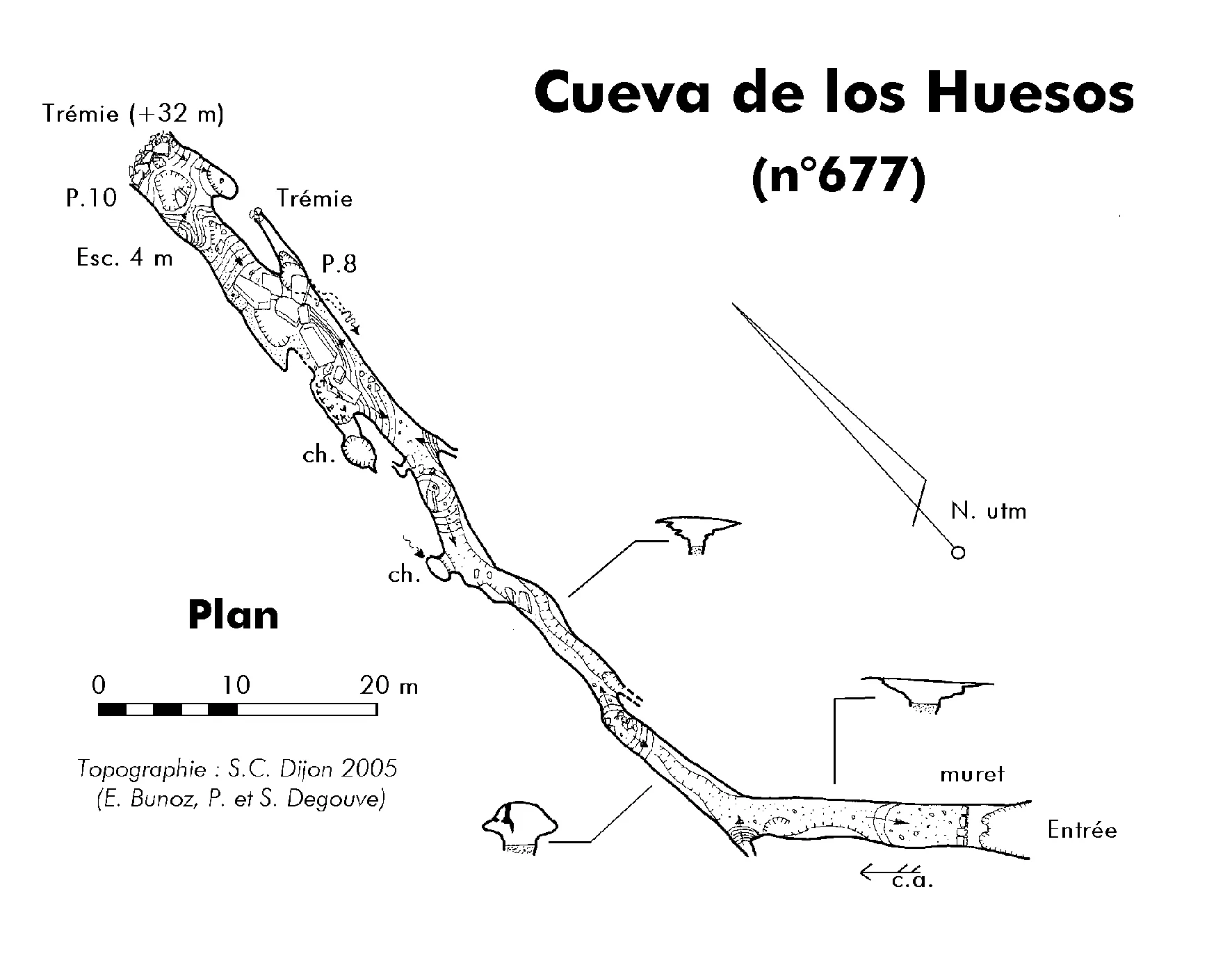
© S.C.Dijon août 2005 · CC BY-NC-SA (version not stated by the source), https://www.karsteau.org/karsteau/index.php · Karsteau: Topographie de la cavité n°677 (numérotation SCD) · https://www.karsteau.org/karsteau/recherche/entree/recherche_entree.php?entree=21399
الوصف
الشكل
The cave begins with a low porch (1 m x 2 m) barred by a small wall and opening onto a dry gallery traversed by a strong draught of indrawn air. The passage develops along a bedding joint overdeepened by a meander partly filled by the fill. After a low passage, the cave gains in size (2 m x 3 m). Several shafts line the route; the highest, 120 m from the entrance, measures about ten metres in height. A little further on, after large collapsed blocks, one reaches a widening. To the right, an 8 m pit reaches a short meander that becomes impenetrable. To the left, after climbing a clayey slope, a 4-metre step requires a climb to reach the top of the gallery (+ 32 m), entirely barred by a choke of sandstone blocks; just before it, a pit of about ten metres continues via impenetrable fissures.
Geology: Level 7: Sandstone and marls of the Porra (Aptian).
الترسبات الكهفية
An old concretion and the remains of a suspended stalagmitic floor attest that the latter must have been more extensive at one time (see section on the survey).
المياه
Spring: ?
تفاصيل أخرى
Numerous animal bones scattered all along the gallery and doubtless brought there by a predator.
التاريخ
The cueva was known to the shepherds who built a small wall at the entrance. It was located and partly explored by the S.C. Dijon on 17 July 1993 (P. and S. Degouve, C. Lecas). The exploration and the survey were carried out in August 2005 (E. Bunoz, P. and S. Degouve).
تعليقات المستخدمين (0)
لا توجد تعليقات بعد.
كن أول من يشارك تجربته!
الاستكشافات المسجلة (0)
لا توجد استكشافات مسجلة بعد.
سجل زيارتك لهذا الكهف!
الكهوف القريبة

المصدر: Karsteau (Fédération Française de Spéléologie et Canyon) (www.karsteau.org)، مع تعديلات. CC BY-NC-SA (version not stated by the source), https://www.karsteau.org/karsteau/index.php Karsteau (Fédération Française de Spéléologie et Canyon) · النص بقلم Karsteau (FFS) contributors · عدّلته Espeleoworld (توحيد الصيغة، ترجمة)؛ التعديل مرخّص بموجب CC BY-NC-SA (version not stated by the source), https://www.karsteau.org/karsteau/index.php · https://www.karsteau.org/karsteau/recherche/entree/recherche_entree.php?entree=21399 · بيانات عام 2026