
Cueva de El Haza
EspeleoWorld
Cueva de El Haza
Cueva de El Haza is a karst system in the Collados del Asón Natural Park, in Soba, with a development of between 6,042 and 6,242 m according to the sources consulted.
Ramales de la Victoria
السجل المحدّث
https://espeleoworld.com/ar/c/cueva-de-el-haza-ramales-de-la-victoria
قد تتغير المعلومات. تحقق دائمًا من الإحداثيات والوصول والطقس وظروف الكهف قبل الانطلاق.
Cueva de El Haza is a karst system in the Collados del Asón Natural Park, in Soba, with a development of between 6,042 and 6,242 m according to the sources consulted.
الوصف
الشكل
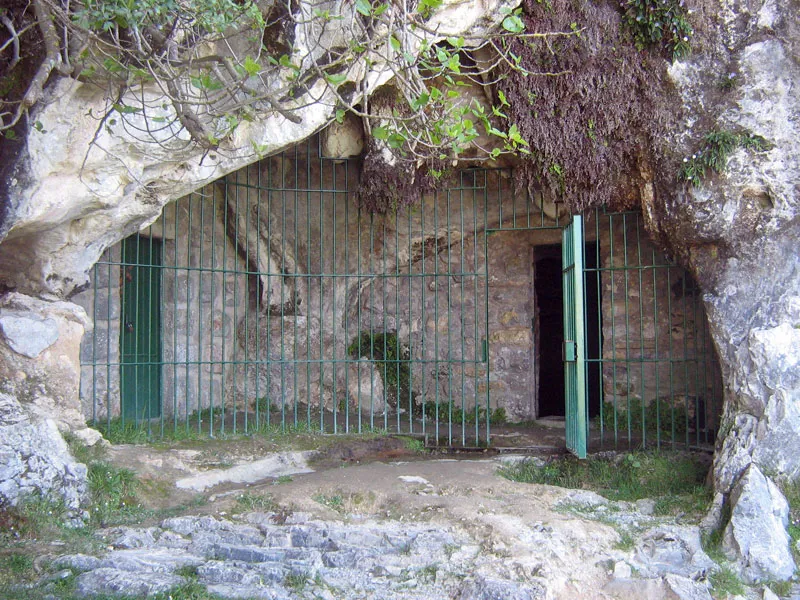
The system has three entrances: the wide rectangular portal of Cueva de la Haza, the pit of about 20 m of the Sumidero de Saco 4 and the small 10 m pit of Torca de la Gigante Roja. The entrance gallery is spacious from the outset, 4-5 m wide, and alternates with narrower meanders, such as the Meandro de los Corales. The watercourse gains volume after the Afluente del Portillón.
The active lower galleries are cut into a substrate of sandstones and marls: a compact sandstone slab of 0.7 m forms ceilings, balconies and bridges, while 3 m of soft dark marls rich in carbonates appear heavily eroded. The main entrance opens at the foot of a fault. Regionally, the Asón karst develops in a thick folded succession of limestones, sandstones, marls and siltstones from the Barremian to the upper Albian (Socueva anticline).
المياه
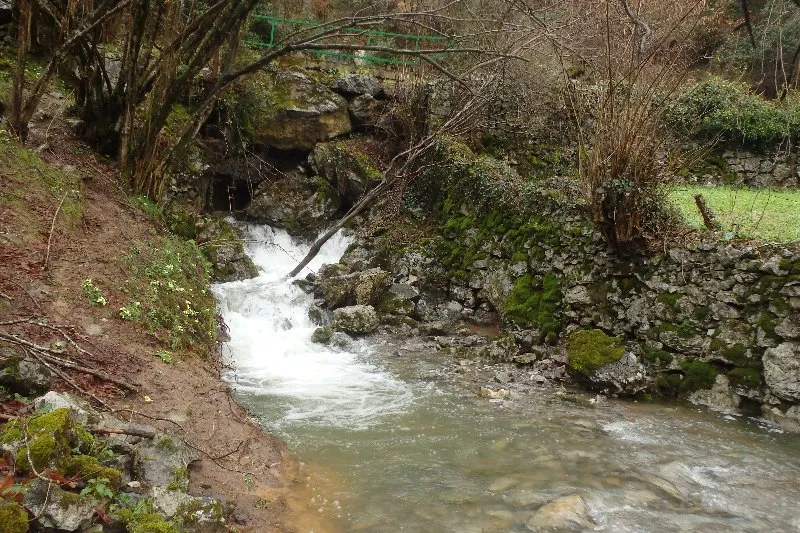
The cave drains to the northwest and the southeast, and its waters resurge at the Cascada del Asón, the spring that gives rise to the Asón river.
تفاصيل أخرى
In the fills of the Portillón galleries appear limonite nodules the size of an egg or a fist. In the Galería Colateral, bones were found in 1972 that suggested to the explorers that they were not the first visitors. Despite more than ten years of searches, no physical connection has been found with the adjacent system of Torca de Hoyo Grande.
التاريخ
In 1964, C. Mugnier, of the Spéléo-Club de Dijon, located the cave on 25 and 29 July and began its exploration. In 1972, under the direction of P. Castin, the same club overcame the boulder chaos at the entrance and explored about 2 km to the Afluente de la Cascada, with 1,050 m surveyed. In 1973 the French group surveyed 2,350 m, ascended the Afluente de la Cascada (150 m) and the Afluente del Portillón (140 m), and connected the cave with the Sumidero de Saco 4, a second entrance.
In 1974 the P105 was descended and the meander at its base down to the low point of -418 m; the Meandro de las Cúpulas was also explored and the development reached 4,550 m. In 1986, the Spéléo-Club de Dijon, together with the Spéléo-Club de Chablis, discovered the third entrance, Torca de la Gigante Roja, raising the development to 5,318 m, while the depth remained at -418 m. In 1987, new explorations by the Spéléo-Club de Chablis at the base of a P100 brought the development to 5,573 m. In 1988, the Spéléo-Club de Chablis discovered and descended a new interior pit of 102 m to the Meandro de la Visión Crepuscular, bringing the development to 6,042 m.
الأحياء
In the cave, remains of fossil corals up to 1 m long are preserved.
تعليقات المستخدمين (0)
لا توجد تعليقات بعد.
كن أول من يشارك تجربته!
الاستكشافات المسجلة (0)
لا توجد استكشافات مسجلة بعد.
سجل زيارتك لهذا الكهف!
الكهوف القريبة
يحتوي على معلومات من Grottocenter (Wikicaves)، grottocenter.org، متاحة بموجب رخصة قاعدة البيانات المفتوحة (Open Database License، ODbL 1.0, https://opendatacommons.org/licenses/odbl/1-0/)، مع تعديلات. · https://grottocenter.org/ui/entrances/20311 · بيانات عام 2026 · نص كتبه Espeleoworld استنادًا إلى مصادر عامة. يُرجى استئذاننا قبل إعادة استخدامه. · عدّلته Espeleoworld (توحيد الصيغة، ترجمة)؛ التعديل مرخّص بموجب Our own text, written from public sources. Please ask us before reusing it. · بيانات عام 2026 · البيانات المشتقة متاحة عند الطلب بموجب ODbL: [email protected]